
Practice question, Question 1 of 40
Passing target: 80% (32/40)
When should a driver avoid moving into the opposing lane to pass near a hill or curve?
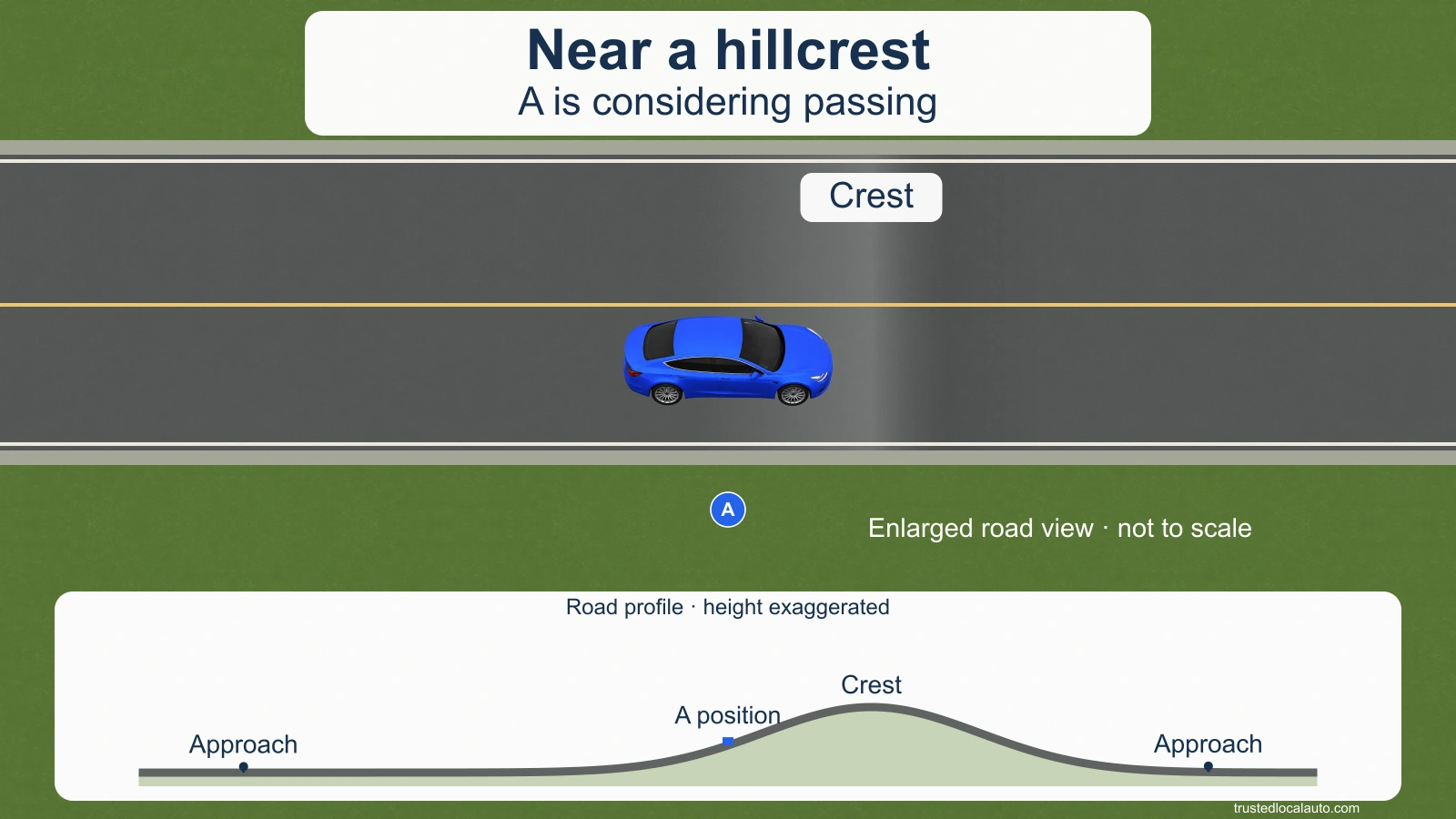
Correct answer: When the driver cannot see far enough ahead to complete the pass safely.
Why
Do not pass into opposing traffic when a hill, curve, or other obstruction limits the view needed to complete the maneuver.
Verified against California Driver's Handbook · No-passing situations · p. 30
Is this question correct and clear?
Continue learning
Related California questions
- After passing on a two-lane highway, when should a driver return to the original lane?
- Who has the right-of-way when a driver enters a highway from an on-ramp?
- You drive car A on a freeway and plan to move into the next lane. You check your mirrors, traffic and blind spot. Which statement about your turn signal is correct?
- How long before a freeway lane change should a driver signal?
- Which left turn may be made against a steady circular red light when no sign prohibits it and the driver first stops and yields?
- You are on a one-way street and want to turn left onto another one-way street. You face a steady circular red light, and no sign prohibits the turn. May you make the turn?