
Practice question, Question 1 of 30
Passing target: 7 correct signs and 18 correct rules
When may a driver pass another vehicle on the right?
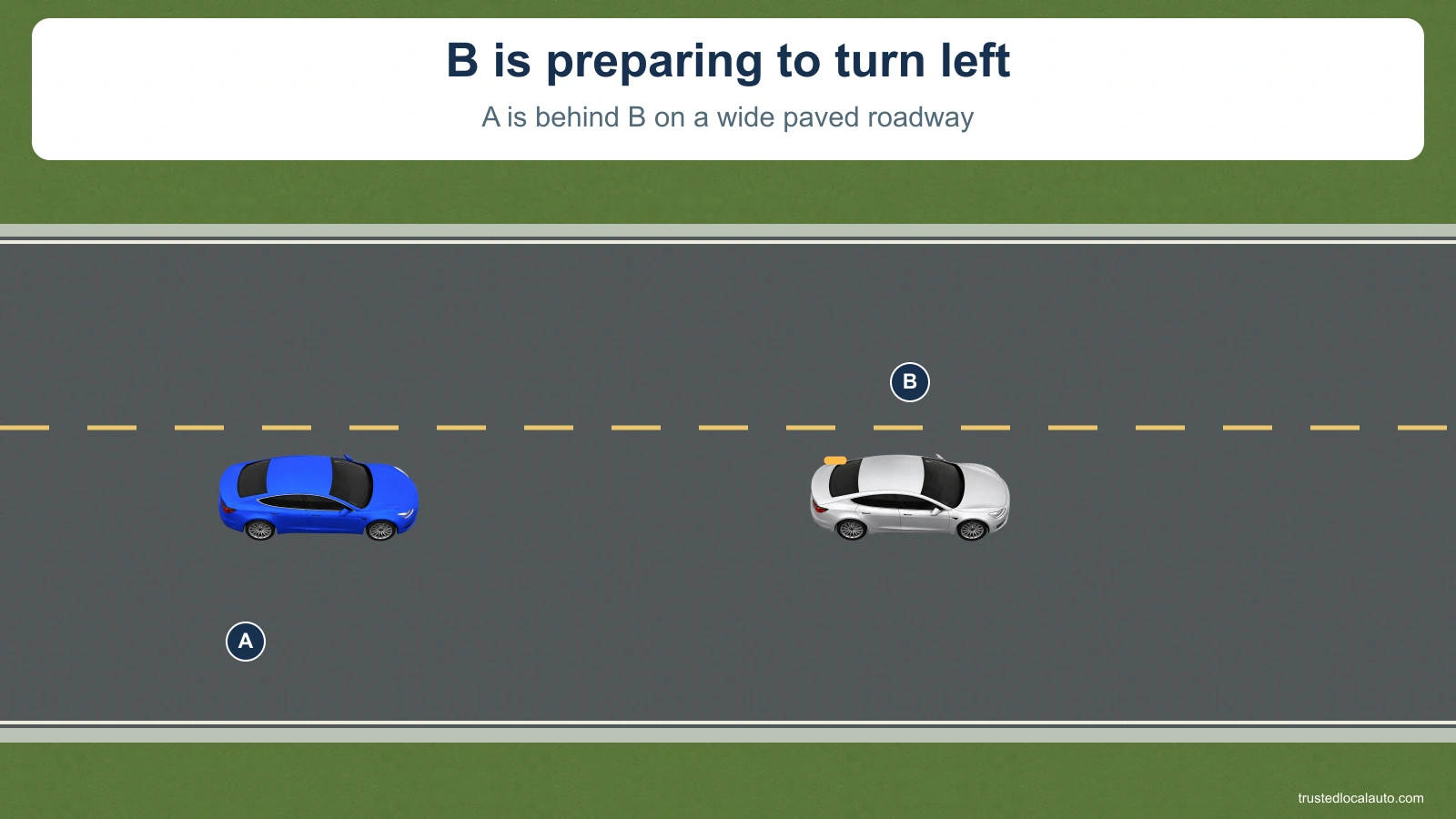
Correct answer: Only where permitted and safe, without leaving the roadway.
Why
Right-side passing is allowed when the vehicle ahead is making or about to make a left turn, or when the roadway has unobstructed pavement wide enough for at least two lawful lanes moving in your direction. The pass must be safe and must not leave the roadway. Do not treat a paved shoulder as an extra travel lane.
Verified against Indiana Driver's Manual · Passing on the right · p. 51
Is this question correct and clear?
Continue learning
Related Indiana questions
- What sequence best prepares for a lane change?
- Another vehicle is lawfully passing on the left. What should the driver being passed do?
- Hand-and-arm signals are given with the left arm from the driver's side. Which pair of turn signals is correct?
- What hand-and-arm signal indicates a left turn?
- A highway has three lanes in each direction. The leftmost lane is a designated HOV lane, and you may lawfully use it. You drive in it at the speed limit. A faster vehicle comes up behind you. Which statement is correct?
- On a two-way road with one lane in your direction, the car ahead of you stops to wait for a left turn. The only space on its right is a paved shoulder outside the white edge line. You want to pass it on the right. Which statement is correct?