
Practice question, Question 1 of 25
Passing target: 20/25 correct (Trusted Local Auto practice target)
How should following distance change when pavement is wet, visibility is poor, or a large vehicle blocks the view ahead?
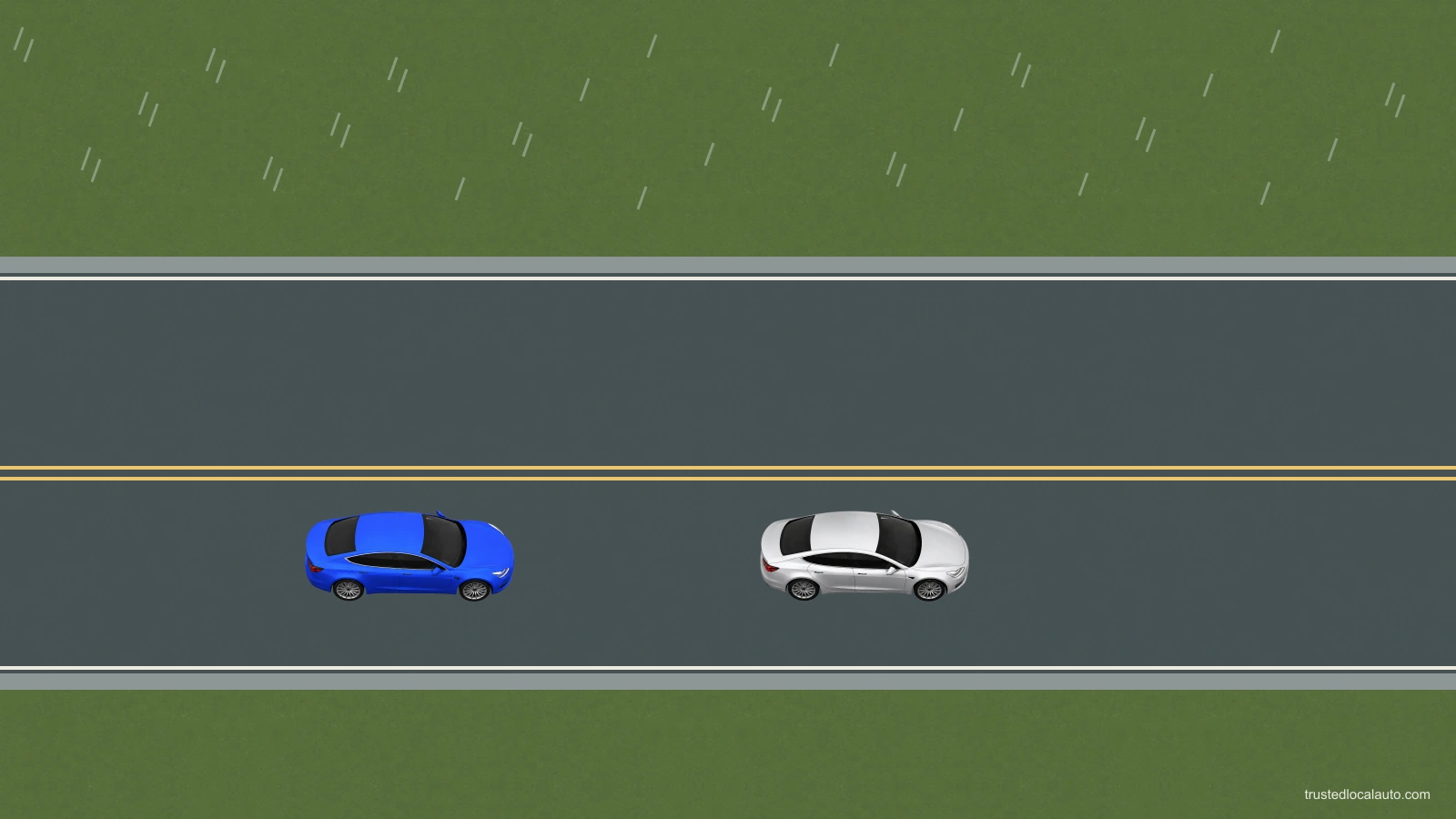
Correct answer: Increase it beyond three to four seconds.
Why
Allow more time and space when visibility or traction is poor. The manual recommends at least 6 seconds on slippery roads or when a vehicle ahead blocks your forward view; its ordinary guide is 3–4 seconds. Adjust further when necessary rather than treating a time count as a guarantee.
Verified against Iowa Driver's License Manual · Safe Following Distance · p. 41
Is this question correct and clear?
Continue learning
Related Iowa questions
- A hill crest prevents a driver from seeing far ahead. How should speed be chosen?
- Before moving into an adjacent lane, what observation is needed in addition to checking mirrors?
- After a hazard appears, your vehicle moves while you recognize the need to stop and move your foot to the brake. How does that distance affect the total stop?
- The road is dry and the weather is good. A large truck ahead of you blocks your view of the road in front of it. What following gap does the manual recommend?
- Which pair of recommended following gaps is correct for ordinary traffic in good weather and for a slippery road?
- You want to find hazards early, while you still check nearby traffic and your mirrors. How far ahead does the manual recommend that you scan?