
Practice question, Question 1 of 25
Passing target: 80% (20/25)
A blind pedestrian carrying a clearly visible white cane or accompanied by a guide dog is crossing your path. What must you do?
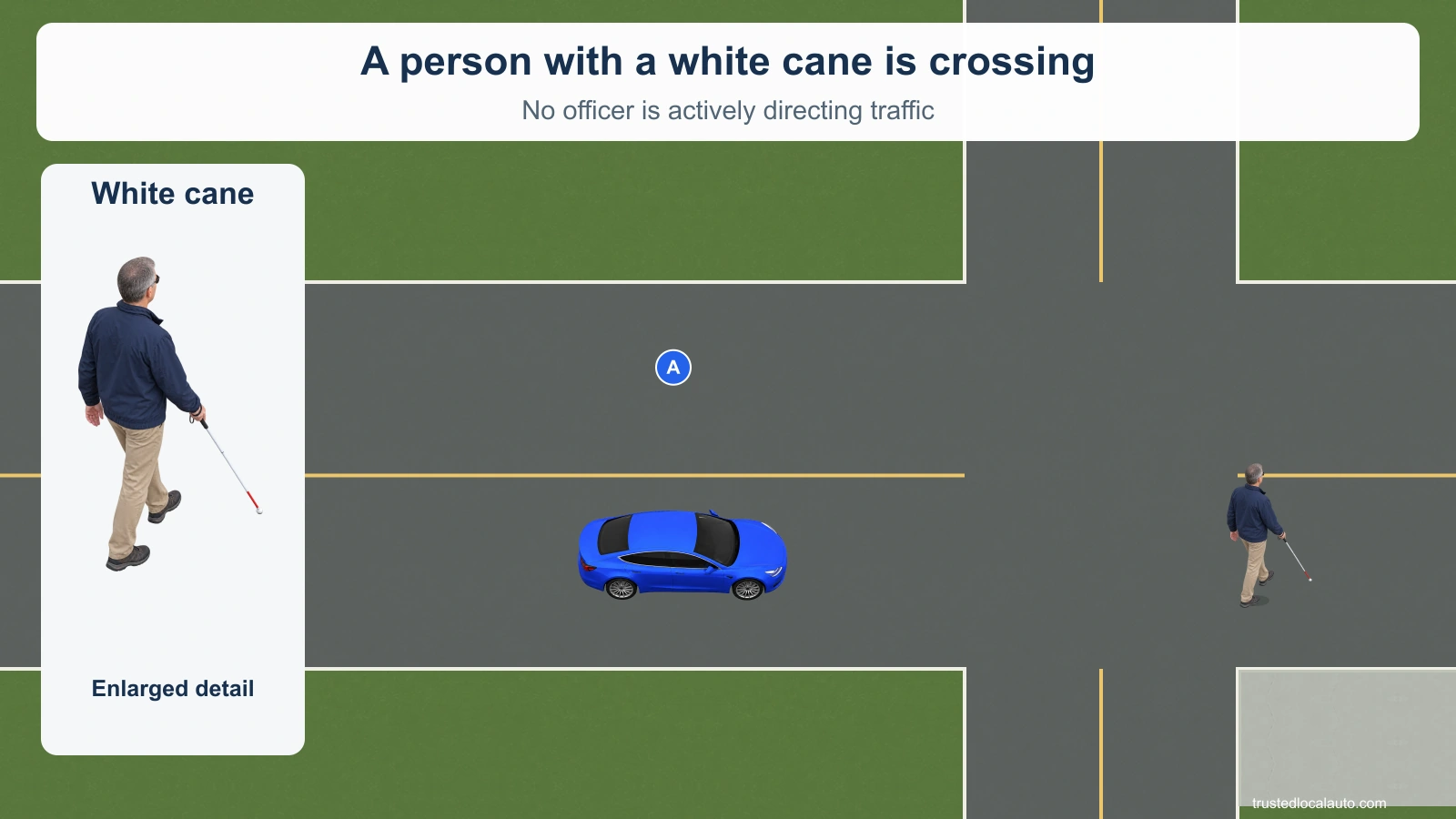
Correct answer: Yield the right-of-way and take care to avoid a collision.
Why
Yield to a blind pedestrian carrying a clearly visible white cane or accompanied by a guide dog. Slow or stop as necessary and do not assume the person can see your vehicle or interpret a gesture. The specific rule complements the general duty to avoid a collision with any pedestrian.
Verified against Kansas Driving Handbook and applicable current Kansas primary law · Blind pedestrian with a cane or guide dog · p. 33
Is this question correct and clear?
Continue learning
Related Kansas questions
- How much lateral clearance must a Kansas driver leave when overtaking a bicyclist traveling in the same direction?
- On a two-lane road in a no-passing zone, a bicyclist rides ahead of you in your direction. No oncoming traffic is near, you have room to give at least 3 feet of clearance, and you can complete the whole pass safely. Which statement is correct?
- Why may a bicyclist lawfully move away from the far-right edge?
- On a one-way road with two marked lanes, a bicyclist who rides slower than traffic rides near the left edge of the road. Which statement is correct?
- You overtake a bicyclist who travels in the same direction as you. Which statement about your clearance is correct?
- Which statement about emergency vehicles and stopped vehicles is NOT correct?