
Practice question, Question 1 of 25
Passing target: 80% (20/25)
When rain, darkness, heavy traffic, or a blocked view increases risk, what should happen to following distance?
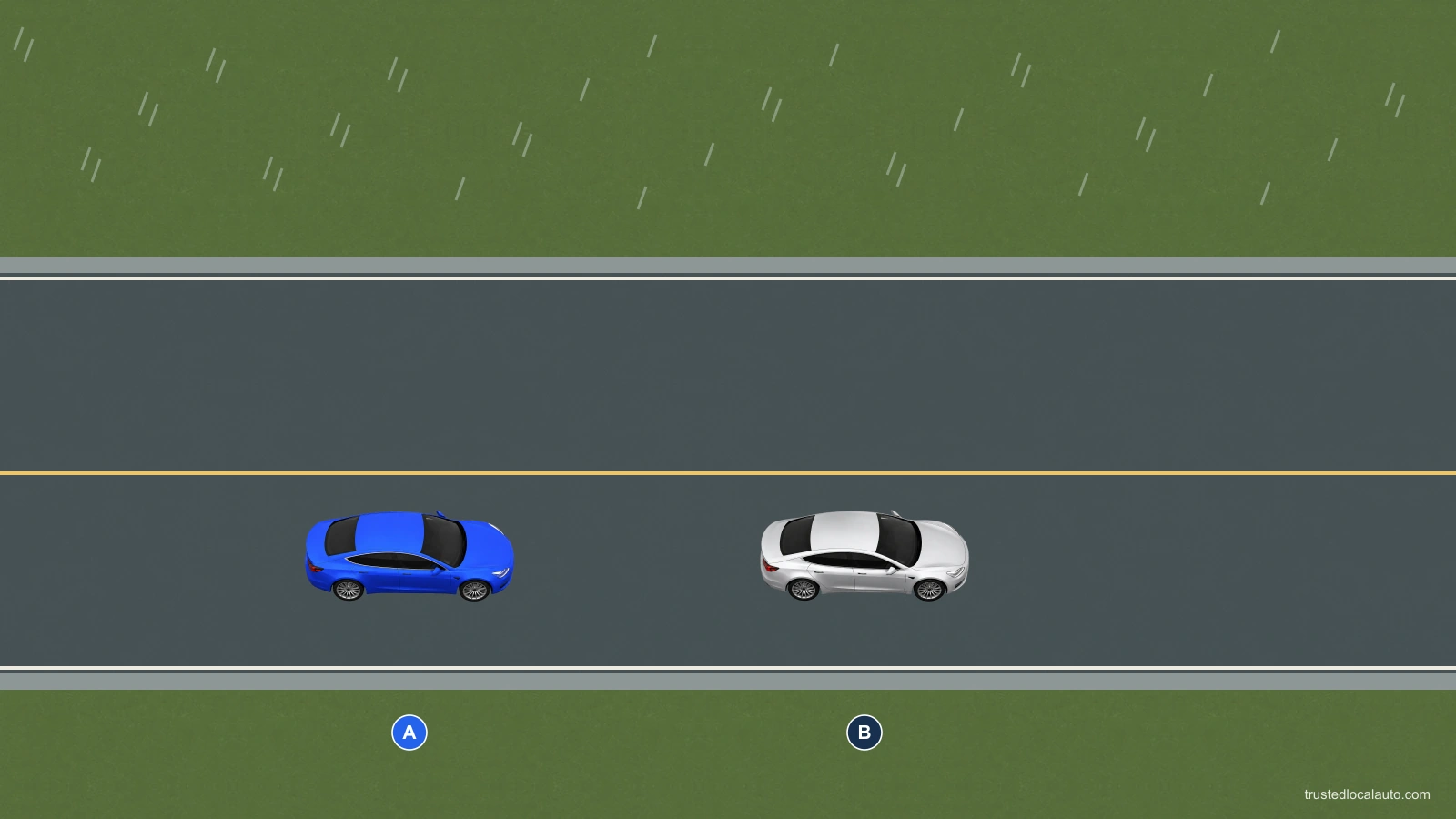
Correct answer: Increase it to at least four seconds, and more when needed.
Why
Increase the gap as conditions worsen. The Kansas summary gives two seconds in prime conditions and four seconds in adverse conditions; allow still more space when traction, visibility, vehicle characteristics or traffic make it necessary. Four seconds is not the ordinary baseline or a guarantee that every situation is safe. The statutory duty is a reasonable and prudent following distance. The handbook’s visibility section also gives a three-second minimum, with an extra second for unusual weather or traffic. These different contexts do not establish one uniform handbook baseline; choose enough space for the actual conditions.
Verified against Kansas Driving Handbook · Following distance · p. 17, 62, 63, 77
Is this question correct and clear?
Continue learning
Related Kansas questions
- The road is icy. You drive well below the posted limit and slower than other traffic, because a higher speed would be dangerous on the ice. Which statement is correct?
- Why should a driver reduce speed when headlights illuminate only a short distance ahead?
- To reduce last-second decisions, how far ahead does the Kansas handbook recommend that you scan, while you also check nearby traffic and mirrors?
- You drive on a two-lane Kansas county highway outside an urban district. It is not a separated multilane highway, no other lawful limit is established, and no hazard requires a lower speed. What statutory maximum applies?
- To reduce last-second decisions, how far ahead should a driver ideally scan?
- Even with a green light, what should a driver check before entering an intersection?