
Practice question, Question 1 of 40
Passing target: 80% (32/40)
On a 30 mph road, you stayed about 180 feet behind the car ahead, which was about a four-second gap. Now you drive at 60 mph on a highway, still about 180 feet behind the car ahead. What should you do?
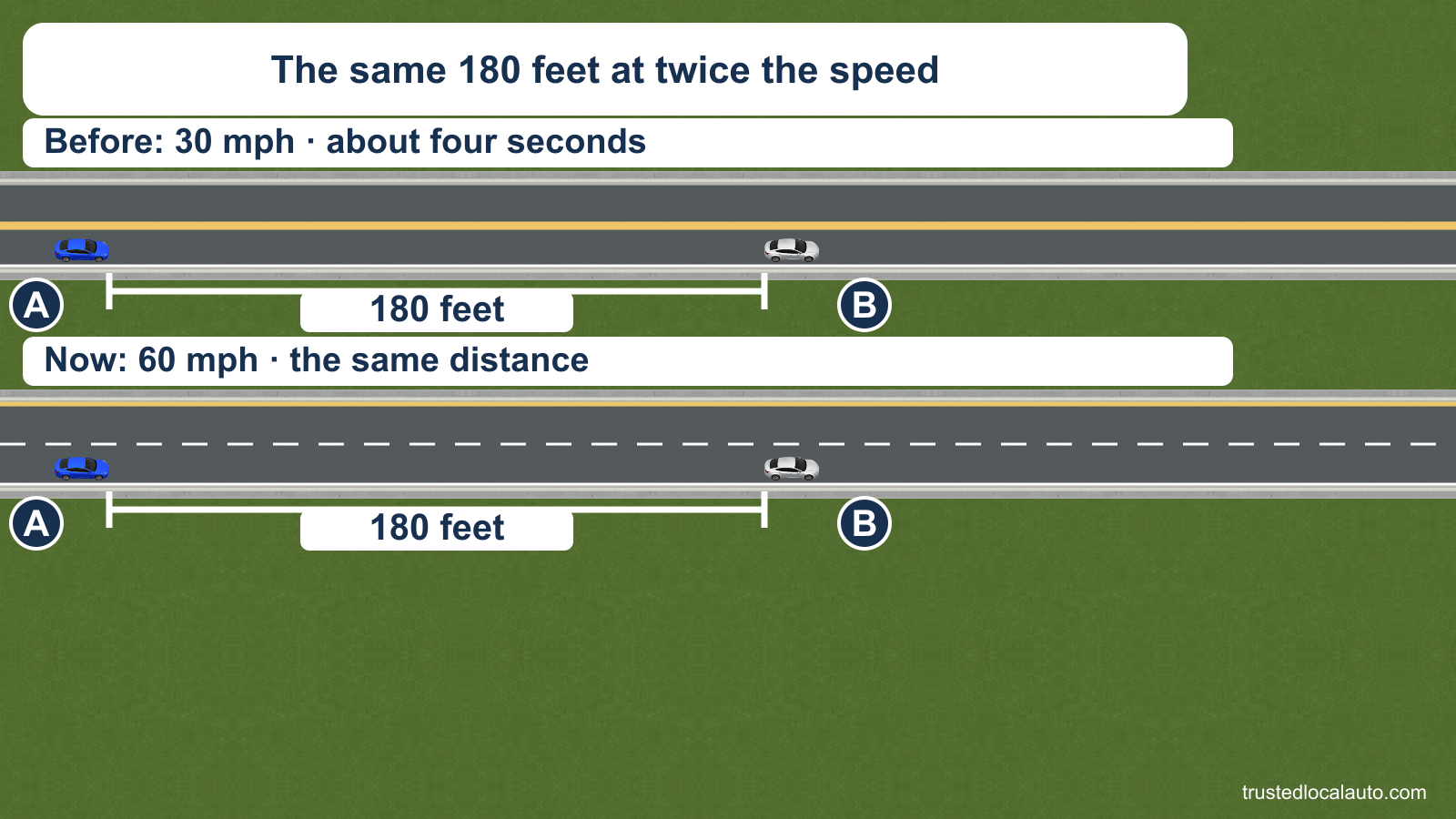
Correct answer: Drop back until you count at least four seconds, which is about 350 feet at 60 mph
Why
The manual says that stopping distance becomes about 4 times as long when speed doubles, because you cover more ground while you react and the brakes need much more distance. A time gap grows in feet as your speed goes up, which is why the four-second count works on every road. Count the seconds from a fixed point often on the highway, and add time in rain, snow, fog or darkness.
Verified against New Hampshire Driver's Manual · High-speed following · p. 22, 36
Is this question correct and clear?
Continue learning
Related New Hampshire questions
- You plan a 6-hour drive, mostly on the interstate. How often does the New Hampshire manual advise you to stop for a break to help avoid fatigue?
- Traffic on a divided highway slows to a crawl. The paved breakdown lane on the right is empty, and your exit is half a mile ahead. What is the rule for the breakdown lane?
- Which pair of maximum speed limits on New Hampshire interstates is correct?
- Which statement about the maximum speed limits on New Hampshire interstates is correct?
- On a dry, clear day with light traffic, you drive in the right lane of a New Hampshire interstate. There is no work zone. You would like to drive at 40 mph. Which statement is correct?
- Freezing rain coats an interstate highway. The traffic in your lane moves steadily at about 30 mph. This speed fits the road and the view, and 45 mph would be too fast on the ice. What speed should you drive?