
Practice question, Question 1 of 50
Passing target: 80% (40/50)
Late at night, you have made a complete stop at a traffic signal that is flashing red for your direction. The cross street has a flashing yellow signal, and a car on that street is close to the intersection. What should you do next?
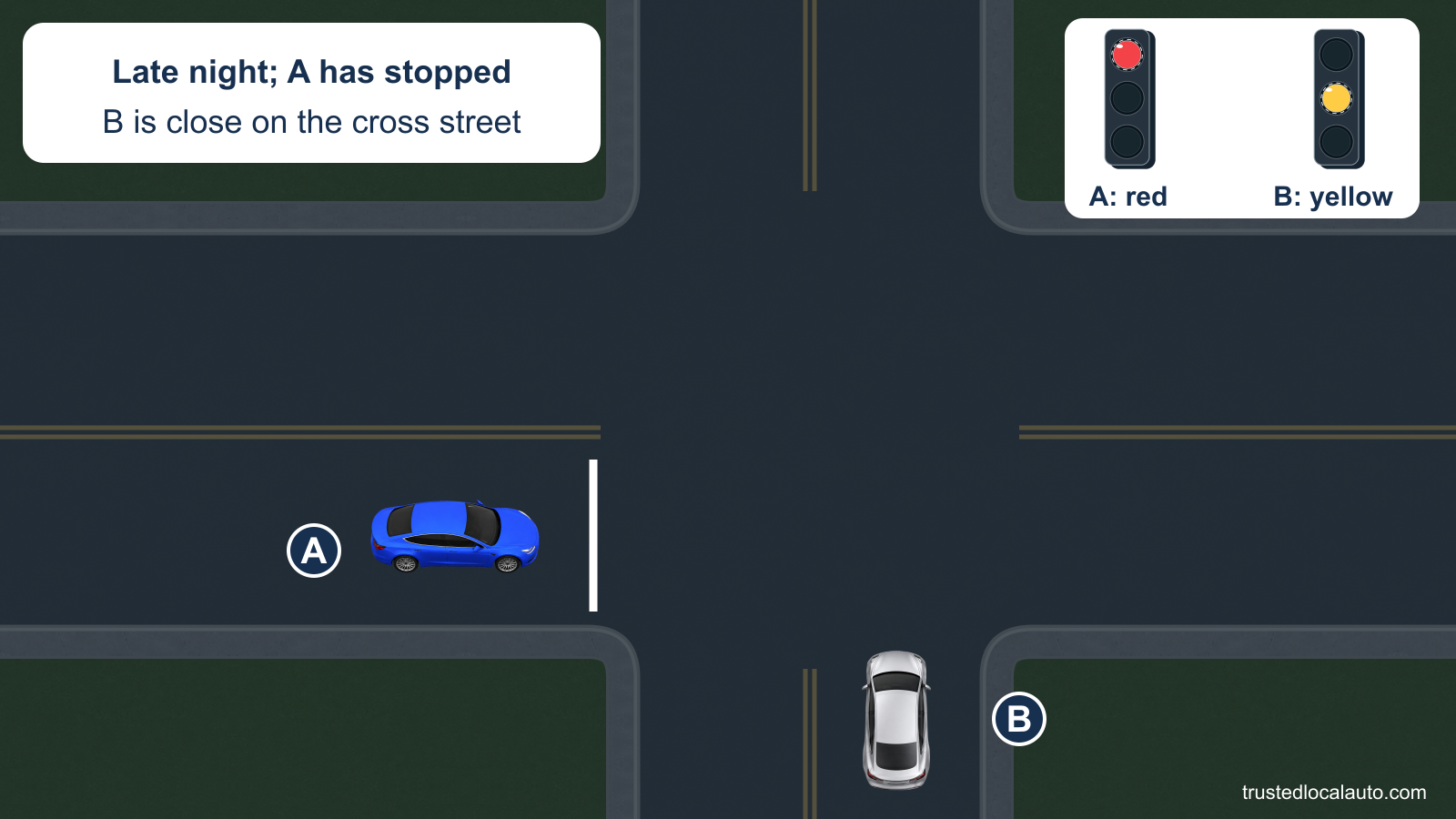
Correct answer: Let the car cross first, then go when no other vehicle is close enough to be a hazard.
Why
Treat a flashing red signal like a stop sign: stop completely, look left and right for vehicles and pedestrians, and go only when it is safe. You yield to a car on the cross street that is close enough to be a hazard; when no vehicle is that close, you may go. At a railroad crossing, flashing red lights have a different meaning: a train is coming, and you must wait until the lights stop flashing and all other warnings end.
Verified against New Jersey Driver Manual · Traffic Signals · p. 214
Is this question correct and clear?
Continue learning
Related New Jersey questions
- A storm has cut the power, and the traffic signal at the next intersection is dark. A police officer stands in the intersection and holds up a hand toward you while the cross traffic goes through. What must you do?
- A storm has cut the power. At the next intersection, none of the traffic signal's lights are working, and no officer is directing traffic. What should you do?
- You approach an intersection where a single signal light is flashing yellow for your direction. What does it require?
- Your traffic light is green, but a police officer standing in the intersection holds up a hand for you to stop. What should you do?
- On a rural highway at night, your tires suddenly rumble and the steering wheel shakes as you drive over a set of raised strips across your lane. What should you do?
- You drive toward an intersection. The light changes from green to steady yellow when your car is so close to the stop line that a safe stop before it is not possible. What does New Jersey law expect you to do?