
Practice question, Question 1 of 30
Passing target: 80% (24/30)
You pass an orange sign that marks the start of a work zone. The posted speed limit in the zone is 45 mph. For the next mile, you see no workers or equipment. Where does the work-zone speed limit apply?
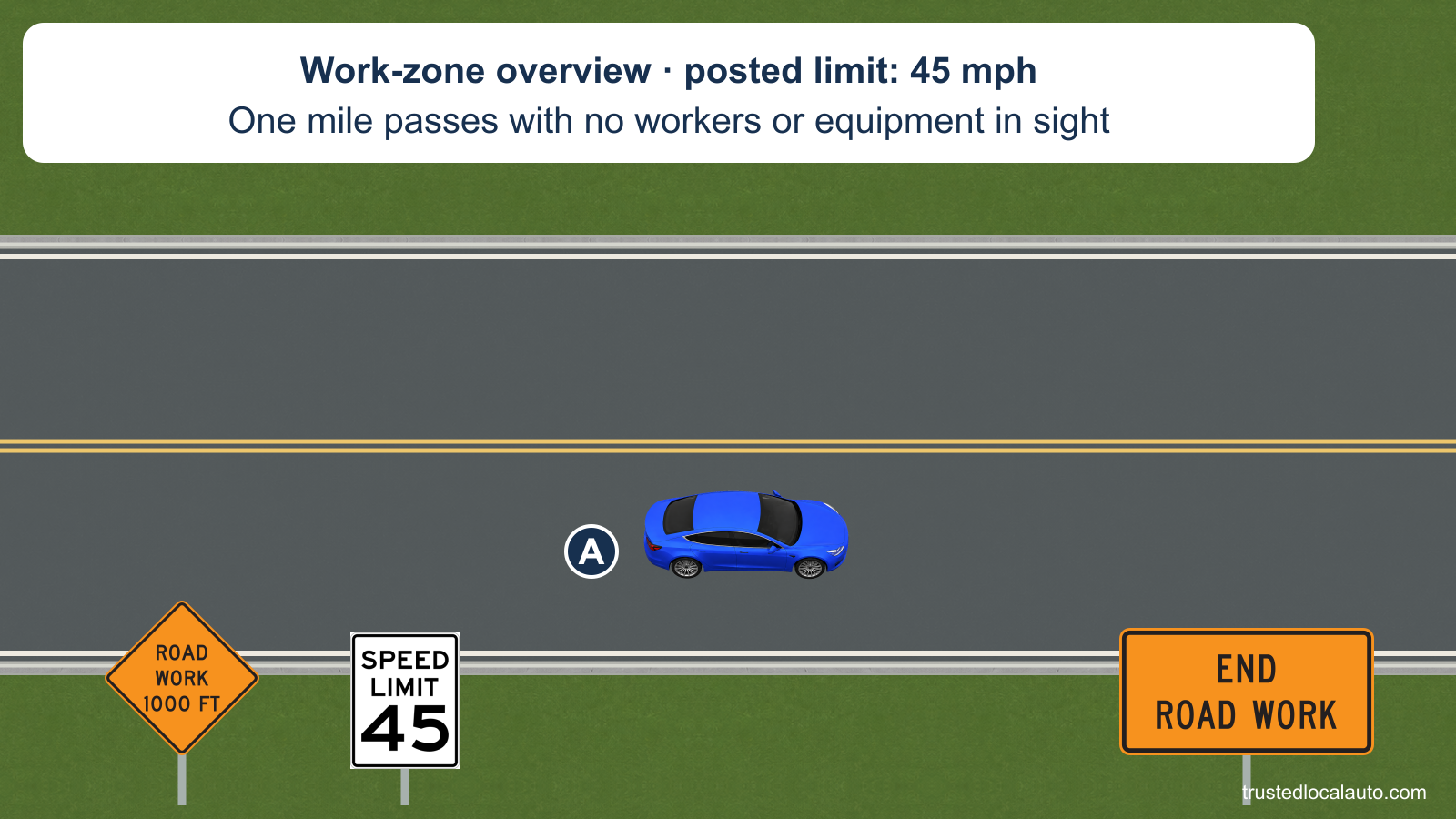
Correct answer: From the first sign of the work zone to the last sign that marks its end
Why
Black-on-orange signs are used only for work zones. They warn you before the zone and give directions inside it, such as a lane shift, and they give you enough time to act, so act early. Keep to the posted limit, but do not drive much slower than the traffic around you: slow vehicles are a major cause of rear-end crashes in work zones.
Verified against North Carolina Driver Handbook · Work Zones · p. 72, 73
Is this question correct and clear?
Continue learning
Related North Carolina questions
- Which conviction in North Carolina brings a fine of at least $500 and 5 driver license points?
- As you approach a railroad crossing, the red lights start to flash and the gate begins to come down. Where must you stop?
- At 7:30 on a school morning, you approach a group of children who wait at a school bus stop beside the road. No bus is in sight. What should you do?
- You come to a railroad crossing, and no train is in sight. Traffic is stopped just past the tracks, and there is no room for your car on the far side. What should you do?
- You drive through a highway work zone with a posted 45 mph limit. In the zone, the lanes shift to the left, and a flagger controls the traffic. At which point does the work-zone speed limit end?
- In a work zone, a flagger in an orange vest turns a STOP/SLOW paddle so that the STOP side faces you. The car ahead of you went through just before. What should you do?