
Practice question, Question 1 of 20
Passing target: 80% (16/20)
Late at night, the traffic signal for your direction flashes red. The signal for the cross street flashes yellow. What must you do?
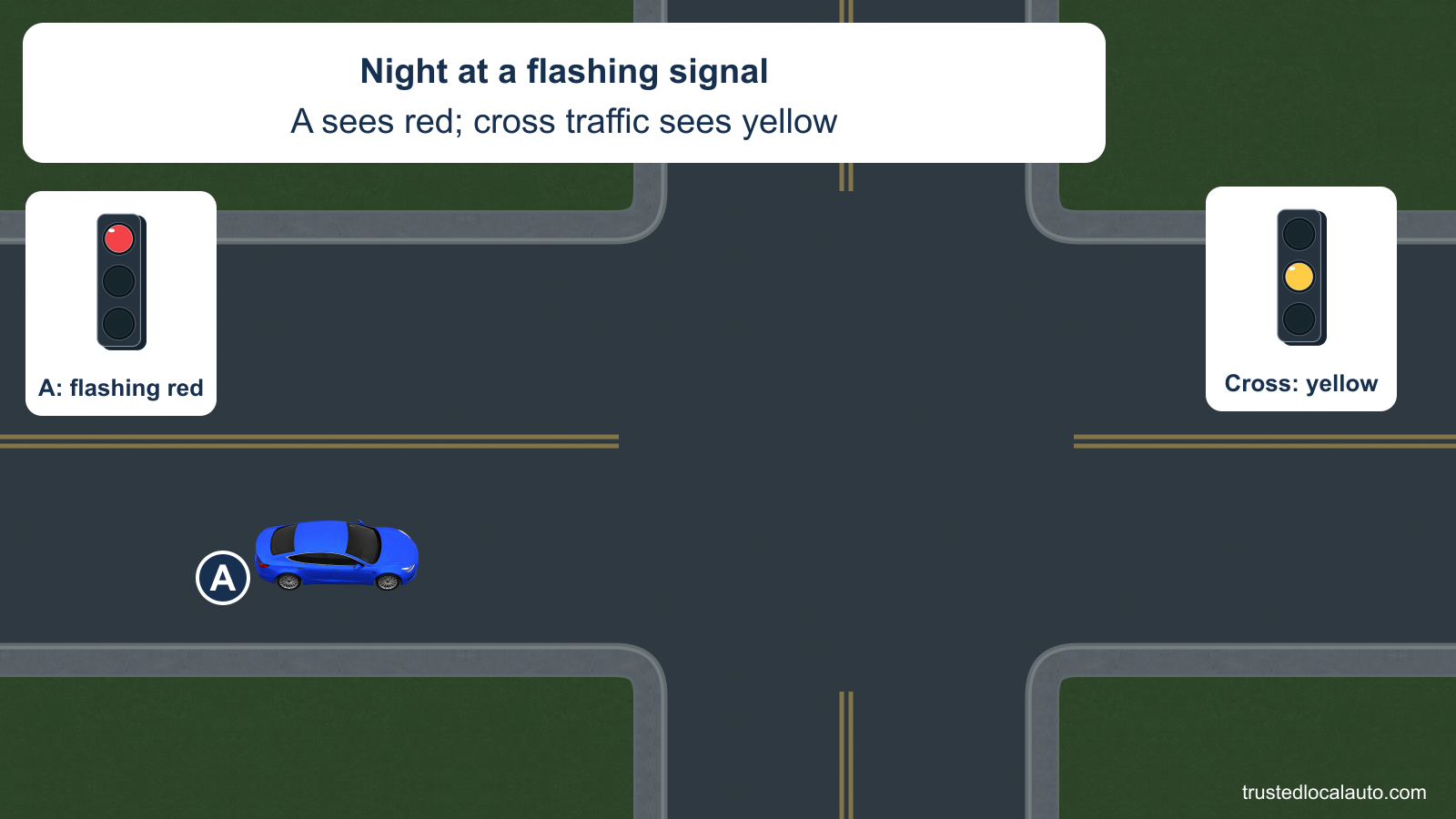
Correct answer: Stop fully, yield, then go when the way is clear
Why
Here cross traffic has a flashing yellow light and does not stop, so judge the gap with care before you go. If a signal is dark, for example in a power failure, stop as if there were STOP signs in all directions. The flashing-signal rules do not apply at railroad crossings or to school buses, which have their own rules.
Verified against Vermont Driver's Manual · Flashing signals · p. 33, 32
Is this question correct and clear?
Continue learning
Related Vermont questions
- On a five-lane street, the center lane has a solid yellow line and a broken yellow line on each side, and left-turn arrows that point in opposite directions. How should you use this lane?
- Late at night, the traffic signal for your direction flashes red. The signal for the cross street flashes yellow. What must you do?
- You wait to turn left at a signal that shows a flashing yellow arrow pointing left. Oncoming cars are still coming. What should you do?
- You come to an intersection where the traffic signal for your direction flashes yellow. You plan to go straight. What must you do?
- You drive on a road with a signal above each lane. Above your lane is a steady green arrow that points down at the lane. What does it tell you?
- A traffic signal allows you to turn left, but the turn is not protected: oncoming traffic usually has a green light, so you must yield to it. Which signal shows this?