
Back to Virginia
Virginia Passenger Knowledge Exam Practice
Full test preview Question 1 of 40
0 answered 40 remaining
Passing target: 85% (34/40)
Weather, Visibility & EmergenciesStandalone practice
At dusk, a deer jumps into your lane close in front of you. You cannot stop in time, and a crash seems certain. What should you do?
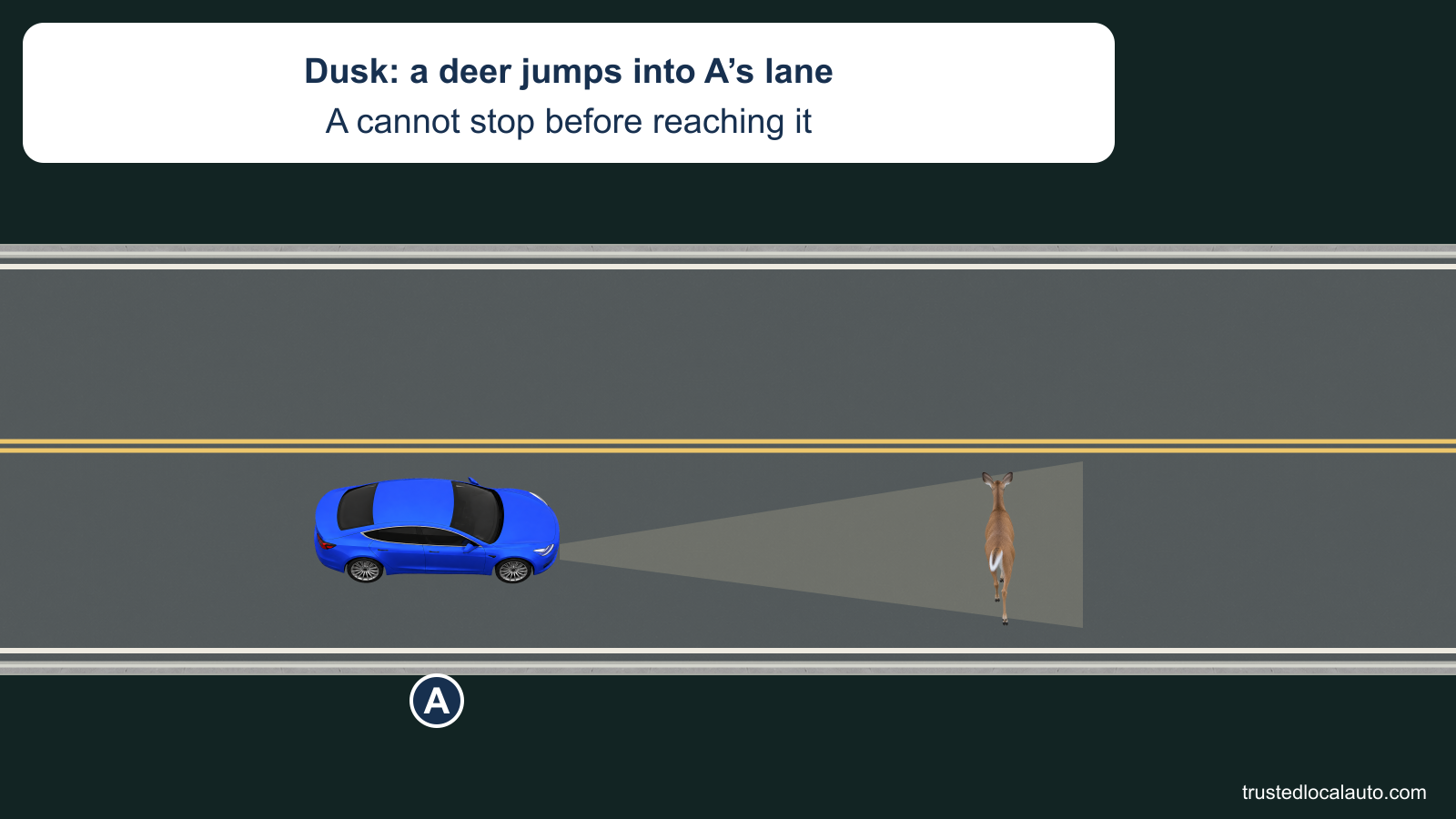
At dusk, blue A approaches a deer in its own lane on a two-way road. No escape path is marked.
Correct answer: Brake hard, keep the car in your lane and stop under control
Why
Many serious deer crashes happen when drivers swerve and hit another vehicle or a fixed object. Be most alert at dusk and dawn, especially in the fall, and slow down when you see one deer, because others are often nearby. If you hit a large animal, report it to law enforcement.
Verified against Virginia Driver's Manual · Deer/large animal hazards · p. 27
Report a question issueContinue learning
Related Virginia questions
After a snowstorm, you clear the windshield, the side windows and the mirrors. Snow still covers the roof, the hood and the taillights. What should you do before you drive?It has not rained for a week. Light rain started ten minutes ago. When is the road surface most likely to be slippery?Today the sun sets at 7:40 p.m. You drive on a well-lit city street, and the sky is still bright. From what time does Virginia law require your headlights to be on?At night, thick fog cuts your view to about 200 feet on a rural road. Which lights should you use?It is noon. Steady rain makes you run your windshield wipers all the time, but you can still see more than 500 feet ahead. What does Virginia law require for your lights?At night on a dark rural highway, you are using your high beams. You come up behind a car that goes in the same direction. When must you switch to low beams?