
Practice question, Question 1 of 25
Passing target: 80% (20/25)
According to the Kansas handbook’s prime-conditions summary, how should a driver check the recommended following interval?
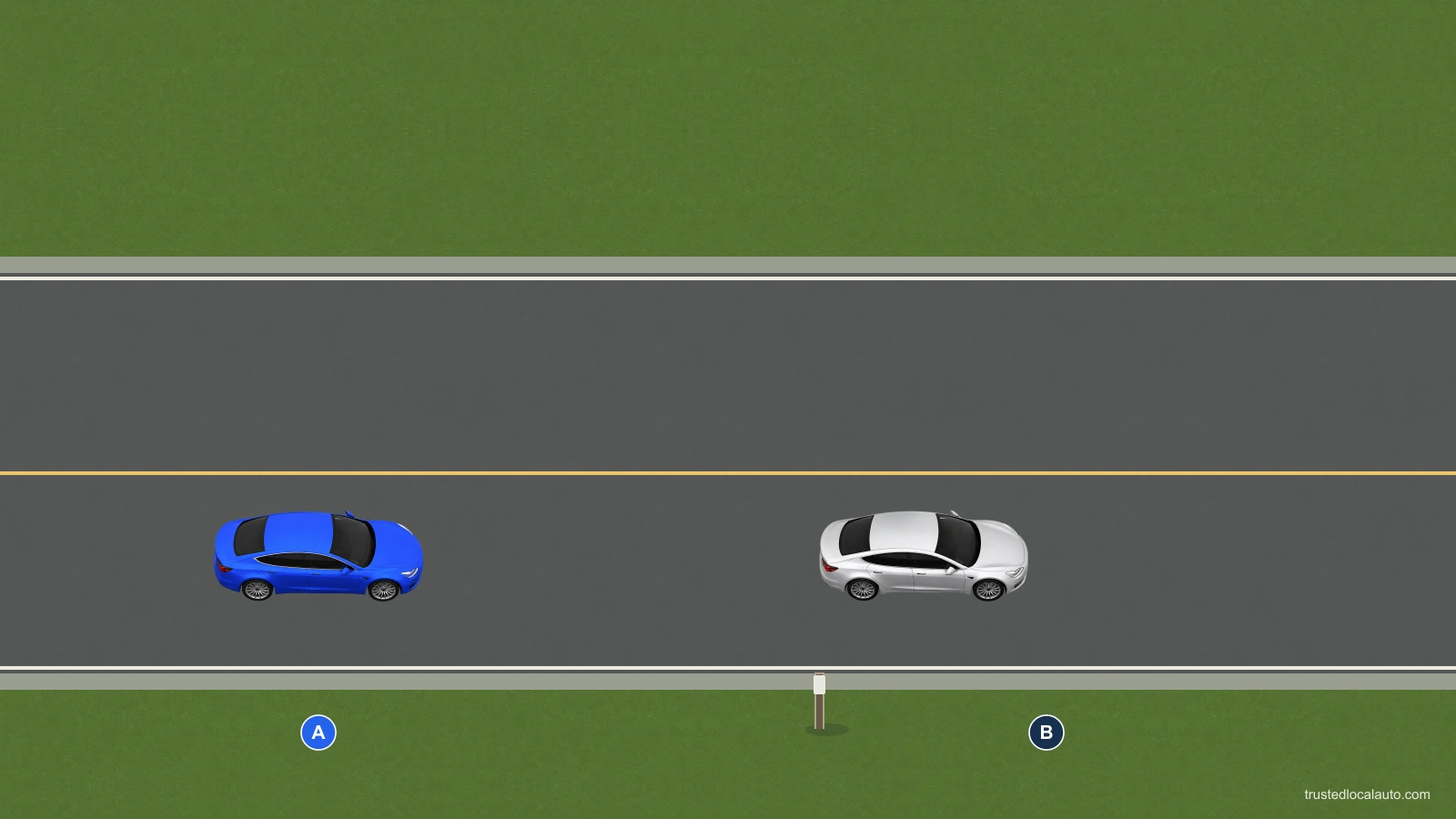
Correct answer: Use a fixed point and count at least two seconds.
Why
For prime conditions, the Kansas summary recommends a two-second following interval. Choose a fixed roadside point; count the time after the vehicle ahead passes it until you reach it. The summary recommends four seconds for adverse conditions, and more space may be needed. The law requires a reasonable and prudent distance, not a universal fixed number of seconds. The handbook’s visibility section also gives a three-second minimum, with an extra second for unusual weather or traffic. These different contexts do not establish one uniform handbook baseline; choose enough space for the actual conditions.
Verified against Kansas Driving Handbook · Following distance · p. 17, 62, 63, 77
Is this question correct and clear?
Continue learning
Related Kansas questions
- The road is icy. You drive well below the posted limit and slower than other traffic, because a higher speed would be dangerous on the ice. Which statement is correct?
- When rain, darkness, heavy traffic, or a blocked view increases risk, what should happen to following distance?
- Why should a driver reduce speed when headlights illuminate only a short distance ahead?
- To reduce last-second decisions, how far ahead does the Kansas handbook recommend that you scan, while you also check nearby traffic and mirrors?
- You drive on a two-lane Kansas county highway outside an urban district. It is not a separated multilane highway, no other lawful limit is established, and no hazard requires a lower speed. What statutory maximum applies?
- To reduce last-second decisions, how far ahead should a driver ideally scan?