
Practice question, Question 1 of 40
Passing target: 80% (32/40)
In favorable conditions, how can a Louisiana driver check the basic following interval for ordinary traffic?
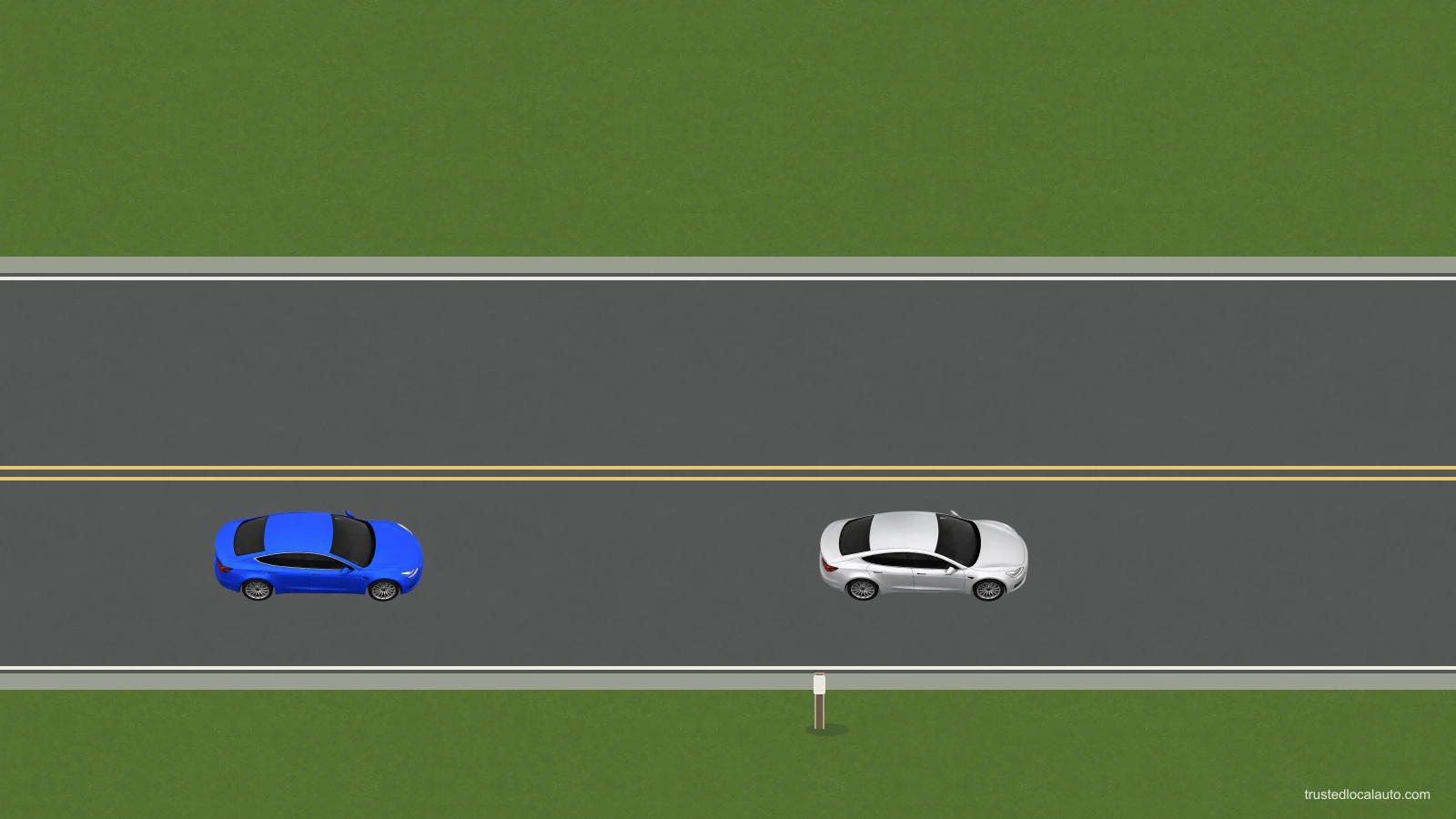
Correct answer: Use a fixed point and count at least three seconds.
Why
For favorable ordinary conditions, the guide gives a three-second reference-point check: begin timing when the vehicle ahead passes a fixed object, and do not reach it too soon. This is a guide, not a universal legal minimum or a guarantee of safety. Other contexts need more space: the guide discusses at least four seconds in adverse conditions, and more space on interstates and in bad weather. The legal duty is to follow at a reasonable and prudent distance for speed, traffic and road conditions.
Verified against Louisiana Class D & E Driver's Guide · Following distance · p. 70, 71, 106
Is this question correct and clear?
Continue learning
Related Louisiana questions
- At night in heavy rain, you approach a sharp curve. Below the yellow curve warning sign, a yellow plaque reads 35 MPH. Which statement is correct?
- When rain, darkness, heavy traffic, or a blocked view increases risk, what should happen to following distance?
- You drive on an ordinary road, not an interstate, in daylight. The pavement is dry, traffic is light and your view is clear. Which basic following interval does the guide give for these conditions?
- The Louisiana guide gives one following interval for favorable conditions and another for rain, darkness, heavy traffic or a blocked view. Which pair of guide figures is correct?
- Why should a driver reduce speed when headlights illuminate only a short distance ahead?
- How far ahead along your planned path does the Louisiana guide tell you to look?