
Back to Massachusetts
Massachusetts Class D Learner's Permit Exam
Full test preview Question 1 of 25
0 answered 25 remaining
Passing target: 72% (18/25)
Traffic Signals & Road MarkingsStandalone practice
A single solid white line separates two same-direction travel lanes. According to the Massachusetts handbook, how should you treat that line?
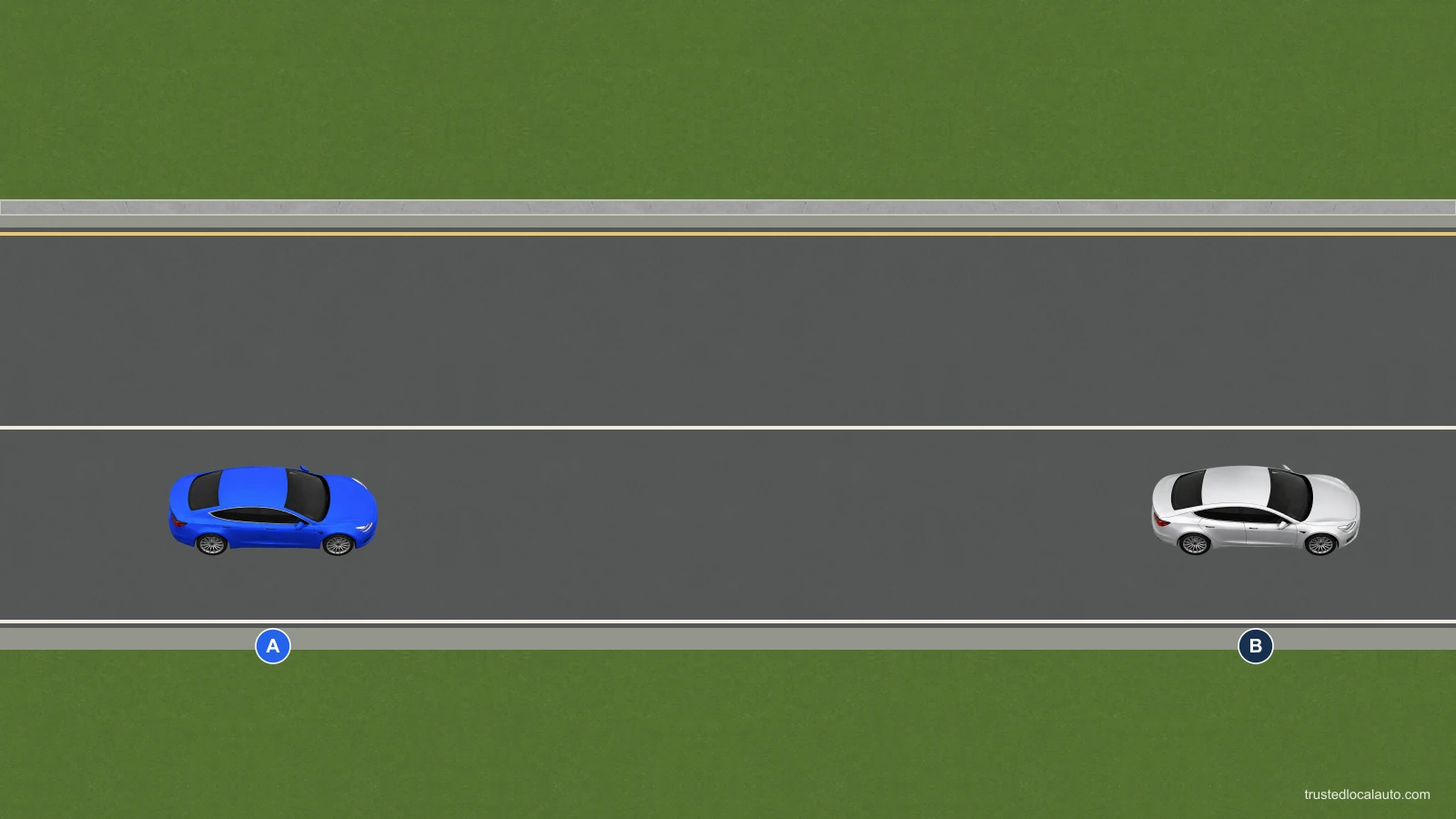
Blue A follows silver B in the right of two eastbound lanes. One solid white line separates the lanes. The opposite carriageway is outside the view.
Correct answer: Avoid crossing it unless needed to avoid danger.
Why
A single solid white line can separate same-direction lanes; the handbook says not to cross it unless needed to avoid danger. A white edge line may instead border a shoulder, which is not another ordinary travel lane. Double solid white has a separate no-crossing meaning.
Verified against Massachusetts Driver’s Manual · A single white boundary between lanes · p. 98
Report a question issueContinue learning
Related Massachusetts questions
A narrow street has an advisory bicycle lane marked with dashed boundaries. If using that space becomes necessary, what must a motorist do first?Your left-turn arrow is flashing yellow. Oncoming traffic has green and a vehicle is approaching. When may you turn?The circular signal turns steady yellow as you approach. You can stop safely before the stopping point. What should you do?The two upper red lights of a pedestrian hybrid beacon are flashing alternately. What must you do before proceeding?An amber rectangular beacon is flashing rapidly at a marked crosswalk, and a pedestrian is crossing your path. What should you do?At a red light, an empty green bicycle box lies ahead of your marked stopping position. Where should you stop?