
Practice question, Question 1 of 25
Passing target: 80% (20/25)
Another car bumps yours in a lane of the interstate. No one is hurt, and both cars can still be driven safely. What does the Nebraska manual tell you to do?
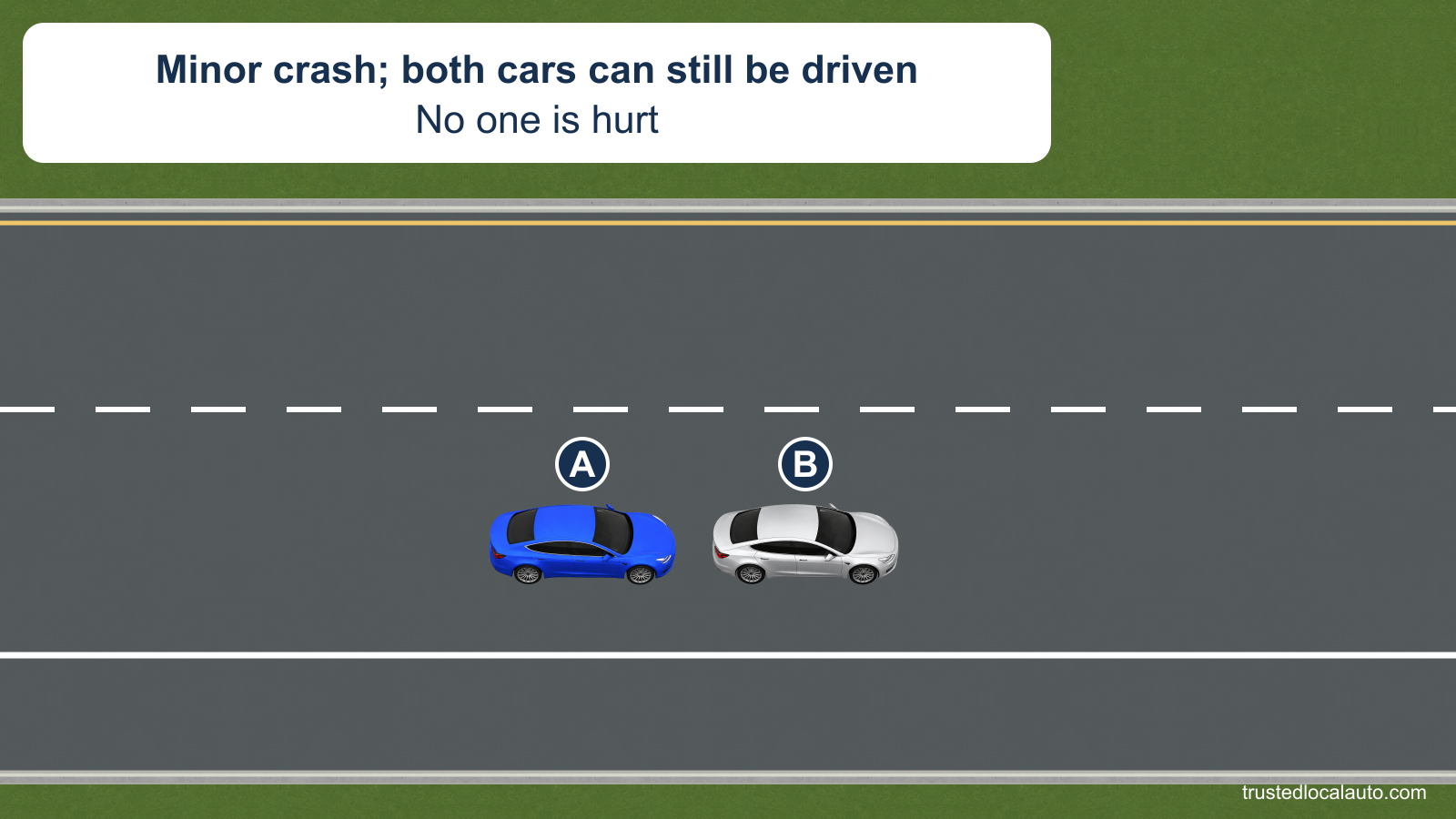
Correct answer: Drive both cars to the nearest shoulder, out of the travel lanes, then exchange information.
Why
On an interstate or freeway, cars left in a travel lane after a minor crash can quickly cause a second, more serious one. When no one is injured and the vehicles can still be driven, move them to the nearest shoulder, then exchange names, addresses, phone numbers and license and insurance details. If a vehicle cannot be moved, police may push it to the shoulder or have it removed.
Verified against Nebraska Class O Driver's Manual · Move Crashes to Shoulder and Quick Clearance · p. 59, 81
Is this question correct and clear?
Continue learning
Related Nebraska questions
- Your exit is on the right, and you are in the left lane of the interstate. According to the Nebraska manual, when should you signal and move into the proper lane for the exit?
- You are about to leave the interstate at an exit where a separate lane branches off before the ramp. Where should you do most of your slowing?
- Your car breaks down at night on the interstate. You stop on the shoulder, fully clear of the traffic lanes. Which lights does Nebraska law require you to use?
- You have just merged onto a Nebraska interstate. The weather is clear and dry, and traffic moves freely at about 70 mph. You feel nervous and want to drive 35 mph in the right lane until you are used to the traffic. Is this allowed?
- The weather is clear, the interstate is dry and traffic is light. A car changes lanes into the space ahead of you. Under the Nebraska manual's rule, what is the minimum following time behind that car?
- Packed snow covers a Nebraska interstate, and visibility is good. Traffic moves slowly. You drive 30 mph in the right lane, because a higher speed is not safe on the snow. Which statement is correct?