
Practice question, Question 1 of 40
Passing target: 80% (32/40)
Heavy snow falls on an interstate highway. Traffic in your lane moves steadily at about 35 mph, a speed that fits the road and the view, and 45 mph would be too fast on this snow. What speed should you drive?
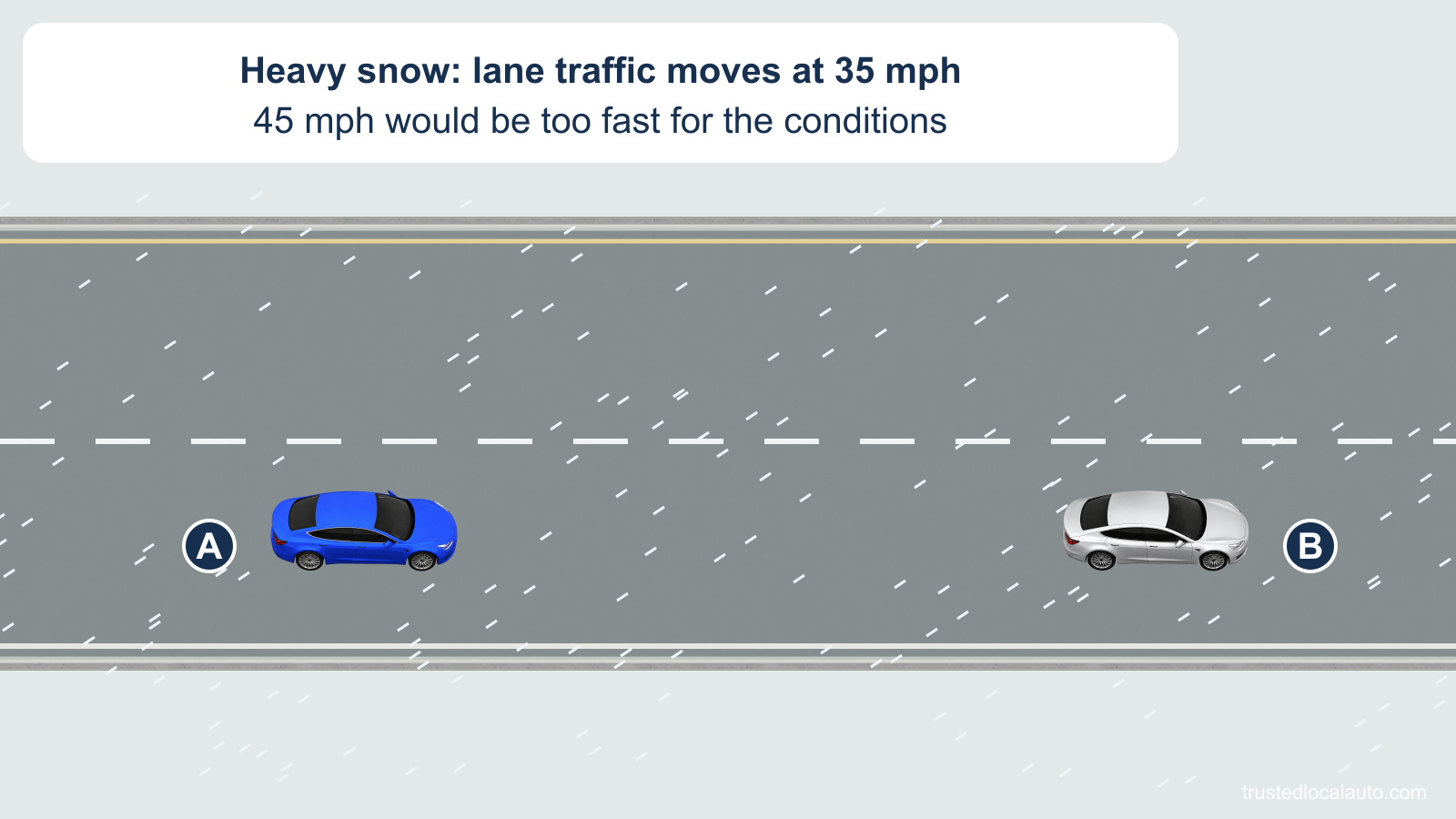
Correct answer: About 35 mph with the flow, since the minimum does not apply when 45 is too fast
Why
New Hampshire sets a 45 mph minimum on interstates, but the manual and the law allow a lower speed when road and weather conditions make 45 mph unsafe. Even then, a car that moves far slower than the traffic around it makes other drivers brake hard, weave between lanes or pass when it is not safe. In good weather, keep at least 45 mph and move with the flow of traffic, within the limit.
Verified against New Hampshire Driver's Manual · Speed management · p. 21
Is this question correct and clear?
Continue learning
Related New Hampshire questions
- You plan a 6-hour drive, mostly on the interstate. How often does the New Hampshire manual advise you to stop for a break to help avoid fatigue?
- On a 30 mph road, you stayed about 180 feet behind the car ahead, which was about a four-second gap. Now you drive at 60 mph on a highway, still about 180 feet behind the car ahead. What should you do?
- Traffic on a divided highway slows to a crawl. The paved breakdown lane on the right is empty, and your exit is half a mile ahead. What is the rule for the breakdown lane?
- Which pair of maximum speed limits on New Hampshire interstates is correct?
- Which statement about the maximum speed limits on New Hampshire interstates is correct?
- On a dry, clear day with light traffic, you drive in the right lane of a New Hampshire interstate. There is no work zone. You would like to drive at 40 mph. Which statement is correct?