
Practice question, Question 1 of 50
Passing target: 80% (40/50)
Your engine starts to fail while you drive at highway speed. The highway has a wide paved shoulder. How should you get off the road?
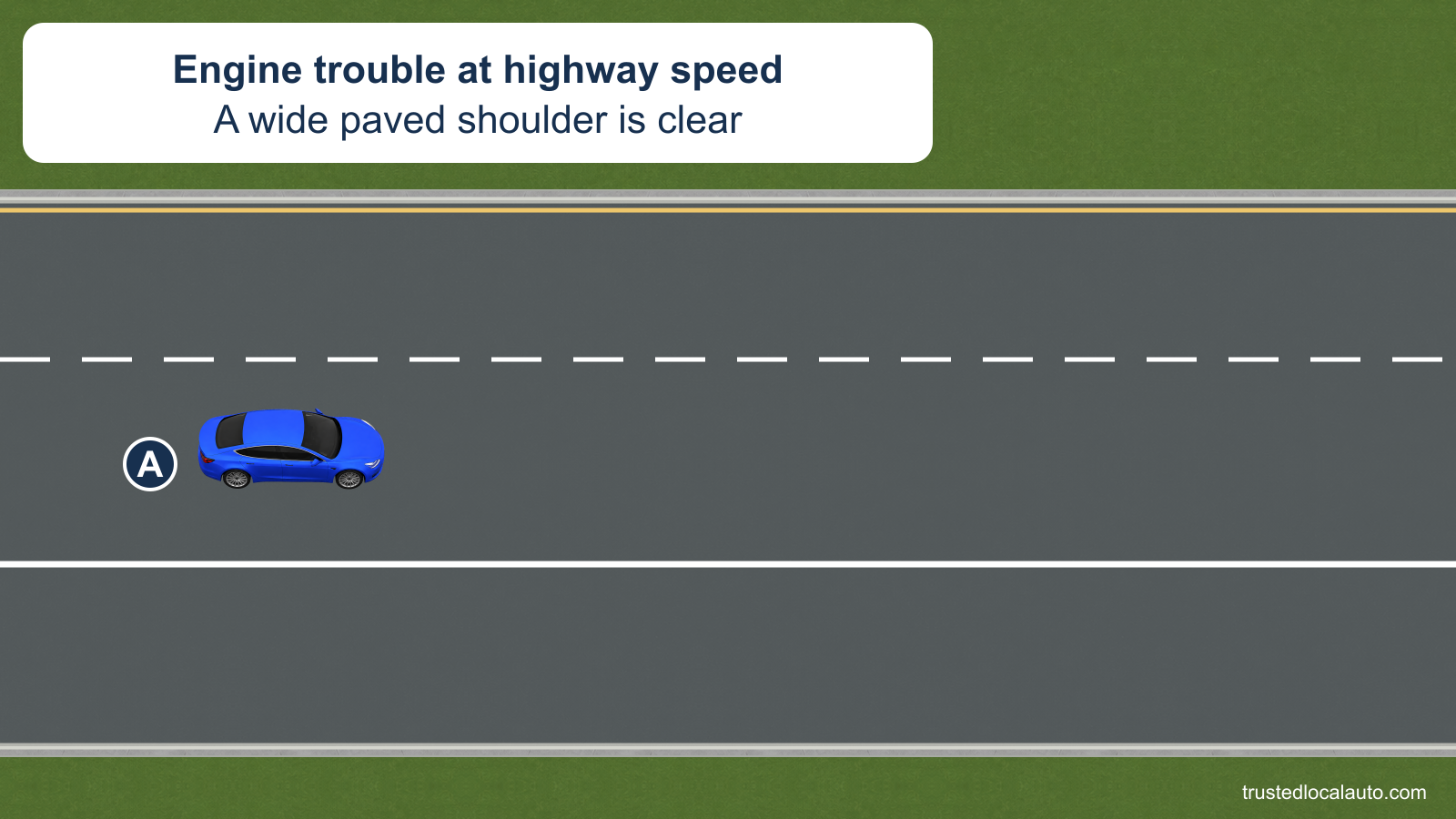
Correct answer: Signal, move onto the paved shoulder at or near traffic speed, then slow down.
Why
Braking in a travel lane at highway speed invites a rear-end crash, so a paved shoulder lets you lose speed outside the traffic flow. If the shoulder is dirt or gravel, slow to a safe speed before you turn off, because a soft surface can pull the car. After you stop, turn on the parking lights or hazard flashers, and set a warning device just behind the car and another one at least 300 feet (about 120 paces) back.
Verified against New Jersey Driver Manual · Emergency Stops · p. 107
Is this question correct and clear?
Continue learning
Related New Jersey questions
- On the approach to a stop sign, you find a curb space where your car would be 40 feet from the sign. No sign, marking or local rule sets another distance. Which statement is correct?
- Your car breaks down on a highway at night. You have pulled far onto the shoulder, turned on the flashers and raised the hood. A stranger stops and offers you a ride to a service station. What should you do?
- You find a curb space in the middle of a block, with no signs, driveways or crosswalks nearby. Your car would be 12 feet from a fire hydrant. Does New Jersey's hydrant rule allow you to park there?
- You have parked at the curb on a busy city street, with a bike lane running next to the parking lane. What should you do before you open the driver's door?
- You finish parallel parking on a city street. How close to the curb must your tires be?
- After you parallel park, you measure 4 inches between your curb-side tires and the curb. Which statement about this parking is correct?