
Practice question, Question 1 of 50
Passing target: 80% (40/50)
At a railroad crossing ahead, red lights start to flash and the gate begins to come down. No train is in sight yet. Where must you stop?
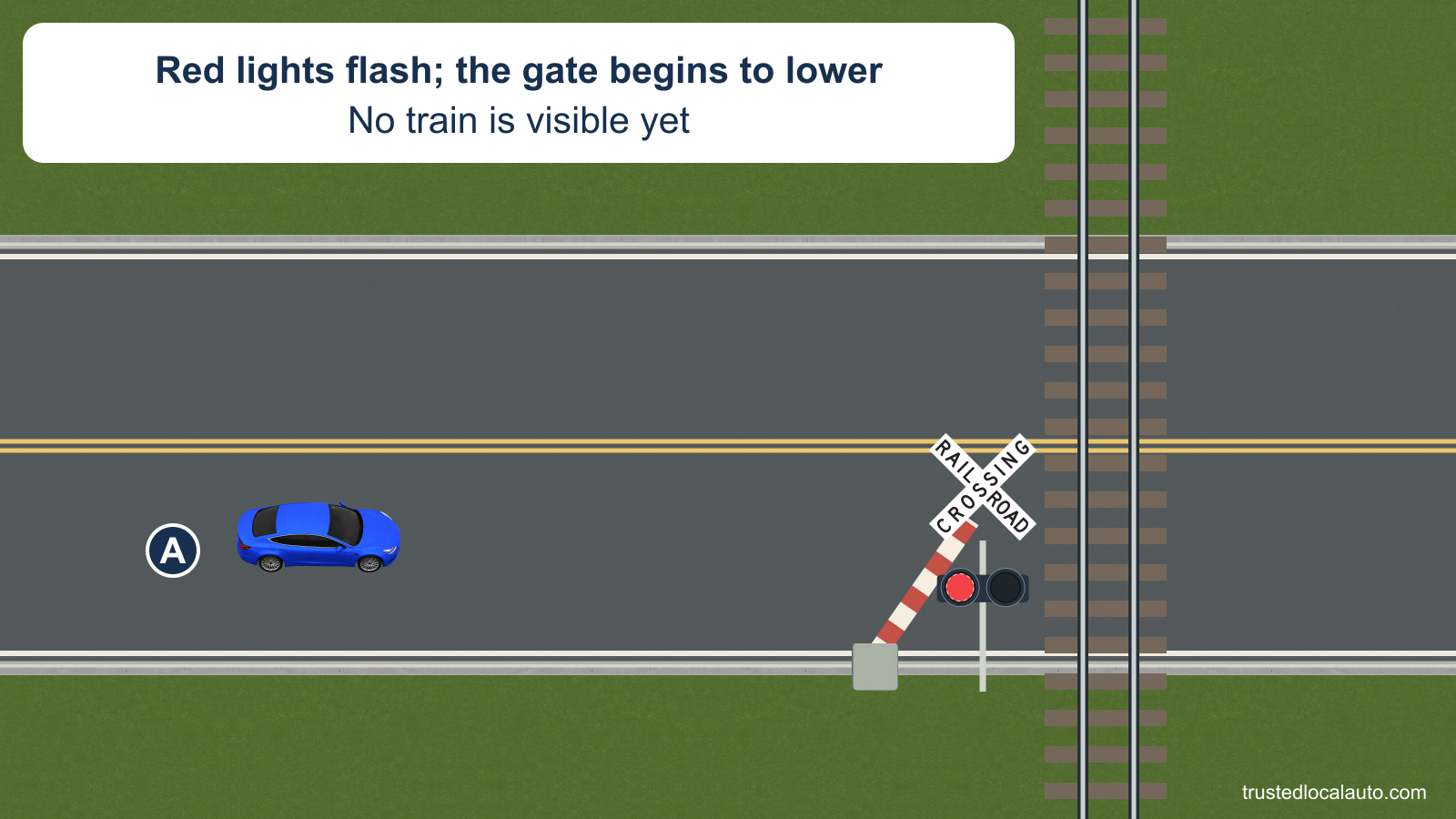
Correct answer: At least 15 feet but not more than 50 feet from the nearest rail, and stay until it is safe to cross.
Why
New Jersey law sets the stopping zone at a railroad crossing: within 50 feet of the nearest rail but never closer than 15 feet, whenever flashing lights, a lowering or lowered gate, a flagger or a nearby train warns of danger. The manual states only the 15-foot minimum; the statute adds the 50-foot limit. Wait until the gates are fully up, the bells stop and the lights go dark. Never race a train: at 60 mph or more, a train can need more than a mile to stop.
Verified against New Jersey Driver Manual · Stop at Railroad Crossings · p. 78
Is this question correct and clear?
Continue learning
Related New Jersey questions
- An orange diamond sign shows a person holding a flag. What should you get ready to do?
- An ice cream truck is stopped on a two-lane street. Its red lights are flashing and its stop arm is out. Nobody is crossing the street now. What does New Jersey law require?
- You see this sign as you drive. What should you expect ahead?
- An ice cream truck is stopped on a two-lane street with its red lights flashing and its stop arm out. No one is crossing the street at the moment. What must you do?
- You come to railroad tracks marked only by a white X-shaped sign that reads RAILROAD CROSSING. There are no lights or gates. What does this sign require?
- At a railroad crossing, the red lights start to flash and the gate begins to come down. No train is in sight yet. A driver stops with the front of the car 12 feet from the nearest rail. Which statement is correct?