
Practice question, Question 1 of 50
Passing target: 80% (40/50)
You drive in the right lane of a one-way street with three lanes. At a marked crosswalk, an in-street sign reads STATE LAW and shows a red STOP symbol and the word FOR above a walking-person symbol. A pedestrian steps off the left curb into the far-left lane. What must you do?
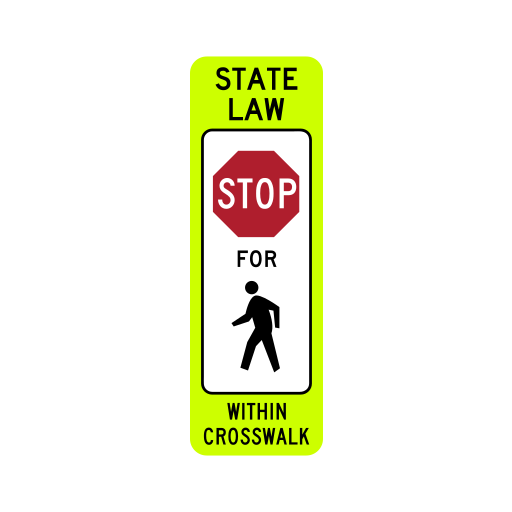
Correct answer: Stop and stay stopped, because on a one-way road the whole width is your half
Why
New Jersey law counts all lanes that carry traffic in one direction as one half of the road; on a one-way street, that is the full width. The in-street STATE LAW sign reminds drivers of this duty at crosswalks that have no signal. A driver in another lane may block your view of the pedestrian, so stop early, and never pass a car that has stopped at a crosswalk.
Verified against New Jersey Driver Manual · Traffic signs · p. 224, 68, 146
Is this question correct and clear?
Continue learning
Related New Jersey questions
- What does this sign tell you to do?
- Next to a lane marked with a solid white line, a white sign shows a bicycle symbol above the words BIKE LANE. What does the sign tell drivers?
- You are driving alone on a weekday morning. The left lane has white diamonds painted in it. This overhead sign shows a white diamond, the number of people that a vehicle must carry to use the lane, and weekday hours. It is now within those hours. What should you do?
- You are about to turn onto a ramp. Facing you is a square white sign with a red circle, a white bar across the middle of the circle, and the white words DO NOT ENTER on the circle. What does this sign mean?
- A fully licensed driver drives alone on a weekday. The lane under this overhead sign has white diamonds. The sign shows HOV 2+ ONLY and 6AM–9AM MON–FRI. When may this driver use the lane?
- You drive on a weekday morning with one passenger, so your car carries two people in all. The left lane has white diamonds. Its overhead sign shows a white diamond, HOV 3+ ONLY and weekday hours, and it is now within those hours. Which statement is correct?