
Practice question, Question 1 of 30
Passing target: 80% (24/30)
You drive on a paved, winding secondary road with a marked center line and a posted 55 mph limit. Hills and sharp curves let you see only a short distance ahead. How should you choose your speed?
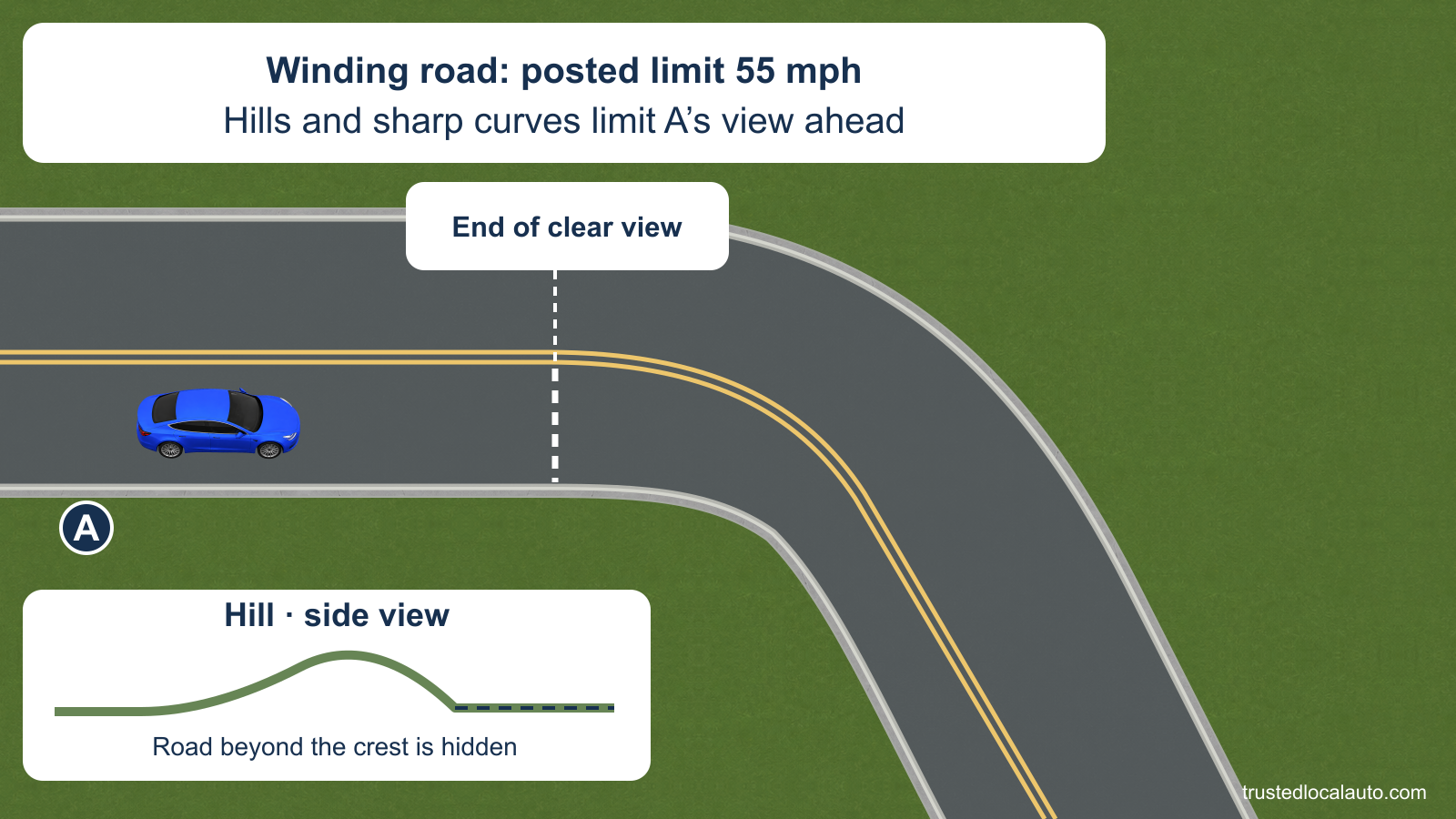
Correct answer: Slow to a speed that lets you stop within the distance you can see
Why
At 55 mph a car needs about 211 feet to stop even in ideal conditions, and a hill crest or a sharp curve can hide the road much closer than that. Secondary roads often have steeper hills, sharper curves and very short sight distances. North Carolina law also bans a speed that is greater than is reasonable and prudent for the conditions, even when you are under the posted limit. Watch for animals that cross these roads too.
Verified against North Carolina Driver Handbook · Adjusting Your Speed to Driving Conditions · p. 55, 65, 56
Is this question correct and clear?
Continue learning
Related North Carolina questions
- On a four-lane highway, you want to move from the right lane to the left lane. Your inside and side mirrors show that the left lane is clear. What should you do before you move over?
- Which statement about stopping distance is NOT correct?
- You follow a tractor-trailer on a two-lane highway. The trailer hides the road ahead of it, and you cannot see the truck's side mirrors. What should you do?
- You are driving on a busy city street. To spot problems early, about how far ahead should you try to look along the road?
- You drive at 45 mph in the left lane of a highway with two lanes in each direction. The speed limit is 55 mph. Traffic is light. You are not passing anyone, and your route goes straight on for many miles. Which statement is correct?
- You drive at 45 mph on a highway with two lanes in each direction. The speed limit is 55 mph. You will turn left at an intersection a short distance ahead. Which statement is correct?