
Practice question, Question 1 of 30
Passing target: 80% (24/30)
Your engine begins to overheat on the Interstate, and you must stop. What does the North Dakota manual tell you to do?
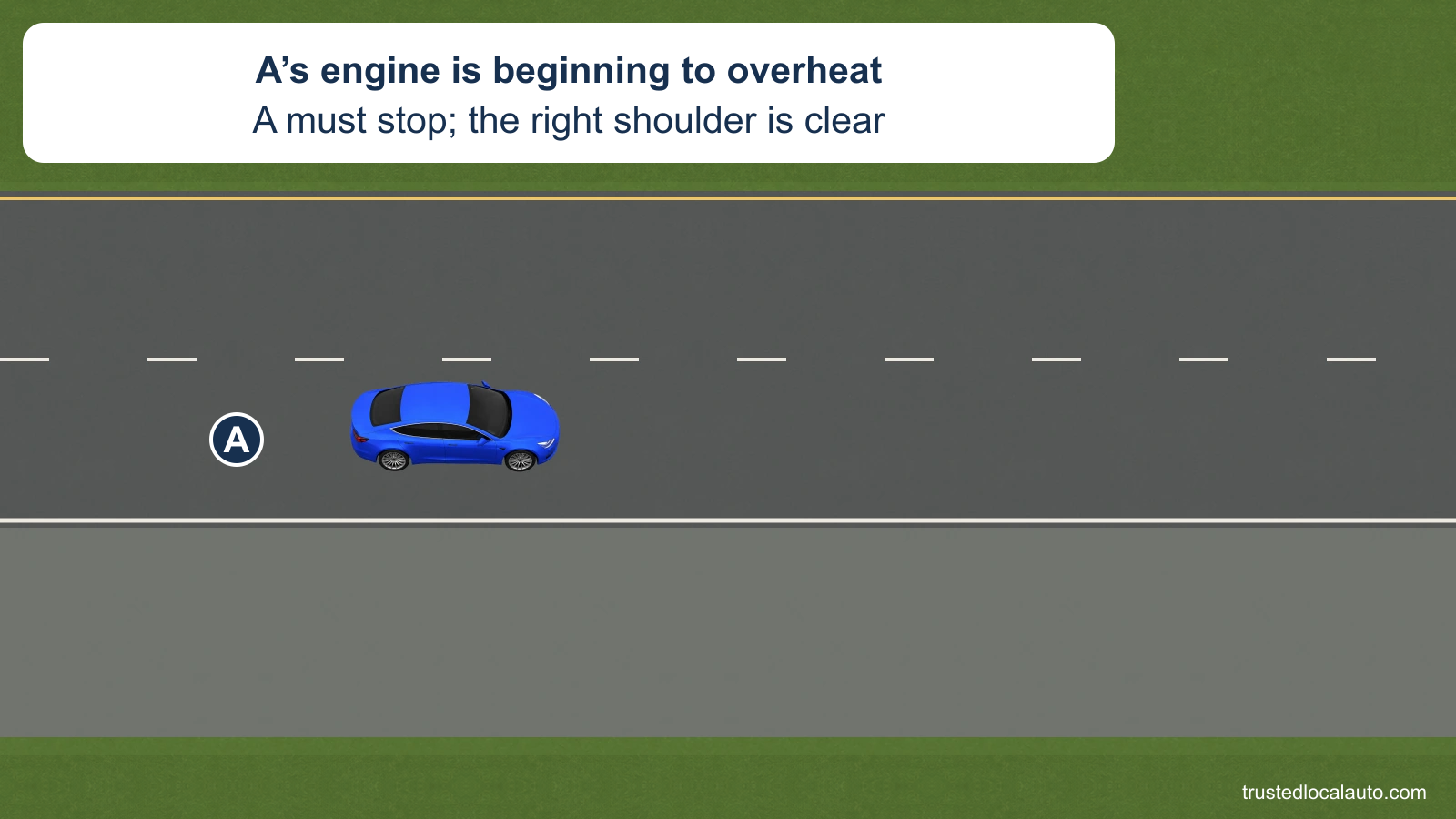
Correct answer: Stop on the shoulder, and raise the hood to show that you have a problem.
Why
Interstate traffic moves fast, so a car that stops in a travel lane gives other drivers very little time to react. The shoulder is for emergencies, not for normal stops, and a raised hood tells passing drivers and officers that you need help. For emergency help on the highway, dial 911; for road and weather conditions in North Dakota, dial 511.
Verified against 2025-2027 Class D Noncommercial Driver License Manual · Interstate driving · p. 28, 31
Is this question correct and clear?
Continue learning
Related North Dakota questions
- You compare driving at 75 mph on the Interstate with driving at 30 mph on a city street. Your reaction time to a sudden hazard is the same at both speeds. Which statement about the distance that your car covers before you start to brake is correct?
- After two hours on I-94, you begin to feel sleepy. Your passenger does not have a license. Which plan does the North Dakota manual support?
- You are at the end of an acceleration lane. The ramp joins the freeway from the right, and a car in the freeway's right lane is level with you, on your left. A gap is open behind that car. No sign gives a different rule. What must you do?
- You drive at 75 mph on the Interstate instead of 30 mph on a city street. Your reaction time to a sudden hazard is the same. What changes?
- On a dry, clear day, you drive at 75 mph on the Interstate. You keep the same gap to the car ahead that you keep on city streets: one car length. What is true of this gap?
- Which statement about lane use on a four-lane rural Interstate is NOT correct?