
Practice question, Question 1 of 30
Passing target: 80% (24/30)
At night you enter a highway work zone. A sign posts a lower work-zone speed limit. The lanes are narrow, the pavement is uneven, and workers stand a few feet from your lane. How should you choose your speed?
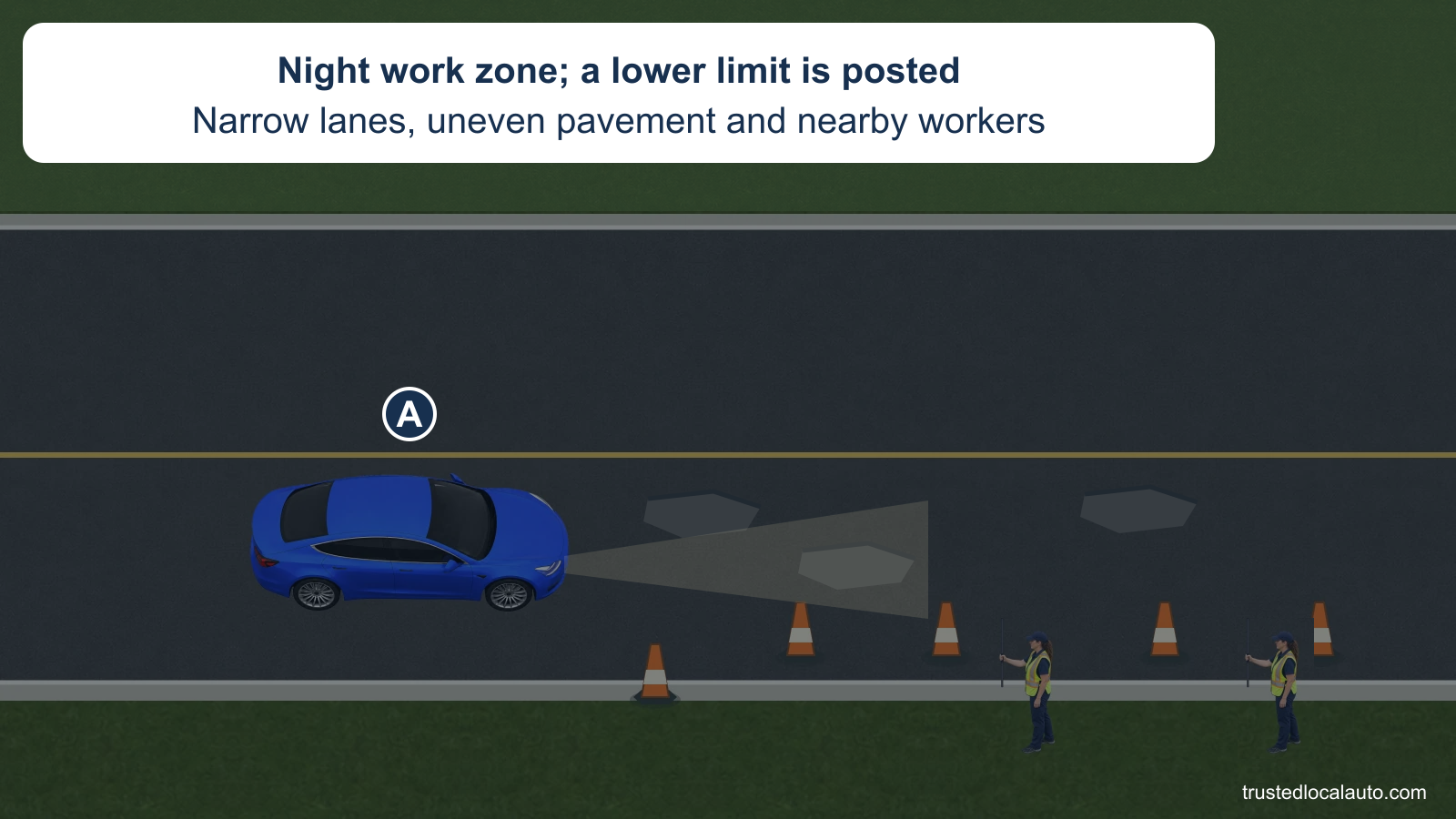
Correct answer: Stay at or below the posted work-zone limit and slow down more for the lanes and workers.
Why
Work zones can have rough pavement, narrow lanes, heavy machines, and loose gravel, and workers may be just inches from traffic. Most people killed in work zones are drivers and passengers, not workers. North Dakota law makes a posted work-zone limit a legal limit, and the basic speed rule also requires a speed that is safe for the conditions. Slow down, watch for orange signs, and stay alert day and night.
Verified against 2025-2027 Class D Noncommercial Driver License Manual · Construction and maintenance devices; work zone safety tips · p. 17, 18
Is this question correct and clear?
Continue learning
Related North Dakota questions
- You are stopped at a railroad crossing with two tracks and no gates. A train has just passed on the near track, but the red lights still flash. What should you do?
- A school bus has stopped with its red lights flashing and its stop arm out. Which of these drivers need not stop for it?
- You approach a railroad crossing. Its red lights begin to flash and its bells ring, but no gate is down and you cannot see a train yet. What must you do?
- As you come up to a railroad crossing, the lights start to flash and the gates begin to come down. You can see the train, and it looks far away. What should you do?
- At a work zone, one lane of a two-lane road is closed. A flagger turns the paddle to STOP as you arrive. The open lane ahead looks empty. What should you do?
- You approach a rural railroad crossing that has no lights or gates. Tall corn blocks your view of the tracks in both directions. No speed is posted. What is the highest speed that North Dakota law presumes is lawful as you come near the crossing?