
Practice question, Question 1 of 35
Passing target: 80% (28/35)
The road you are on ends at a T intersection with no signs or signals. You want to turn right. A car on the through road approaches from your left, and another approaches from your right. What should you do?
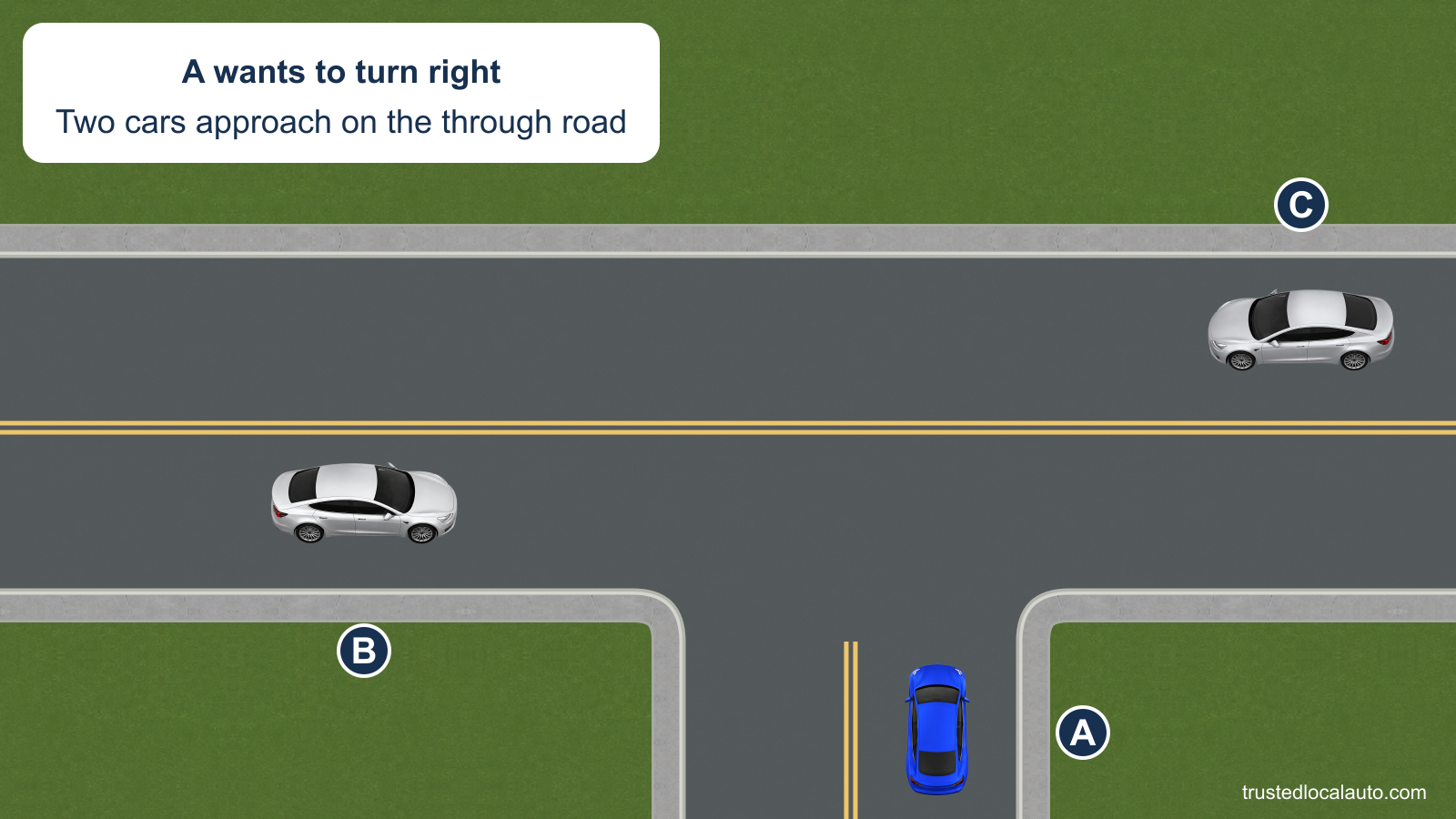
Correct answer: Yield to the cars on the through road from both directions, then turn.
Why
The T intersection rule is an exception to the rule of yielding to the right at intersections with no signs or signals. Drivers on the through road do not expect a car from the road that ends to pull out in front of them. Stop if needed, look both ways, and enter only when there is a safe gap.
Verified against Oregon Driver Manual · T intersections · p. 50
Is this question correct and clear?
Continue learning
Related Oregon questions
- You approach a single-lane roundabout. A pedestrian is crossing the crosswalk in your lane just before the entry. A car inside the circle comes toward your street from the left with its right turn signal on, as if it will leave at your street. What should you do?
- Late at night, the signal for your street flashes red. The signal for the cross street flashes yellow. You have stopped at the stop line. What should you do next?
- Late at night, the signal for your street flashes red, and the signal for the cross street flashes yellow. You stopped at the stop line before a car on the cross street came near. That car is now close to the intersection. What should you do next?
- You wait in a left-turn lane. The signal for your lane shows a flashing yellow arrow. You see a long gap in oncoming traffic, and no one is in the crosswalk. What may you do?
- Your light is green. Traffic on the far side of the intersection is backed up, and there is room for only half of your car past the far crosswalk. What should you do?
- You are stopped at a red light in the left lane of a one-way street. You want to turn left onto a one-way street whose traffic moves to your left. No sign prohibits a turn on red. What may you do?