
Practice question, Question 1 of 40
Passing target: 75% in each of the three areas
A Québec expressway has two lanes in your direction and a posted limit of 100 km/h. Both lanes are clear. You are not passing or taking a left exit. Which lane should you normally use?
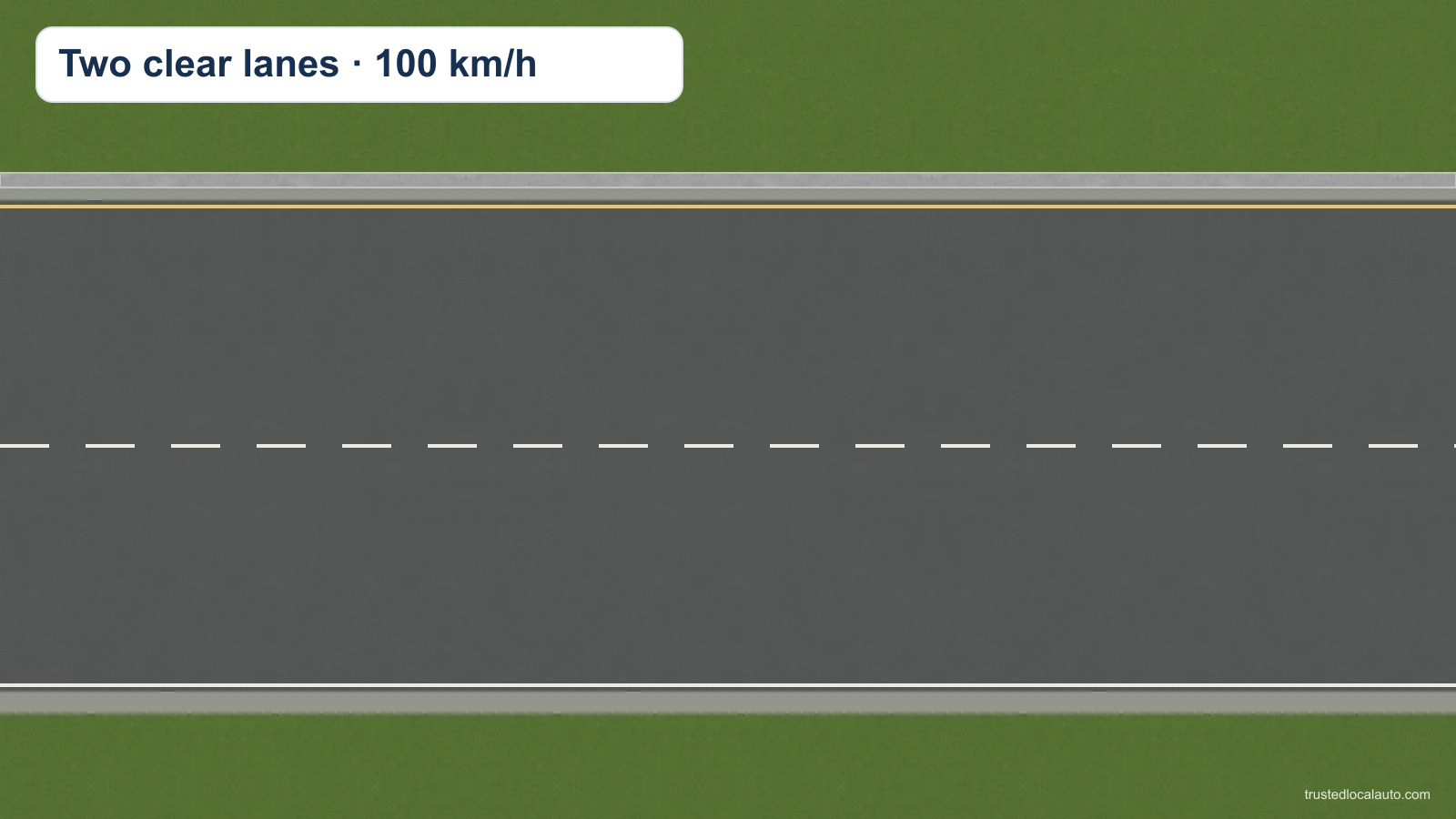
Correct answer: The right-hand lane.
Why
On this two-lane, 100 km/h expressway, use the right lane unless a permitted reason calls for another lane, such as passing, an obstruction or a left exit. On a roadway with three or more same-direction lanes, one of the right-hand lanes may be used. A separate rule applies below 80 km/h; do not extend this example to every multilane street.
Verified against Guide de la route (SAAQ), French 2024 fourth edition · Freeways and high-speed roads
Is this question correct and clear?
Continue learning
Related Quebec questions
- Traffic is moving steadily on the expressway. How should the entering driver use a clear acceleration lane?
- A person on an ordinary bicycle wants to ride on the wide paved shoulder of an expressway exit lane to reach a local road. The cyclist will not enter the main lanes. Is this permitted?
- Your car is stopped on an expressway shoulder after a breakdown. There is no fire or immediate collision threat. What does SAAQ advise while waiting for help?
- A driver wants to check directions. The car would be fully on the right shoulder of an expressway, with the hazard lights on and the driver inside, for a short stop. There is no emergency, and no sign authorizes a stop. Is the stop permitted?
- The road is clear and conditions are good. For a normal expressway exit with a deceleration lane, where should the driver do most of the slowing?
- What is the main benefit of checking expressway exit signs well before the exit?