
Practice question, Question 1 of 30
Passing target: 80% (24/30)
Late at night, the traffic light facing you flashes red. The light for the cross street flashes yellow. What must you do?
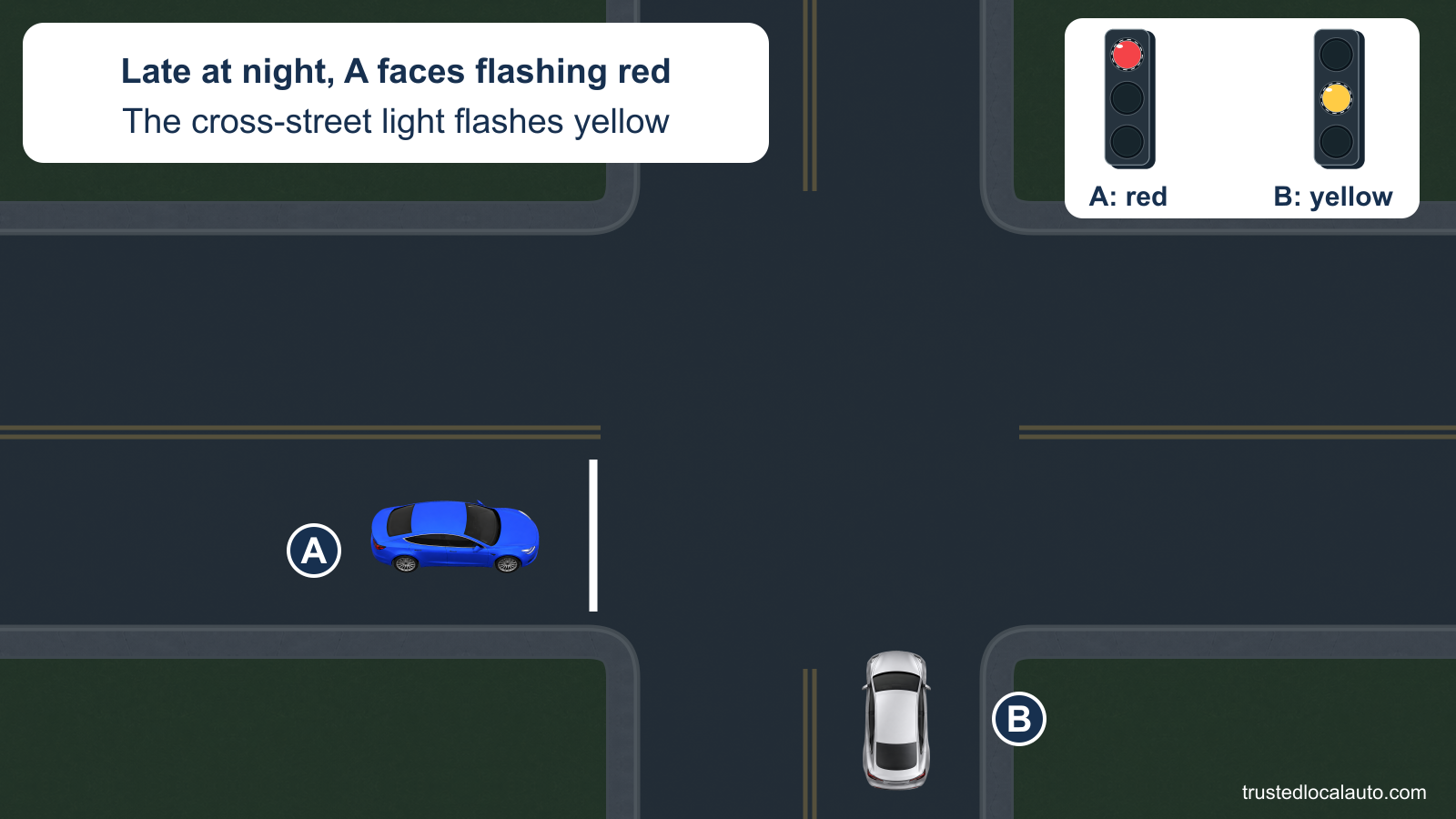
Correct answer: Stop fully, yield to cross traffic, then go when it is safe
Why
Signals often change to flashing red and yellow late at night, when traffic is light. The side with flashing red must stop and yield, while the side with flashing yellow may continue with caution. If all directions flash red, the intersection works like an all-way stop.
Verified against Rhode Island Driver's Manual online version · IV. Traffic Lights/Signals · p. 41, 42
Is this question correct and clear?
Continue learning
Related Rhode Island questions
- In the middle of a narrow city travel lane, you see a white marking painted on the road: a bicycle symbol with two chevrons (arrow points) above it. What does it tell you?
- You drive on a road with two lanes that go your way. A broken white line separates the lanes, and a slow car is ahead of you. What does this line tell you?
- You drive on a two-lane road with a double solid yellow center line. A slow truck is ahead of you, and you plan to turn left into a driveway soon. What does the line let you do?
- As you approach an intersection, the traffic signal that faces you is a flashing yellow circle. What does the signal mean for you?
- As you approach an intersection, the traffic signal facing you shows a flashing yellow circle. What should you do?
- You wait in a left-turn lane. The signal for your lane shows a flashing yellow arrow that points left. Oncoming traffic has a green light. What may you do?