
Practice question, Question 1 of 30
Passing target: 80% (24/30)
The rain has stopped, but the road is still wet. It is daytime, and there is no other problem. What minimum following time does the Rhode Island manual call for?
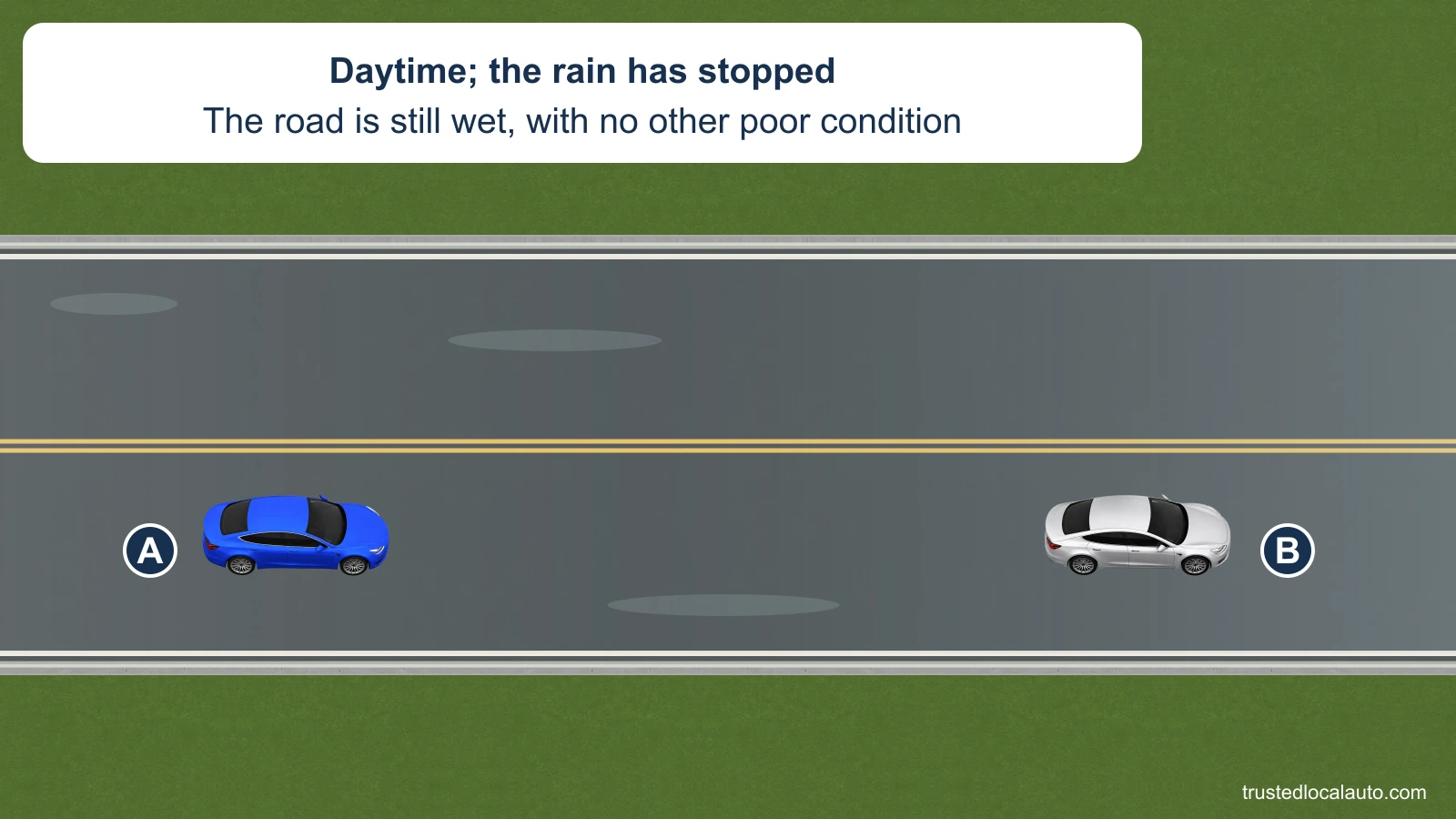
Correct answer: 4 seconds: the basic 3 seconds plus 1 second for the wet road.
Why
On a wet or icy road the tires have less grip, so the braking distance is much longer. The Rhode Island manual tells you to add 1 second of following time for each poor weather or road condition, so two poor conditions need at least 5 seconds. Also reduce your speed, because the manual says that you must drive slower on wet or icy roads.
Verified against Rhode Island Driver's Manual online version · The Three (3) Second Rule - Following Distance · p. 51, 28, 35
Is this question correct and clear?
Continue learning
Related Rhode Island questions
- The rain has stopped. In daylight you follow a car on a road that is still wet. There is no other poor weather or road condition. What minimum following time does the Rhode Island manual call for?
- In daylight you follow a car on a wet road, and there is fog. There is no other poor weather or road condition. What minimum following time does the Rhode Island manual call for?
- To get the overall picture of the road, the Rhode Island manual tells you how far ahead to look. Which pair of look-ahead distances is correct?
- The Rhode Island manual teaches the IPDE process. You see a ball roll into the street from between parked cars, and you think that a child may run after it. Which IPDE step is the thought that a child may follow?
- At night on a dark rural road, your headlights let you see only a short way ahead. The posted limit is 50 mph. How should you choose your speed?
- The temperature is near freezing. The road looks dry, and the posted limit is 45 mph. You approach a bridge in a shady area. What speed should you choose?