
Practice question, Question 1 of 30
Passing target: 80% (24/30)
At night on a dark rural road, your headlights let you see only a short way ahead. The posted limit is 50 mph. How should you choose your speed?
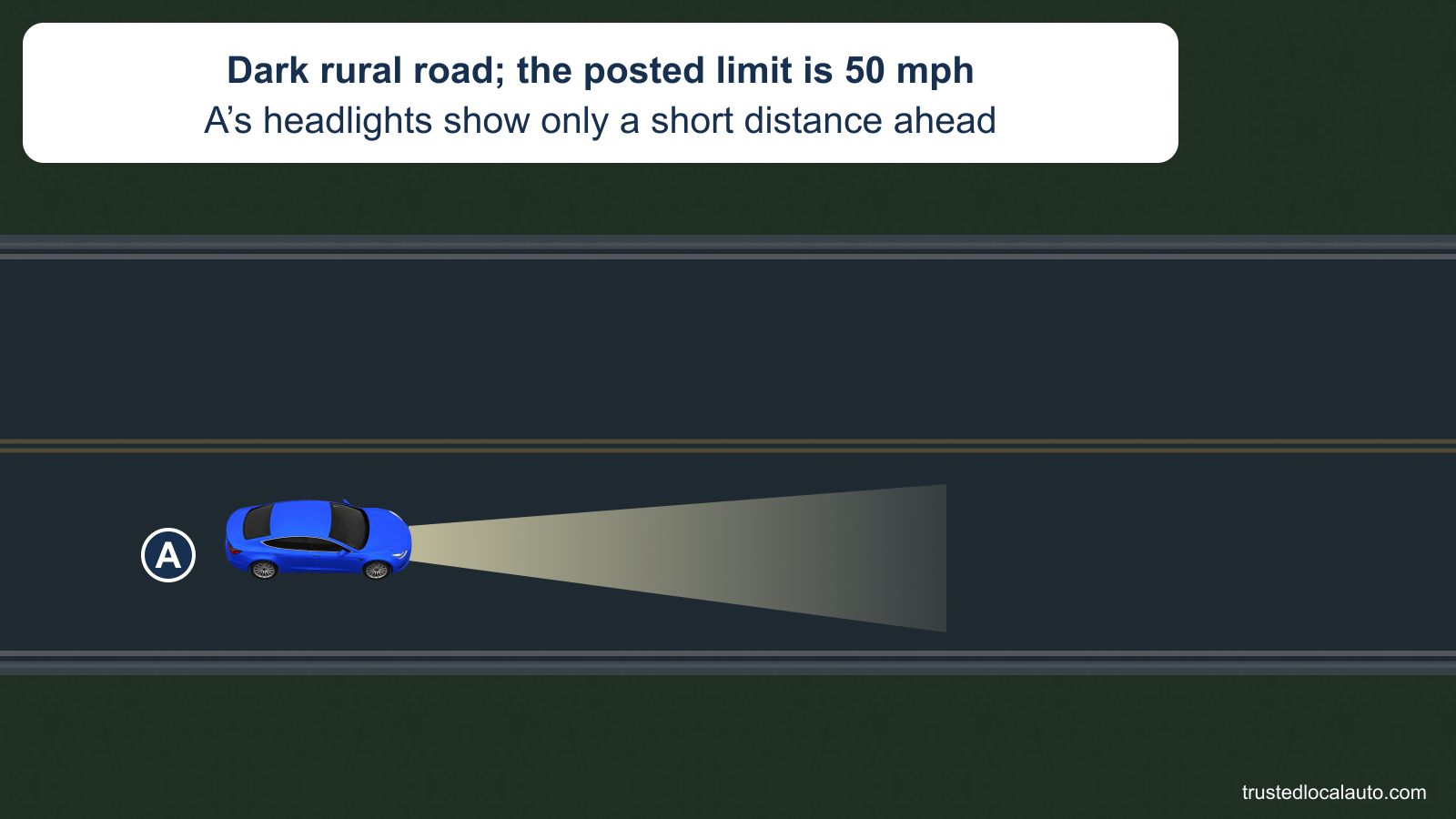
Correct answer: Drive slowly enough that you can stop within the distance your lights show.
Why
Night driving is more dangerous than day driving because you cannot see as far ahead. If you drive faster than your headlights let you see, you can reach a hazard before you see it. Use high beams on dark roads when no one is near, and dim them within 500 feet of an oncoming vehicle and within 200 feet when you follow a vehicle.
Verified against Rhode Island Driver's Manual online version · Night Driving · p. 52, 53, 36
Is this question correct and clear?
Continue learning
Related Rhode Island questions
- The rain has stopped. In daylight you follow a car on a road that is still wet. There is no other poor weather or road condition. What minimum following time does the Rhode Island manual call for?
- In daylight you follow a car on a wet road, and there is fog. There is no other poor weather or road condition. What minimum following time does the Rhode Island manual call for?
- To get the overall picture of the road, the Rhode Island manual tells you how far ahead to look. Which pair of look-ahead distances is correct?
- The Rhode Island manual teaches the IPDE process. You see a ball roll into the street from between parked cars, and you think that a child may run after it. Which IPDE step is the thought that a child may follow?
- The rain has stopped, but the road is still wet. It is daytime, and there is no other problem. What minimum following time does the Rhode Island manual call for?
- The temperature is near freezing. The road looks dry, and the posted limit is 45 mph. You approach a bridge in a shady area. What speed should you choose?