
Practice question, Question 1 of 30
Passing target: 80% (24/30)
You follow a car at a four-second gap on a highway. Snow starts to fall, the road gets slippery, and it is getting dark. What should you do with your following gap?
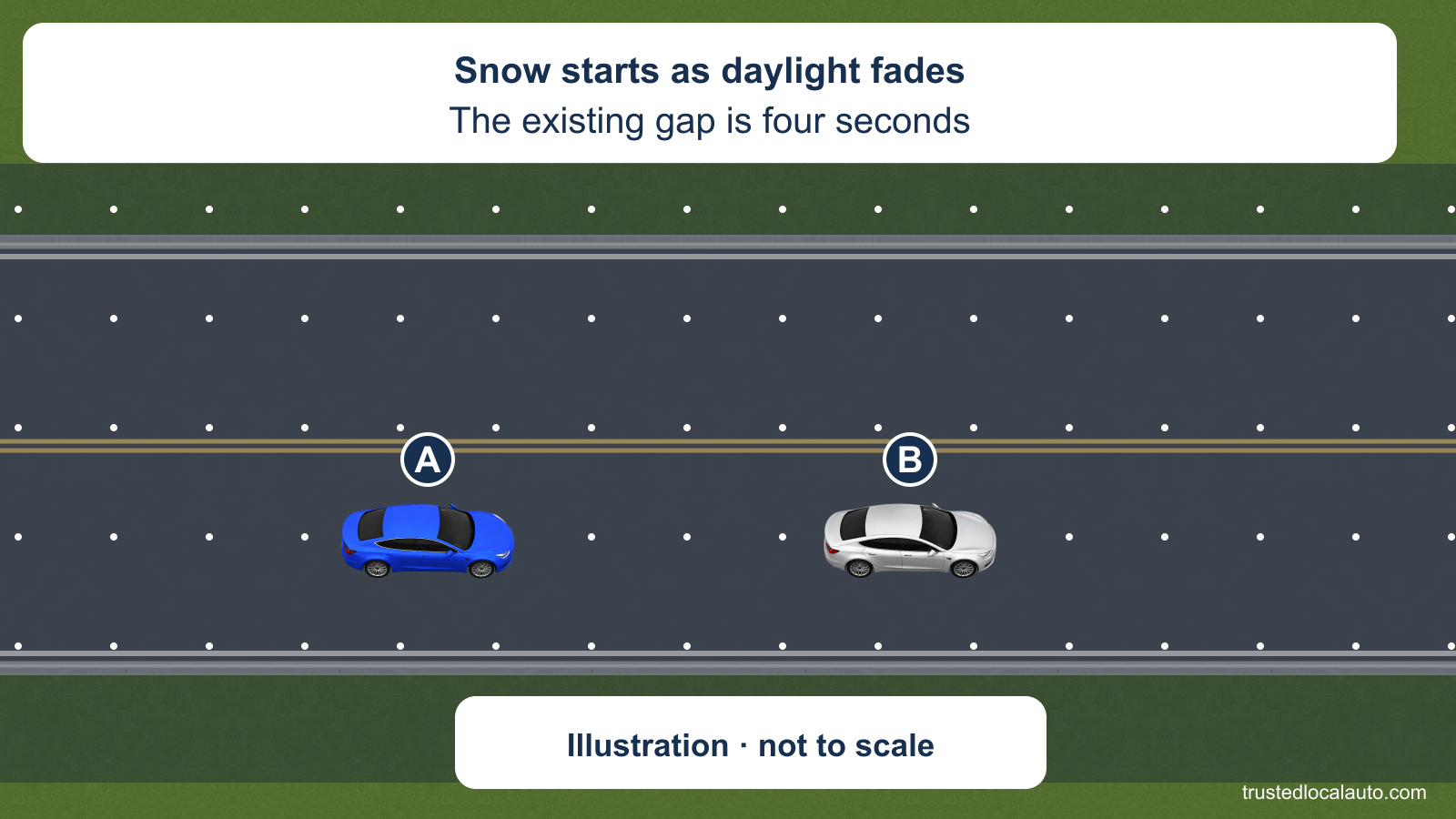
Correct answer: Make it longer than four seconds, because you now need more distance to see and to stop.
Why
The four-second gap is the minimum for good conditions. Increase it on slippery roads, in darkness or bad weather, behind motorcycles and large vehicles, and when a driver follows you closely. South Dakota law also requires a following distance that suits the speed, the traffic and the condition of the highway (SDCL 32-26-40).
Verified against South Dakota Driver License Manual · Following distance · p. 51, 66
Is this question correct and clear?
Continue learning
Related South Dakota questions
- On a dry road in daylight, the car ahead passes a road sign. You count, and your front bumper reaches the same sign at "one thousand three." What should you do?
- You drive at 50 mph on dry pavement, and a hazard appears ahead. Your perception and reaction take about 1 1/2 to 2 seconds. About how far does your car travel before the brakes start to work?
- On a dry city street in daylight, you count a three-second gap to the car ahead. Which statement is correct?
- On a dry road in daylight, the car ahead passes a road sign. You count, and your front bumper reaches the same sign at "one thousand two." What should you do?
- You drive at night on a dark rural highway. Your headlights light only a limited distance ahead. How should you choose your speed?
- The manual tells you to look about 20 to 30 seconds ahead. You drive at 60 mph on an open highway, which is about one mile each minute. About how far ahead is that?