
Practice question, Question 1 of 40
Passing target: 70% (28/40)
You drive at 25 mph on a dry city street in good weather. The car ahead passes a light pole, and your car reaches the pole about 1 second later. What is true about your gap?
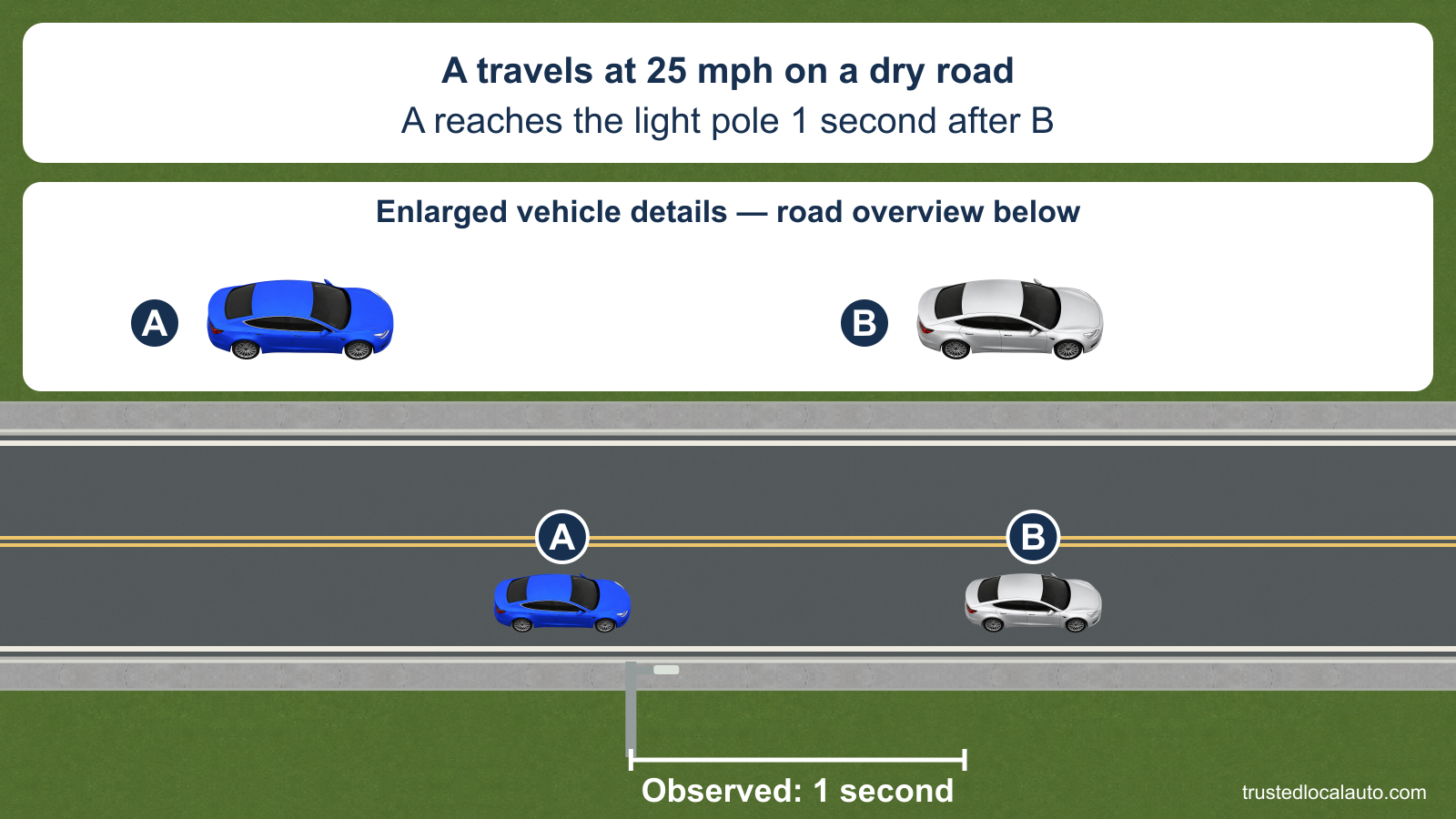
Correct answer: It is too short, because at 30 mph or less you need at least 2 seconds.
Why
Use a fixed object such as a pole or a sign to count your gap: if you reach it less than 2 seconds after the car ahead, you are too close. City traffic can stop suddenly, and a short gap leaves no time to react. The handbook calls a 4-second gap the best practice for new drivers, and every driver needs more time when the road is wet or crowded.
Verified against Texas Driver Handbook · Following Distance · p. 51
Is this question correct and clear?
Continue learning
Related Texas questions
- You use an alley behind a row of shops in a Texas town to reach a delivery door. No speed limit sign is posted in the alley. What is the highest speed that Texas law sets for you there?
- You drive at exactly 30 mph on a dry street in good weather. Under the handbook's following-distance rule, what is the minimum gap behind the car ahead?
- You drive at 55 mph on a dry highway in good weather. The car ahead passes a road sign, and you count: your car reaches the same sign 3 seconds later. Under the handbook's following-distance rule for your speed, what is true about your gap?
- Outside an urban district, no speed limit sign is posted and conditions are good. What is the highest lawful speed for a car on each of these roads?
- On a highway with two lanes in your direction, you drive in the left lane. For the last mile, your car has stayed just behind the left-rear corner of a car in the right lane, at the same speed. What should you do?
- In good weather, you drive at 25 mph on a dry city street. Later, you drive at 55 mph on a dry highway. Under the handbook's following-distance rule, what is the minimum gap behind the car ahead at each speed?