
Practice question, Question 1 of 40
Passing target: 70% (28/40)
At night on a two-lane road, an oncoming driver does not dim the high beams, and the glare makes it hard for you to see. Where should you look?
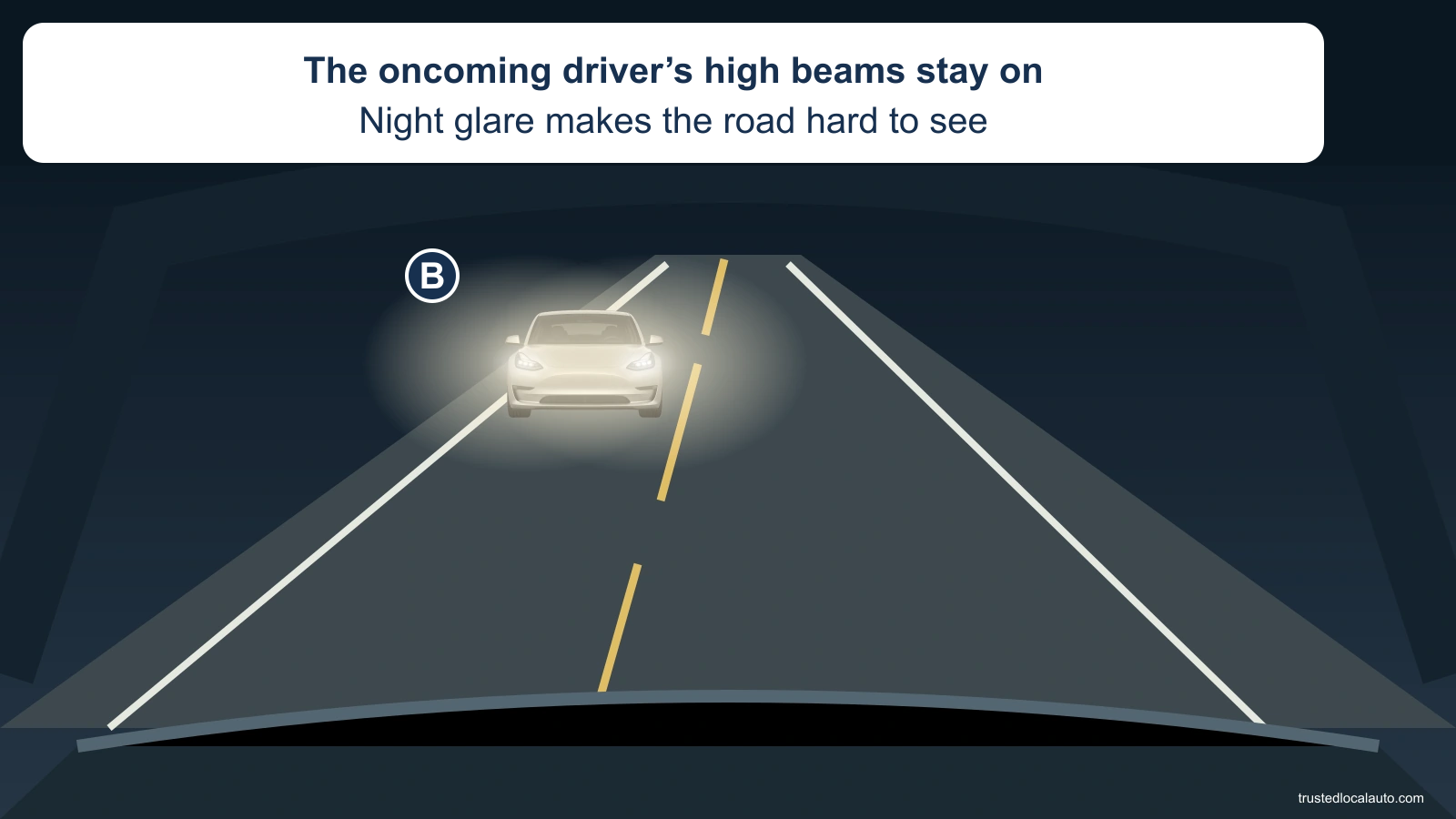
Correct answer: Toward the lower right side of your own lane
Why
Bright lights can blind you for several seconds, and your eyes need time to recover after the car passes. The right edge of your lane helps you stay on course while you keep the glare out of your direct view. Slow down if you cannot see well, and do not answer with your own high beams, because then two drivers cannot see.
Verified against Texas Driver Handbook · Headlights · p. 53
Is this question correct and clear?
Continue learning
Related Texas questions
- As you come toward a red light that is still far ahead, you press the brake pedal and it sinks to the floor. The car does not slow down. What should you do?
- At night you drive onto a low road that you thought was clear. The water is deeper than it looked, your engine stalls, and the water around the car is rising. What should you do?
- On a cold morning, your car is parked in your closed home garage. You want to warm it up before you drive to school. What should you do?
- You drive an automatic car down a long hill. A friend tells you to shift into neutral and let the car roll to save fuel. What should you do?
- You drive with high beams on a dark rural road. Around a curve, an oncoming car comes into view about 400 feet ahead. What does Texas law require you to do with your high beams?
- At night you follow another car on an unlit highway with your high beams on. Within what distance behind that car must you switch to low beams?