
Practice question, Question 1 of 40
Passing target: 85% (34/40)
Late at night, the signal at an intersection flashes red for your direction and flashes yellow for the cross street. What must you do?
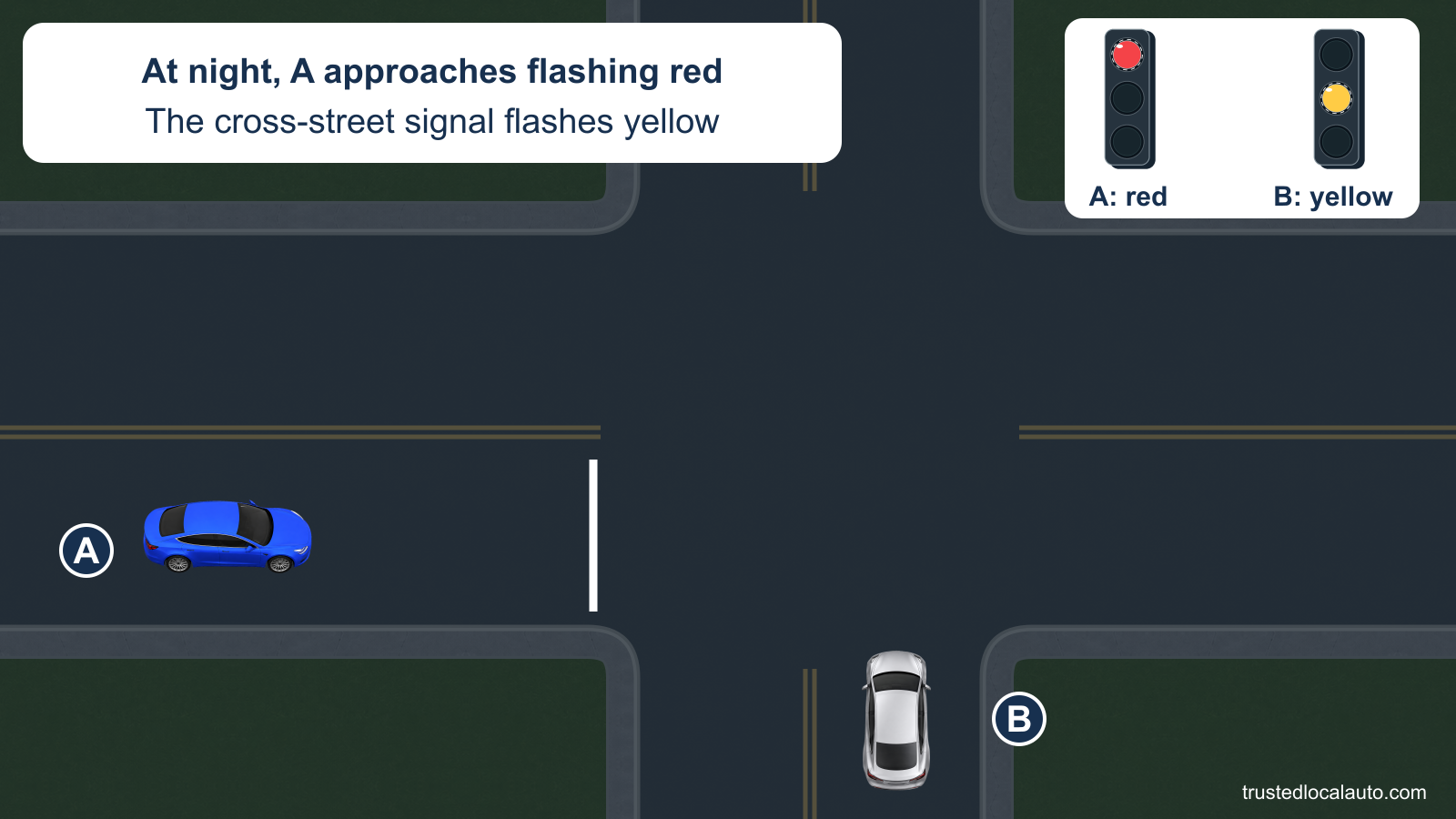
Correct answer: Stop completely, yield, and go when the way is clear
Why
When one road has a flashing red light and the other has a flashing yellow light, drivers on the yellow may keep moving with care. Thus, after your stop, you must wait for a safe gap. A dark signal is different: with no lights at all, treat the intersection as an all-way stop. At a railroad crossing, flashing red lights mean that you must stop even if you do not see a train.
Verified against Virginia Driver's Manual · Flashing red light · p. 7
Is this question correct and clear?
Continue learning
Related Virginia questions
- As you near an intersection, you see that your lane has a white curved arrow that points left and the word ONLY painted on it. You want to go straight. What should you do?
- On an expressway, double solid white lines separate your lane from an HOV lane on your left. Your vehicle meets the HOV rules, and you want to use that lane. What must you do?
- Late at night, the signal at an intersection flashes red for your direction and flashes yellow for the cross street. A car on the cross street comes toward the intersection. What must you do?
- At an intersection, the traffic signal that faces you shows a circular yellow light that keeps flashing. What does this mean?
- You are in a left-turn lane. The signal for your lane shows a flashing yellow arrow. An oncoming car is close to the intersection, and the crosswalk that you will cross is empty. What does the signal let you do?
- You drive under overhead lane signals on a busy road. The signal above your lane changes from a green arrow to a steady yellow X. What should you do?