
Practice question, Question 1 of 40
Passing target: 80% (32/40)
Your lane ends ahead, and traffic in the next lane moves steadily at about 40 mph. Beside you is a small gap, about one car length long. A larger gap is a few car lengths farther back. What should you do?
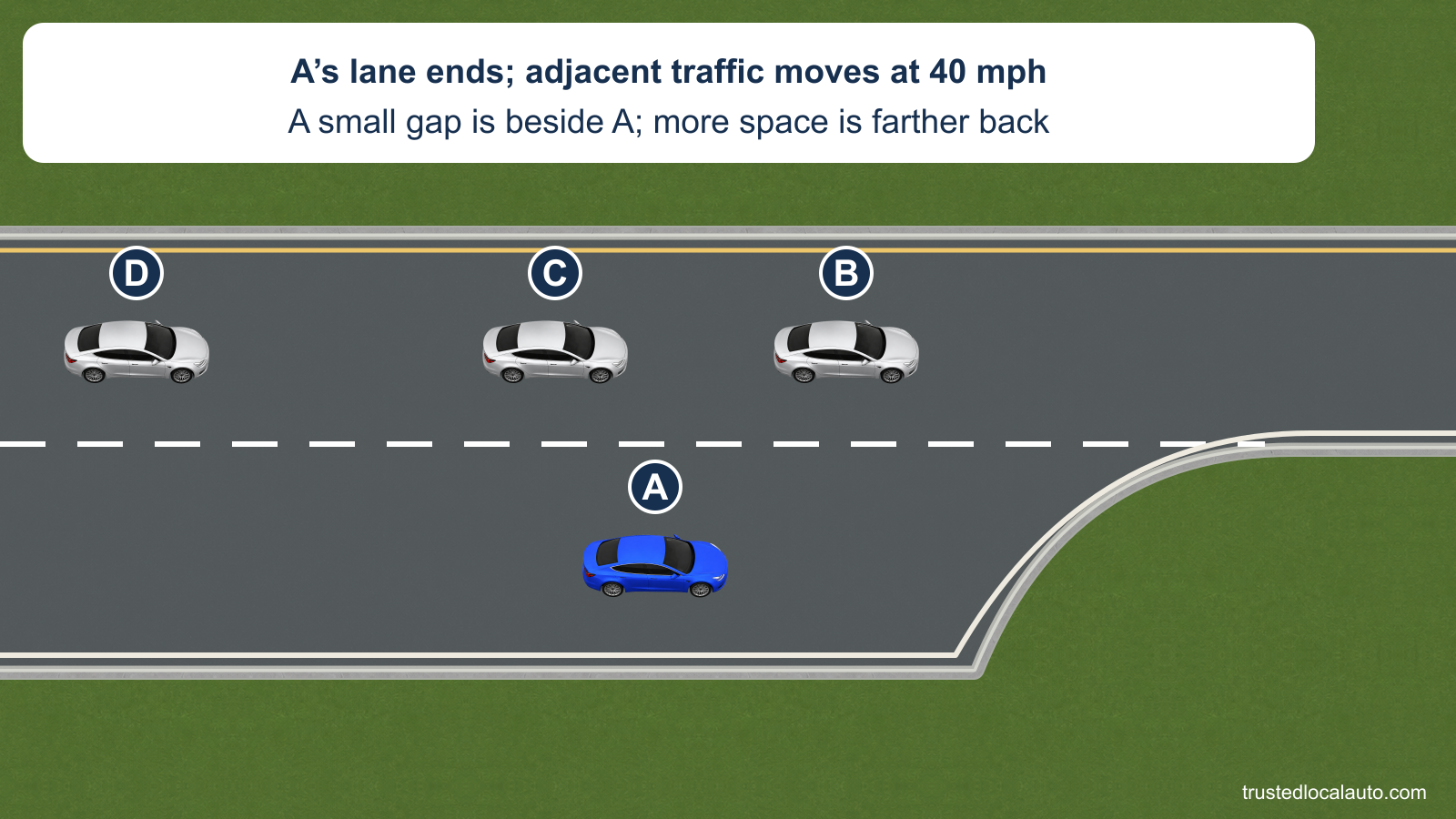
Correct answer: Signal, adjust your speed, and merge into the larger gap
Why
A merge needs space in front of you and behind you. If you squeeze into a small gap and the driver ahead slows down, you have no room to stop, and the driver behind you must brake hard. In slow or stopped traffic at a lane closure, the guide recommends the zipper merge instead.
Verified against Washington Driver Guide · Merging · p. 159, 160
Is this question correct and clear?
Continue learning
Related Washington questions
- A freeway HOV lane has the diamond symbol, and its sign says that the lane is for vehicles with 3 or more people at this time. Which vehicle may use the lane now?
- You are near the end of a freeway on-ramp. A car in the right freeway lane is almost beside you, and there is an open space just behind it. What should you do?
- You drive a loaded pickup at 40 mph on a two-lane highway where traffic normally moves at 55 mph. Oncoming traffic makes passing unsafe, and six vehicles are now in a line behind you. A wide, paved turnout is just ahead. What should you do?
- A freeway HOV lane has the diamond symbol, and its sign says that the lane is for vehicles with 3 or more people at this time. You drive an ordinary car. What is the smallest number of passengers who must ride with you?
- A freeway HOV lane has the diamond symbol, and its sign says that the lane is for vehicles with 3 or more people at this time. Traffic in the other lanes is slow. Which of these vehicles may use the HOV lane now?
- You drive in the left lane of a busy freeway. You suddenly see that your exit ramp starts a few hundred feet ahead on the right, across two lanes of traffic. What should you do?