
Practice question, Question 1 of 30
Passing target: 80% (24/30)
On a dry road in daylight, the car ahead passes a road sign. You start to count "one thousand one, one thousand two," and your front bumper reaches the same sign as you say "two." What does this tell you?
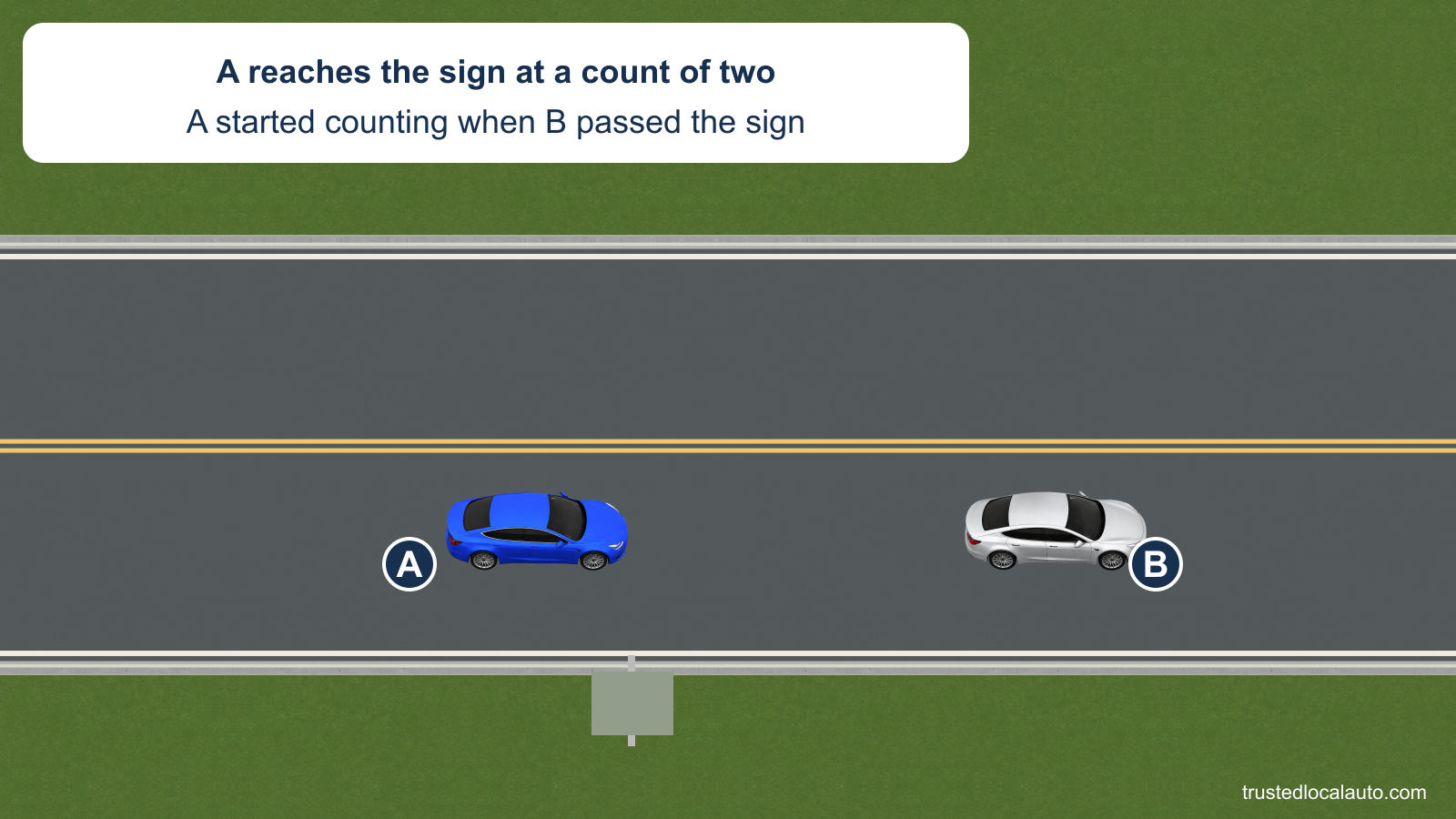
Correct answer: Your gap is too short; drop back until the count reaches at least three.
Why
Following too closely causes most rear-end crashes, and the space ahead is the space that you control best. The three-to-four-second check works at any speed: pick a fixed object, start to count when the car ahead passes it, and see whether you reach it before you finish "one thousand three." If you do, ease off the accelerator and let the gap grow instead of braking hard.
Verified against West Virginia Driver's Licensing Handbook · Following Distance · p. 57
Is this question correct and clear?
Continue learning
Related West Virginia questions
- You leave a 55 mph highway and enter a town's business district, with stores and offices on both sides of the street. You have not seen a speed-limit sign yet. What is the highest speed allowed here?
- You are driving at night in steady rain. The car ahead passes a mile marker, and you reach the marker just as you finish "one thousand three." What is the smallest following gap you should keep in these conditions?
- You drive at night on a dry, clear road with light traffic. What is the smallest following gap that the manual calls for in these conditions?
- At night on a dark two-lane road, you drive with your high beams on about 300 feet behind another car. Then an oncoming car appears about 450 feet ahead of you. What must you do?
- At night on a dark road, no oncoming traffic is in sight. You drive with your high beams on about 180 feet behind another car. Which statement is correct?
- At night you drive with your high beams on. West Virginia law sets the distance at which you must switch to low beams. Which pair of distances is correct?