
Practice question, Question 1 of 50
Passing target: 80% (40/50)
In good weather and road conditions on an ordinary road, rather than a high-speed road, what minimum following time does ICBC recommend behind a passenger car?
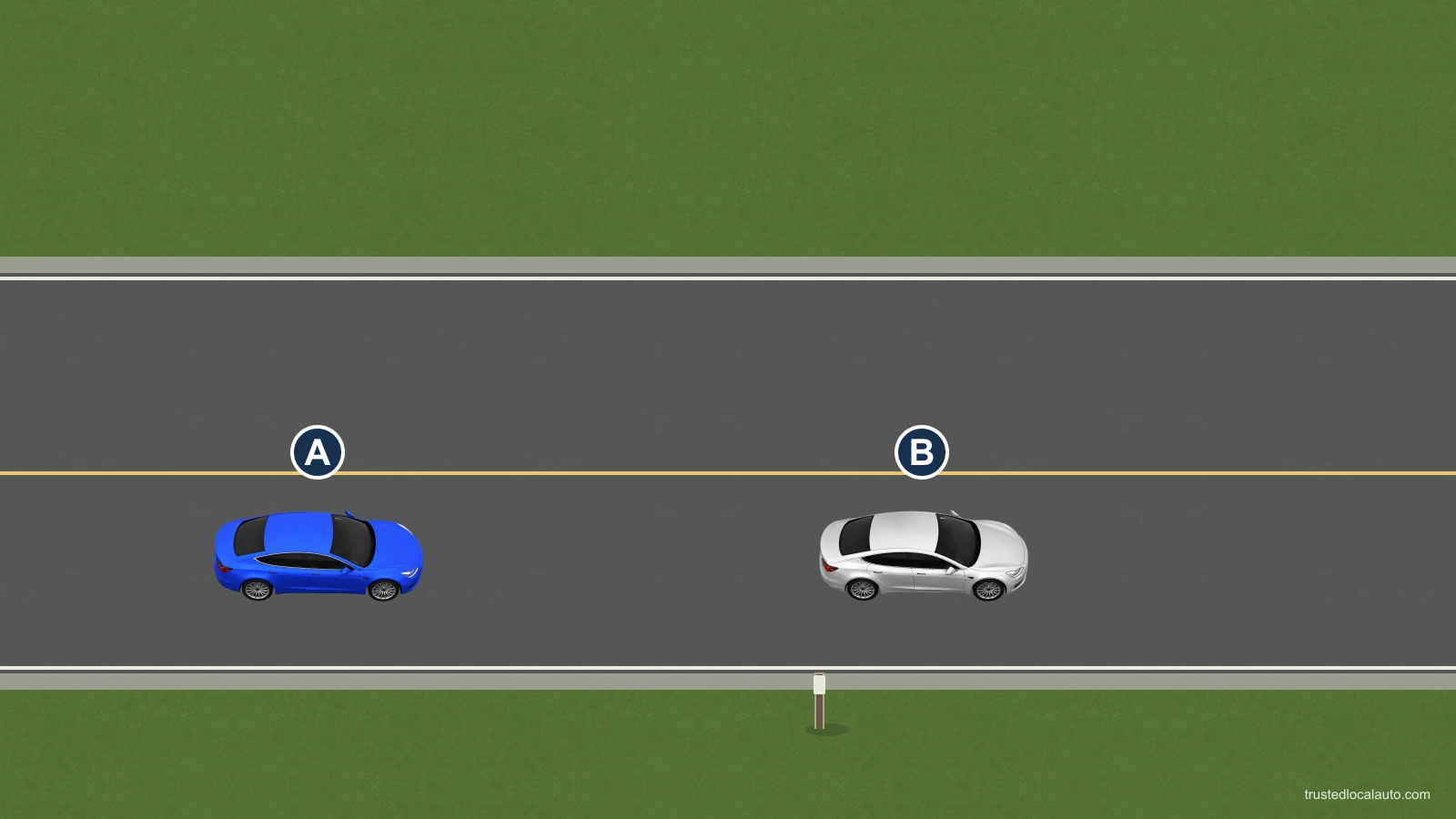
Correct answer: At least two seconds
Why
Leave at least two seconds in ordinary good conditions. Pick a fixed object: start counting when the lead vehicle passes it and check that your vehicle does not reach it too soon. ICBC increases the recommendation to three seconds on high-speed roads and four seconds in bad weather or on uneven or slippery roads. At least three seconds is recommended behind a motorcycle or a large vehicle blocking your view. These are handbook timing guidelines; the law requires a reasonable and prudent gap for the conditions.
Verified against Learn to drive smart: your guide to driving safely · Chapter 5 — Space in front: the two-second rule · p. 84
Is this question correct and clear?
Continue learning
Related British Columbia questions
- Where should you avoid travelling relative to another vehicle?
- You drive a car with a manual transmission down a long hill. Which statement is correct?
- What does it mean to cover the brake?
- If traction begins to break in a curve, what should you do?
- You pass a cyclist who rides on the roadway. On one road the speed limit is exactly 50 km/h; on another road it is 60 km/h. What are the minimum passing clearances on these two roads?
- No speed sign is posted on a BC highway, and no special limit applies. Which pair gives BC's general default speed limits?