
Practice question, Question 1 of 40
Passing target: 80% (32/40)
A police vehicle is stopped on your right shoulder with emergency lights operating in a 90 km/h zone. A second lane in your direction is clear. What must you do?
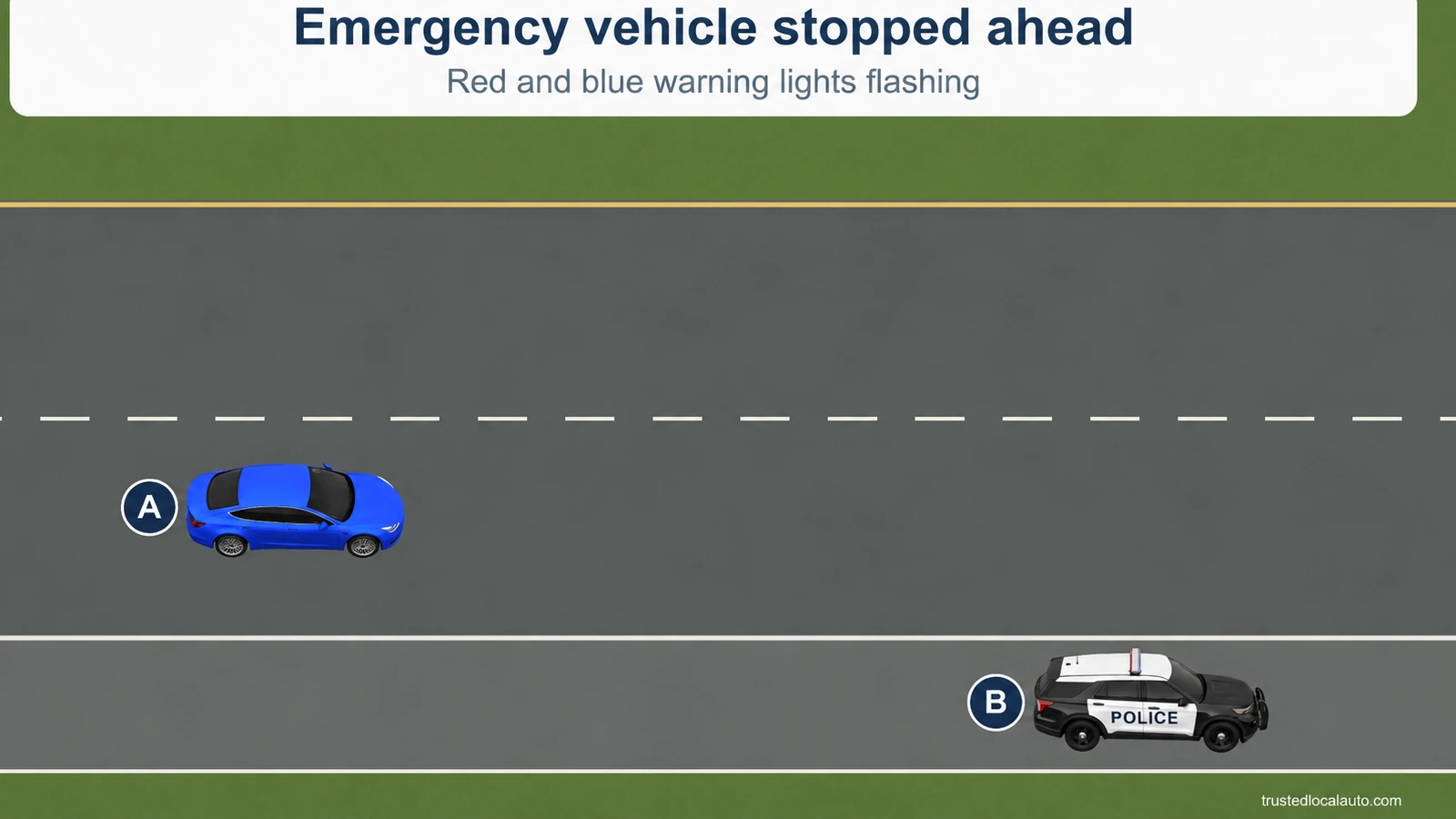
Correct answer: Slow to 60 km/h or less and move to the far lane when safe.
Why
For a qualifying stopped emergency or designated roadside vehicle, proceed cautiously and pass only when safe. The maximum is 40 km/h where the limit is over 40 but below 80, and 60 km/h where it is 80 or higher; a lower posted limit still applies. Move to a farther lane when you occupy the same or adjoining lane, another same-direction lane exists and the move is safe. The opposite roadway of a divided highway is excepted.
Verified against MPI Driver's Handbook · Driving responsibly · p. 64, 65
Is this question correct and clear?
Continue learning
Related Manitoba questions
- Traffic is being redirected through a construction zone. What should you do?
- A police vehicle is stopped on the right shoulder with its emergency lights operating. The posted limit is exactly 80 km/h, and the road has only one lane in your direction. What is the maximum speed that applies when you pass it?
- A railway gate is lowered and the red warning lights are flashing. No officer or railway flagperson is directing you through. What should you do?
- A child is near the road beside a school or playground. How should you respond?
- A police vehicle is stopped on the roadside with its emergency lights operating. What maximum speed applies when you pass it in a zone with a posted limit of 70 km/h, and in a zone with a posted limit of 100 km/h?
- What stopping clearance does MPI's Driver's Handbook advise at railway crossings in restricted-speed areas and elsewhere?