
Back to Minnesota
Minnesota Class D Knowledge Practice Test
Full test preview Question 1 of 30
0 answered 30 remaining
Passing target: 80% (24/30)
Traffic Signals & Road MarkingsStandalone practice
You drive on a road where the line between your lane and the next lane is a line of white dashes. What does this line tell you?
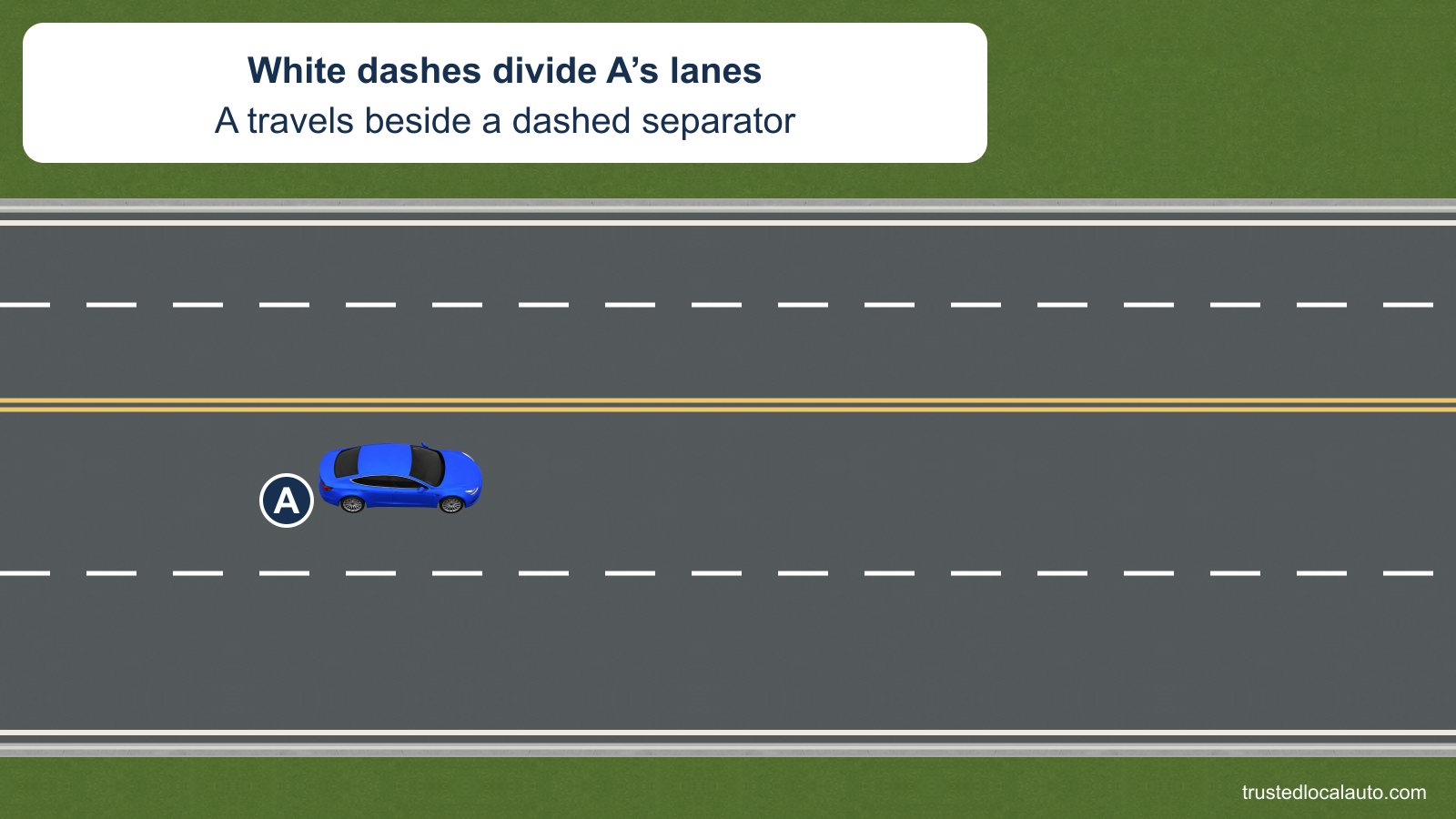
A travels beside a broken white lane separator; no chosen lane change is drawn.
Correct answer: Both lanes go your way, and you may change lanes when it is safe
Why
The color of a line tells you the direction of traffic: white for the same direction, yellow for opposite directions. The pattern tells you what you may do: dashes allow a lane change, and solid lines tell you to stay in your lane. Even where a lane change is allowed, you must first check that the lane is clear and signal.
Verified against Minnesota Driver's Manual · Pavement markings: white lines · p. 72
Report a question issueContinue learning
Related Minnesota questions
A road has one lane in each direction and a center lane. Each edge of the center lane has a solid yellow line with a dashed yellow line beside it, on the center-lane side. How may you use the center lane?On a multilane road, two solid white lines separate your lane from the next lane, which goes the same way. What do these lines tell you?You walk to a street corner to cross. The DON'T WALK hand is flashing, and you have not stepped into the street yet. What should you do?Late at night, the traffic light for your direction flashes red. The light for the cross street flashes yellow, and a car on the cross street is close to the intersection. What must you do?The traffic light for your direction flashes yellow. You want to turn left, and an oncoming car is close to the intersection. What should you do?At an intersection, a police officer directs traffic. The officer waves you through, but your traffic light is red. What should you do?