
Practice question, Question 1 of 30
Passing target: 80% (24/30)
Your car stalls on railroad tracks, and a train is coming toward the crossing from your left. You and your passenger get out at once. Where should you go?
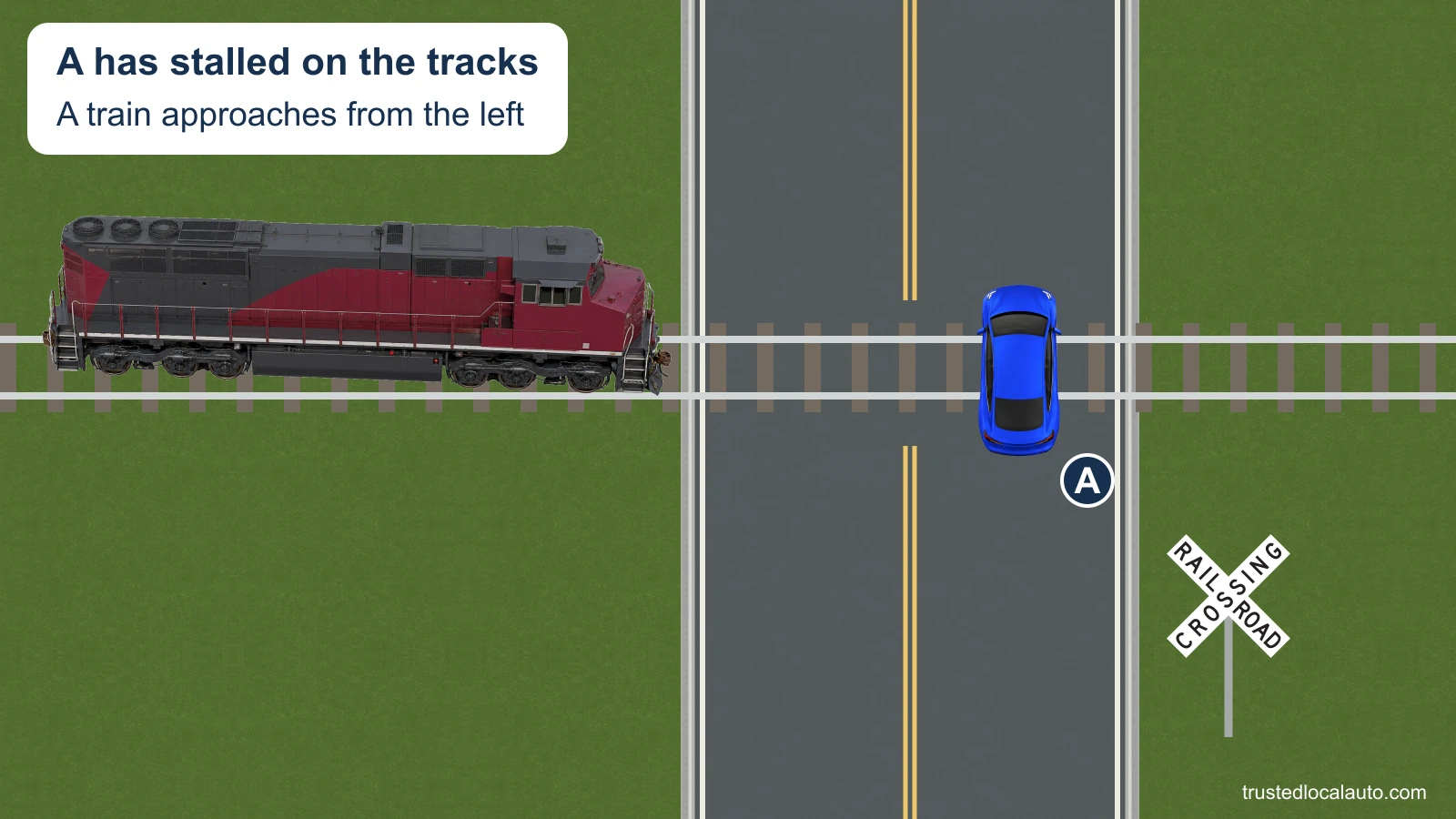
Correct answer: Away from the tracks at an angle, toward the side the train is coming from
Why
Get everyone out of the car immediately; do not stay in it to try to start it again. When a train hits a car, the car and its pieces are thrown forward along the tracks in the direction that the train moves. A path at an angle toward the train's side keeps you clear of them. Move well away from the tracks and stay there.
Verified against Minnesota Driver's Manual · Stalling on railroad tracks · p. 88
Is this question correct and clear?
Continue learning
Related Minnesota questions
- At a railroad crossing, you see that a car has stalled on the tracks and its driver has left it there. No train is in sight, and the crossing lights are not flashing. You are parked in a safe place away from the tracks. What is the best way to get trains stopped or slowed before they reach this crossing?
- You follow an empty school bus on a two-lane road. It comes to a railroad crossing that has no lights or gates, and no train is in sight. What should you expect the bus driver to do?
- Near a school, a student safety patrol member steps to the edge of the street and holds a flag out to stop traffic. A line of children starts to cross the street in front of your car. What must you do?
- One lane of a two-lane highway is closed for road work. You are first in line, and the flagger holds the STOP side of the paddle toward you. After a short wait, the last car from the other direction goes past you, and the open lane ahead looks empty. What should you do?
- You approach a railroad crossing. The red lights start to flash and the bells ring, but the gate arm has not started to come down, and you do not see a train. What must you do?
- You drive on a freeway with a 65 mph speed limit. You pass a sign that sets a 45 mph speed limit for a work zone. Farther on, no sign has marked the end of the work zone yet. At this point you see no workers, and the lane ahead is clear. Which statement is correct?