
Practice question, Question 1 of 25
Passing target: 80% (20/25)
You are driving at night on an open rural highway with your high beams on. When should you switch to low beams?
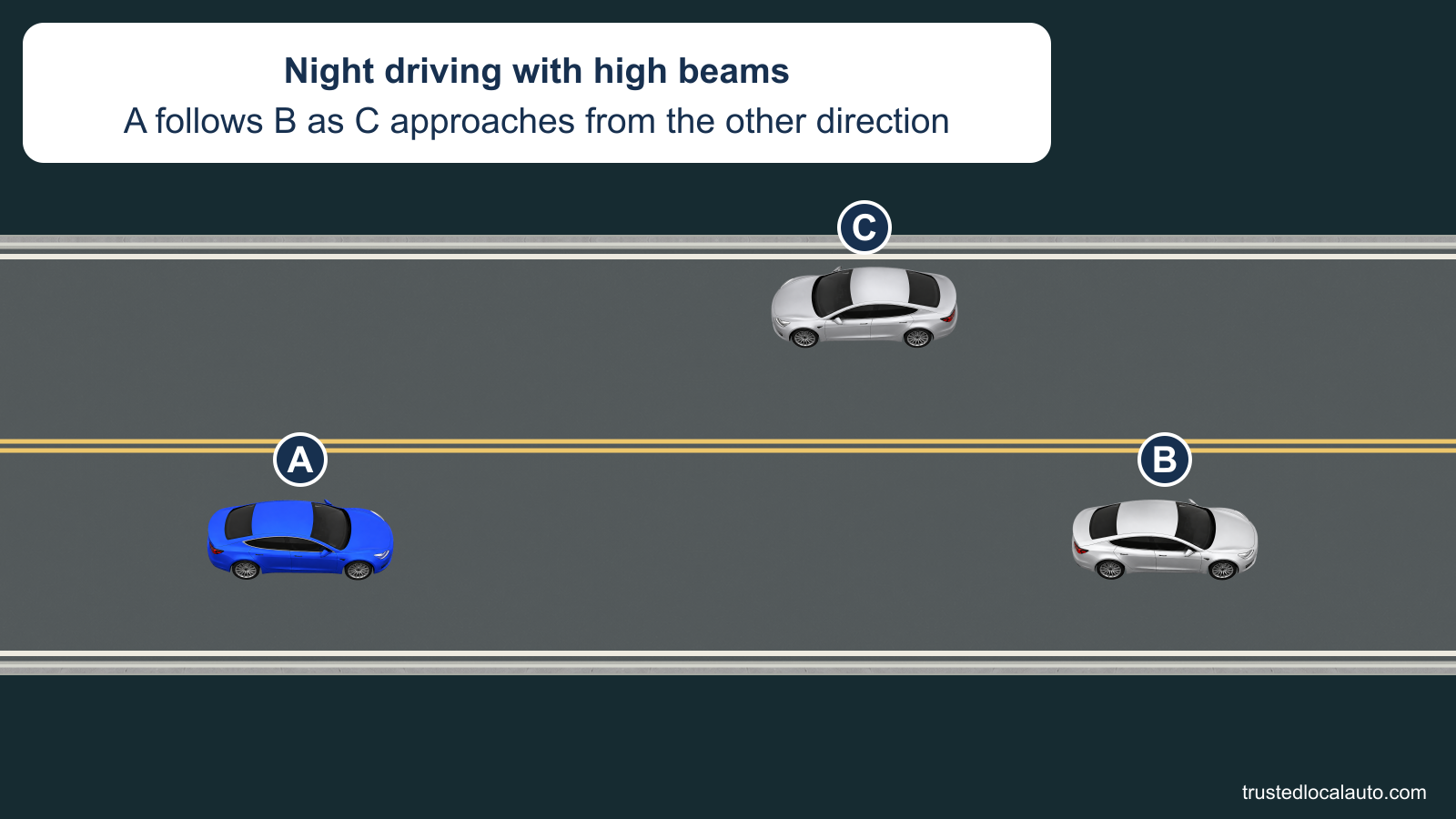
Correct answer: When you meet an oncoming vehicle and when you follow within 200 feet of another vehicle.
Why
High beams let you see farther on dark, open roads, but their glare can blind a driver coming toward you or reflect into the mirrors of the driver ahead. Nebraska law sets the 200-foot rule for following and also requires you to dim when an oncoming driver signals you. Turn off any auxiliary driving lights at the same time that you dim your headlights.
Verified against Nebraska Class O Driver's Manual · Night driving · p. 69
Is this question correct and clear?
Continue learning
Related Nebraska questions
- Your car has antilock brakes (ABS). A vehicle stops suddenly ahead of you on an icy road, and you must stop quickly. How should you use the brakes?
- At dusk on a rural highway, a deer runs onto the road just ahead of your car, and you cannot stop in time to miss it. What does the Nebraska manual say is the safest action?
- The highway is covered with packed snow, and you want to lower your chance of a skid. Which plan follows the Nebraska manual?
- When fog cuts visibility below a set distance, the Nebraska manual advises you not to travel on roads posted at or above a set speed. Which pair of values is correct?
- At night, the headlights of an oncoming car are very bright and make it hard for you to see. Where should you look until the car passes?
- Thick fog forms while you are driving on a two-lane highway in the early evening. What should you do with your lights and your speed?