
Practice question, Question 1 of 40
Passing target: 80% (32/40)
At night, the signal facing you flashes yellow. The signal for the cross street flashes red, and a car on the cross street has stopped at its stop line. What should you do?
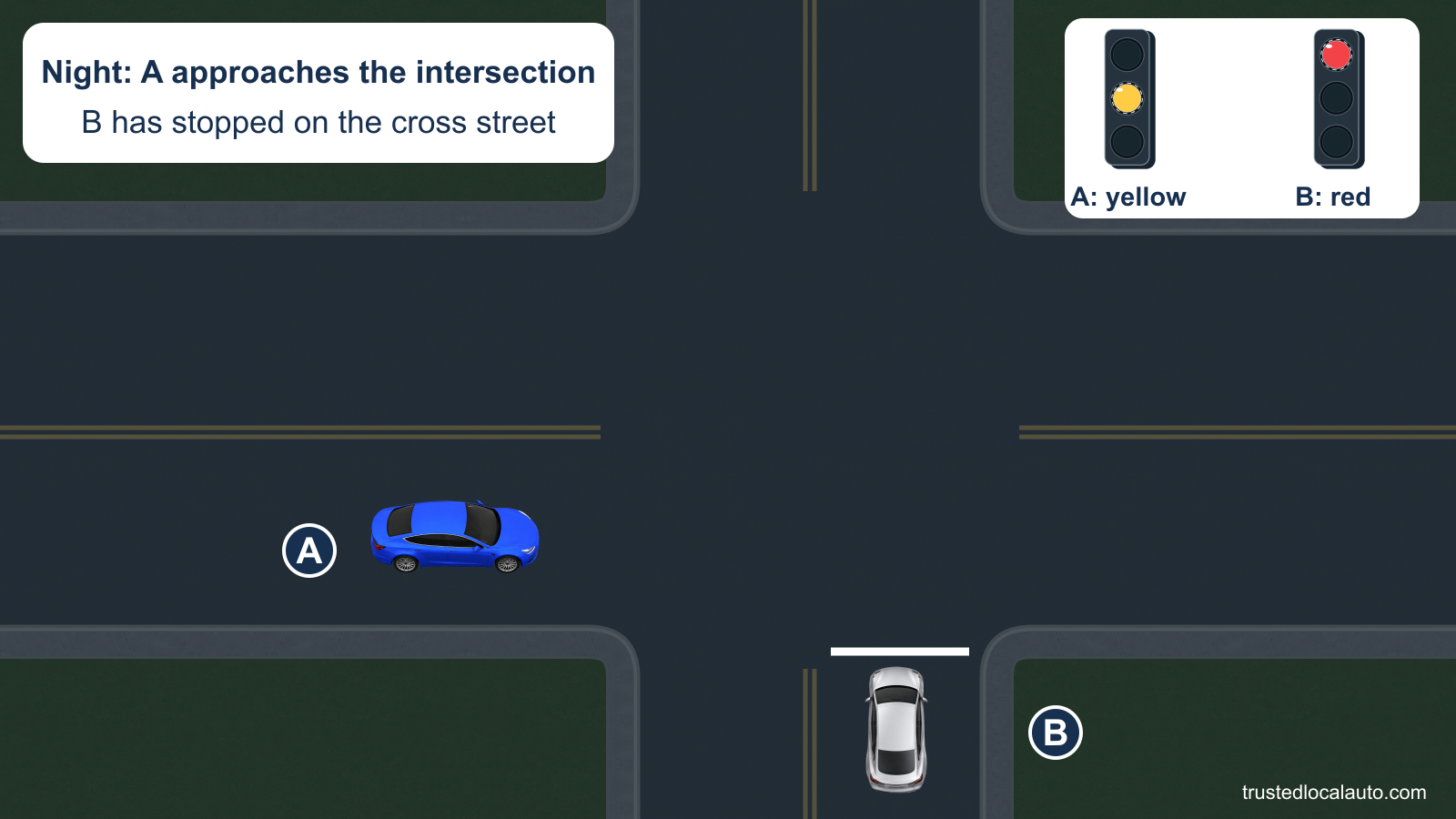
Correct answer: Slow down, watch the stopped car, and go through with care, ready to stop.
Why
Flashing signals are often used at night or at quieter intersections, with yellow for the main road and red for the cross street. The driver who faces the flashing red must stop and then yield, as at a stop sign, but that driver may misjudge your speed and pull out. Compare: a flashing red means stop first, and a steady yellow means that the light is about to turn red.
Verified against New Hampshire Driver's Manual · Signal lights · p. 26
Is this question correct and clear?
Continue learning
Related New Hampshire questions
- On a two-lane road with double solid yellow center lines, you come up behind a bicyclist in your lane. You can see that the oncoming lane is clear well ahead. Which statement is correct?
- You drive on a road where a broken white line separates your lane from the lane on your left. You want to move left to get around a slow car. Where must you look for traffic that could hit you when you move over?
- You follow a slow car on a two-lane road. Double solid yellow lines mark the center, and they continue over a hill as far as you can see. What may you do?
- On a two-lane road, you follow a slow car into a long curve. Double solid yellow lines mark the center, and you cannot see where they end. The oncoming lane looks clear for now. Which statement is correct?
- Late at night, the signal facing you flashes red. The signal for the cross street flashes yellow, and a car on the cross street is about to reach the intersection. What must you do?
- Late at night, the signal facing you flashes red. The signal for the cross street flashes yellow, and a car on the cross street is about to reach the intersection. What should you do?