
Back to New Hampshire
New Hampshire Non-Commercial Operator Knowledge Practice Test
Full test preview Question 1 of 40
0 answered 40 remaining
Passing target: 80% (32/40)
Freeways & High-Speed RoadsStandalone practice
Your highway exit has a deceleration lane, and the traffic in your lane moves at 65 mph. Where should you slow down to the exit speed?
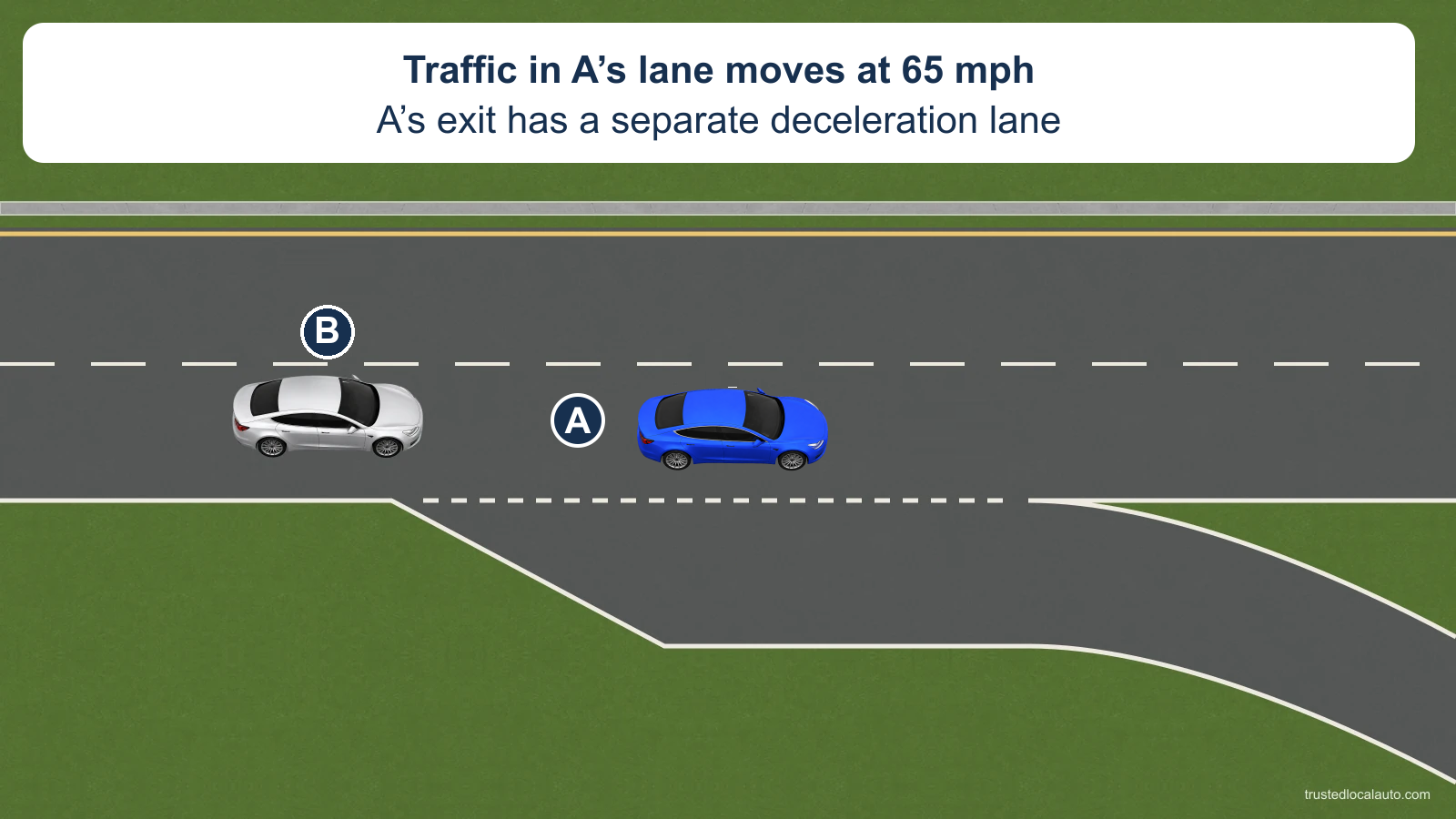
A travels ahead of B in the right highway lane beside a separate deceleration lane. The card states that traffic in A’s travel lane moves at 65 mph.
Correct answer: In the deceleration lane, after you signal and move out of the travel lane
Why
The deceleration lane lets you lose speed without slowing the traffic that you leave. Signal early, move over at highway speed, and then brake smoothly to the posted exit speed. Watch for a curve or a line of cars at the end of the ramp.
Verified against New Hampshire Driver's Manual · Leaving high-speed traffic · p. 22
Report a question issueContinue learning
Related New Hampshire questions
You plan a 6-hour drive, mostly on the interstate. How often does the New Hampshire manual advise you to stop for a break to help avoid fatigue?On a 30 mph road, you stayed about 180 feet behind the car ahead, which was about a four-second gap. Now you drive at 60 mph on a highway, still about 180 feet behind the car ahead. What should you do?Traffic on a divided highway slows to a crawl. The paved breakdown lane on the right is empty, and your exit is half a mile ahead. What is the rule for the breakdown lane?Which statement about the maximum speed limits on New Hampshire interstates is correct?You drive at 60 mph in the left lane of a four-lane interstate with a 65 mph limit. Several cars are lined up behind you, and the right lane is clear. What should you do?Heavy snow falls on an interstate highway. Traffic in your lane moves steadily at about 35 mph, a speed that fits the road and the view, and 45 mph would be too fast on this snow. What speed should you drive?