
Practice question, Question 1 of 40
Passing target: 80% (32/40)
On a two-lane road, the center has a broken yellow line on your side and a solid yellow line on the side of oncoming traffic. A slow car is ahead of you. What do these lines tell you?
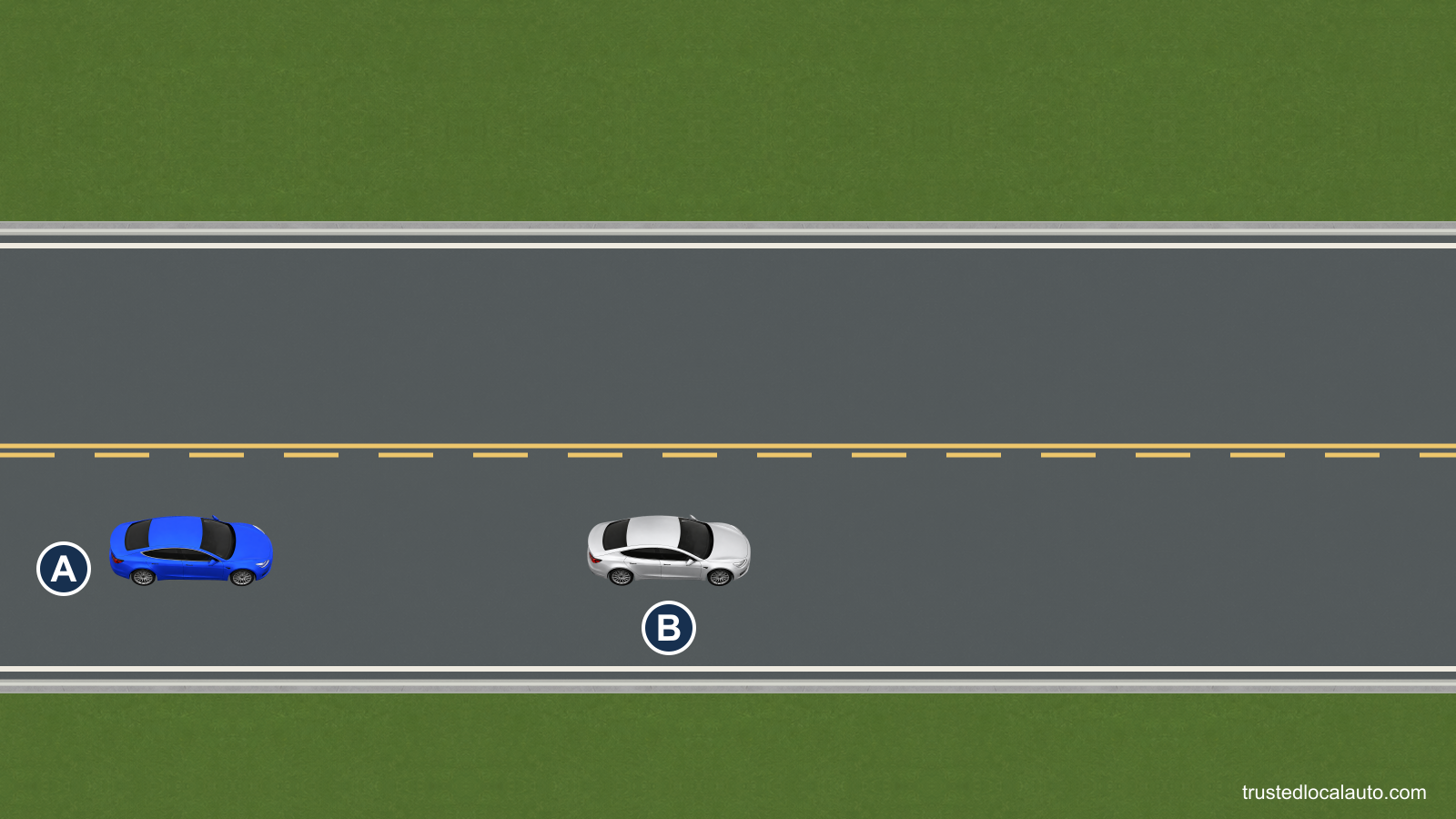
Correct answer: You may pass when the oncoming lane is clear far enough ahead, since your line is broken
Why
When a solid line and a broken line run side by side, the line nearest your lane decides what you may do, and the drivers coming toward you follow the other line. A broken line never makes a pass safe by itself. Do not pass within 100 feet of an intersection or railroad crossing, or where a hill, curve or bridge blocks your view, and wait if an oncoming vehicle is near.
Verified against New Hampshire Driver's Manual · Pavement markings · p. 29, 23
Is this question correct and clear?
Continue learning
Related New Hampshire questions
- On a two-lane road with double solid yellow center lines, you come up behind a bicyclist in your lane. You can see that the oncoming lane is clear well ahead. Which statement is correct?
- You drive on a road where a broken white line separates your lane from the lane on your left. You want to move left to get around a slow car. Where must you look for traffic that could hit you when you move over?
- You follow a slow car on a two-lane road. Double solid yellow lines mark the center, and they continue over a hill as far as you can see. What may you do?
- On a two-lane road, you follow a slow car into a long curve. Double solid yellow lines mark the center, and you cannot see where they end. The oncoming lane looks clear for now. Which statement is correct?
- Late at night, the signal facing you flashes red. The signal for the cross street flashes yellow, and a car on the cross street is about to reach the intersection. What must you do?
- Late at night, the signal facing you flashes red. The signal for the cross street flashes yellow, and a car on the cross street is about to reach the intersection. What should you do?