
Practice question, Question 1 of 40
Passing target: 80% (32/40)
Near an intersection, a solid white line separates your lane from the lane to your left. Both lanes carry traffic in your direction. You would like to move into the left lane. What should you do?
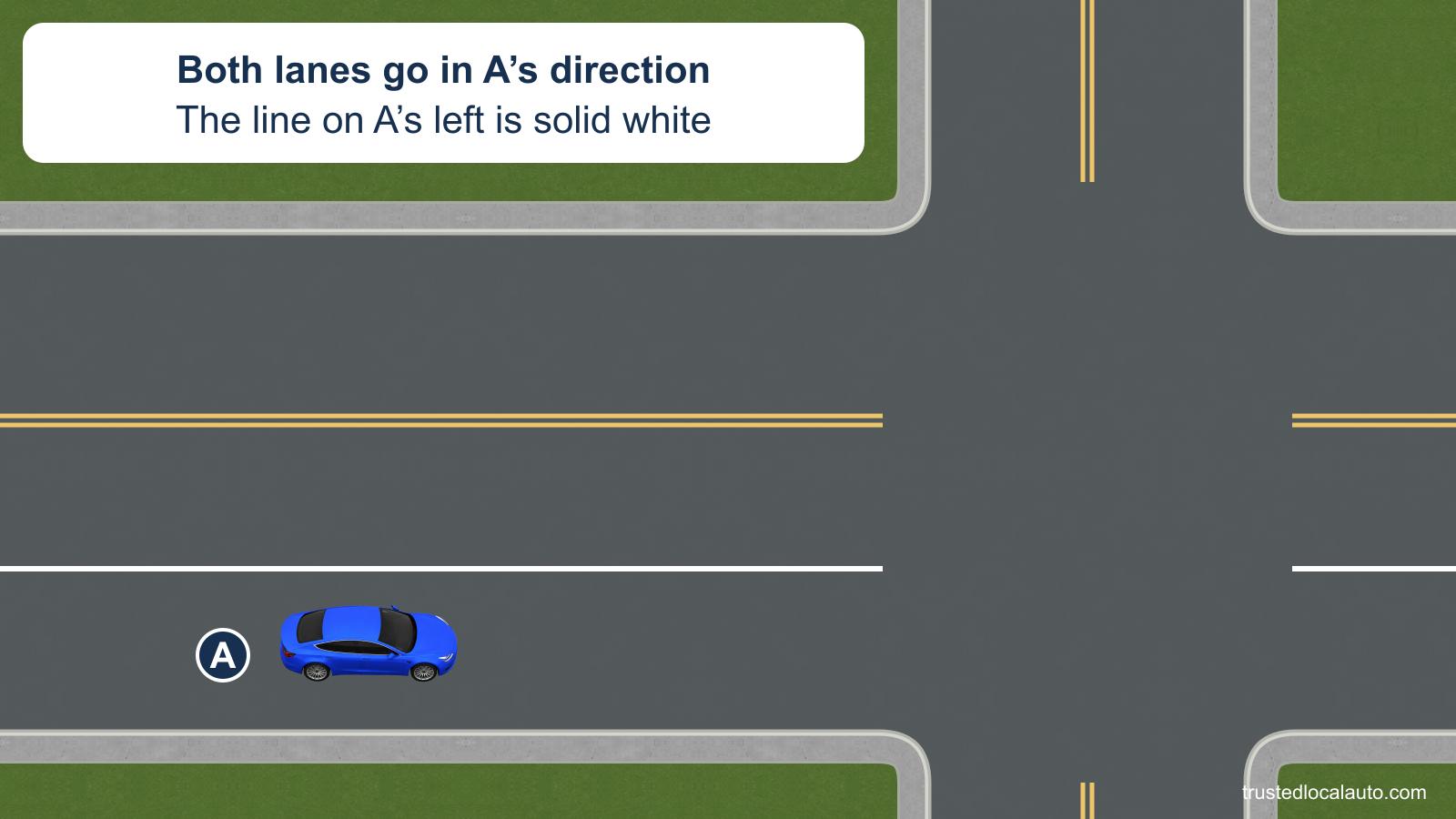
Correct answer: Stay in your lane; a solid white line means you may not change lanes across it.
Why
Solid white lines are often used near intersections, ramps and tunnels, where lane changes are most dangerous. Broken white lines show where you may change lanes after you signal and check. Planning ahead puts you in the right lane before the line turns solid.
Verified against New Hampshire Driver's Manual · Pavement markings · p. 29
Is this question correct and clear?
Continue learning
Related New Hampshire questions
- On a two-lane road with double solid yellow center lines, you come up behind a bicyclist in your lane. You can see that the oncoming lane is clear well ahead. Which statement is correct?
- You drive on a road where a broken white line separates your lane from the lane on your left. You want to move left to get around a slow car. Where must you look for traffic that could hit you when you move over?
- You follow a slow car on a two-lane road. Double solid yellow lines mark the center, and they continue over a hill as far as you can see. What may you do?
- On a two-lane road, you follow a slow car into a long curve. Double solid yellow lines mark the center, and you cannot see where they end. The oncoming lane looks clear for now. Which statement is correct?
- Late at night, the signal facing you flashes red. The signal for the cross street flashes yellow, and a car on the cross street is about to reach the intersection. What must you do?
- Late at night, the signal facing you flashes red. The signal for the cross street flashes yellow, and a car on the cross street is about to reach the intersection. What should you do?