
Back to New Hampshire
New Hampshire Non-Commercial Operator Knowledge Practice Test
Full test preview Question 1 of 40
0 answered 40 remaining
Passing target: 80% (32/40)
Weather, Visibility & EmergenciesStandalone practice
After a heavy storm, a large pool of standing water covers the road ahead. You cannot see how deep it is or what is under it. What should you do?
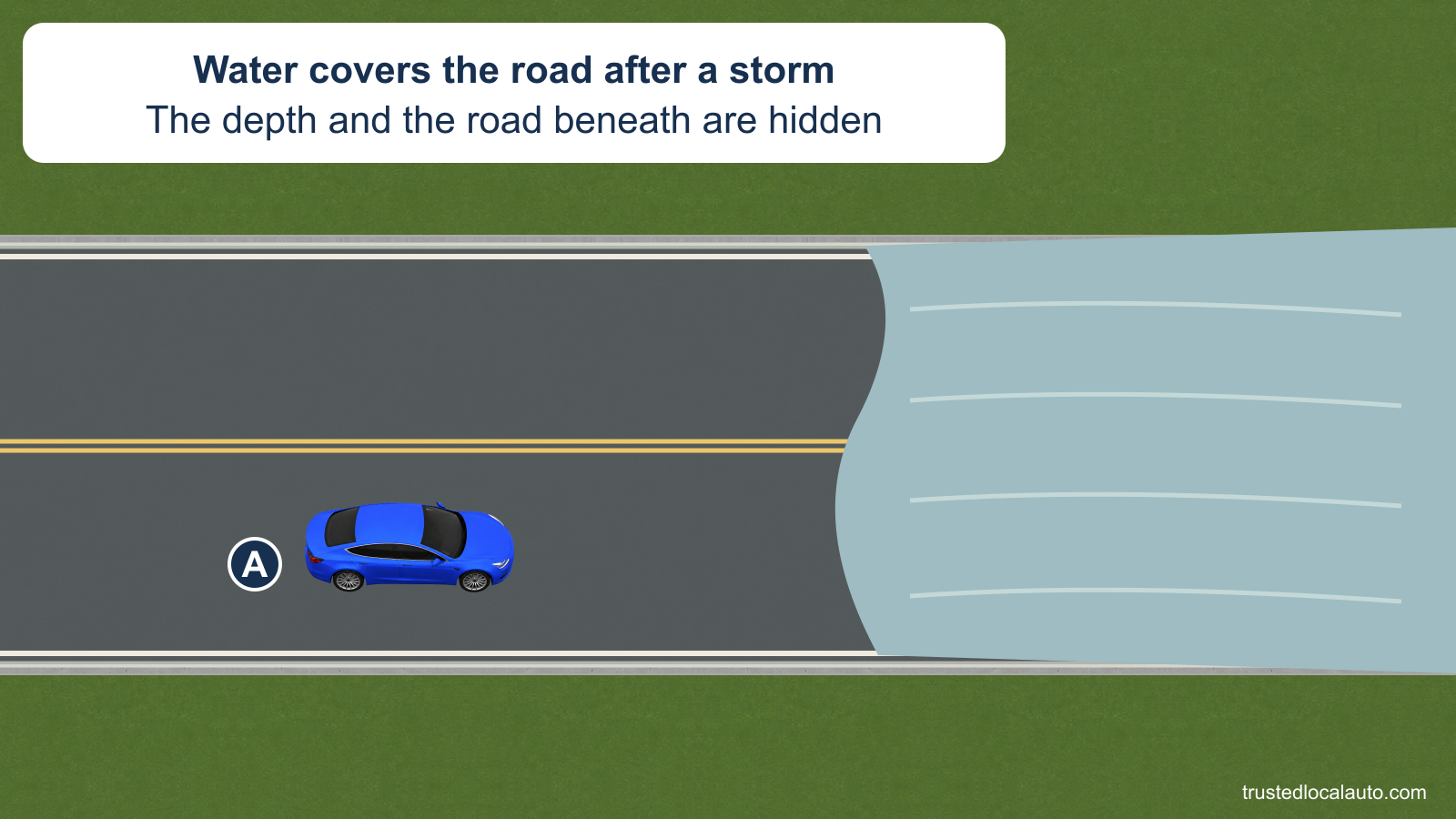
A approaches a large pool of water covering both lanes after a storm. The submerged pavement and depth cannot be seen.
Correct answer: Do not drive into it; turn around and find another route.
Why
Water can hide washed-out pavement and deep holes, and moving water can push a car off the road. Even shallow water can cause hydroplaning or stall the engine. Turning around takes only a few minutes and avoids a serious risk.
Verified against New Hampshire Driver's Manual · Flooded roadways · p. 24
Report a question issueContinue learning
Related New Hampshire questions
A car stops suddenly ahead of you. When you brake hard, your car's anti-lock brakes (ABS) make the pedal pulse, and you hear a clicking sound. What should you do?You press the brake pedal, but the car does not slow down. What should you do first?Sunset today is at 7:10 p.m., and the sky is clear. Under New Hampshire law, by what time must your headlights be on?You are driving at night on a two-lane road when your headlights suddenly go out. What should you do?At noon on a rural road, thick fog lets you see people and cars only about 300 feet ahead. What should you do with your lights?At night on a dark two-lane road, you have your high beams on. You come up behind a slower car going your way and follow it about 100 feet back while you wait for a place to pass. No car comes toward you. What should you do with your headlights?