
Practice question, Question 1 of 50
Passing target: 80% (40/50)
You are driving on a rural highway when a sudden snow squall blows in. You can barely see past the front of your car. A wide paved shoulder is on your right. What should you do?
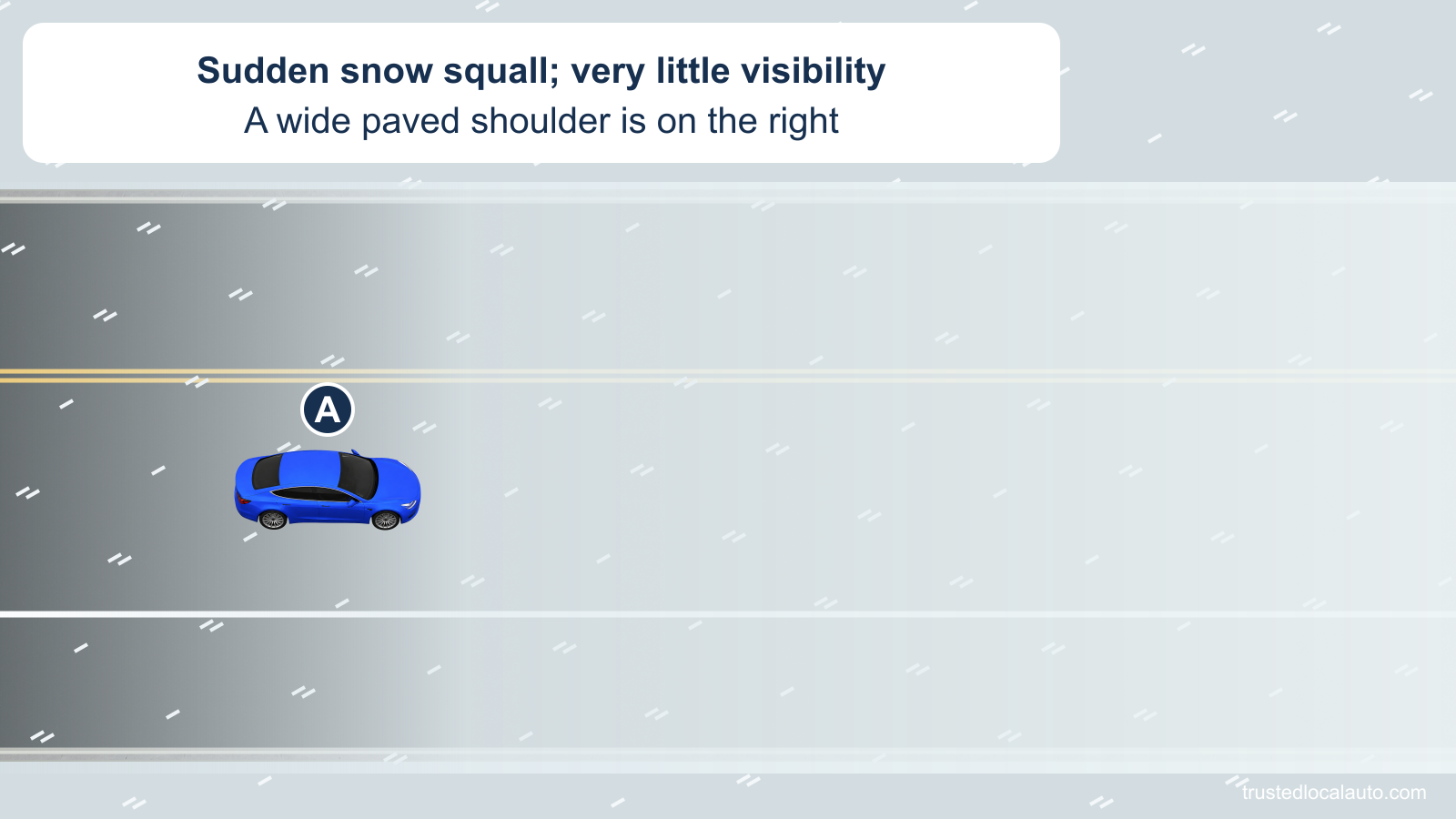
Correct answer: Slow down, pull fully onto the shoulder out of the way of traffic, and turn on your flashers.
Why
When visibility is greatly reduced, the New Jersey manual says to pull off beside the road or onto the shoulder, clear of traffic, and turn on your emergency flashers. New Jersey law also forbids leaving a vehicle standing in a travel lane outside a business or residence district when it can be moved off the roadway. Signal and slow gradually as you leave the lane, and wait until you can see well enough to drive safely again.
Verified against New Jersey Driver Manual · Reduced Visibility · p. 101, 95
Is this question correct and clear?
Continue learning
Related New Jersey questions
- Two drivers must stop quickly on a snowy road. Driver A's car has anti-lock brakes (ABS). Driver B's car has conventional brakes, and B's wheels lock. What should each driver do?
- Your car has conventional disc and drum brakes. You press the brake pedal, but the car does not slow down. What should you do first?
- Your car has conventional disc and drum brakes, not anti-lock brakes. You press the brake pedal, but the car does not slow down. What should you do first?
- In clear weather with a good view, New Jersey law still requires headlights during one period each day. Which period is it?
- Light rain has made the road wet. The car ahead passes a sign, and you count one thousand-one, one thousand-two, one thousand-three. Your car reaches the sign as you say 'three'. Which statement is correct?
- It is raining steadily and the road is wet. You use the three-seconds-plus count behind the car ahead. What is the smallest gap that the New Jersey manual recommends now?