
Practice question, Question 1 of 30
Passing target: 80% (24/30)
You drive at 55 mph on a dry, level road in daylight, and you are alert. From the moment you see a hazard, about how far does your car travel before it comes to a complete stop?
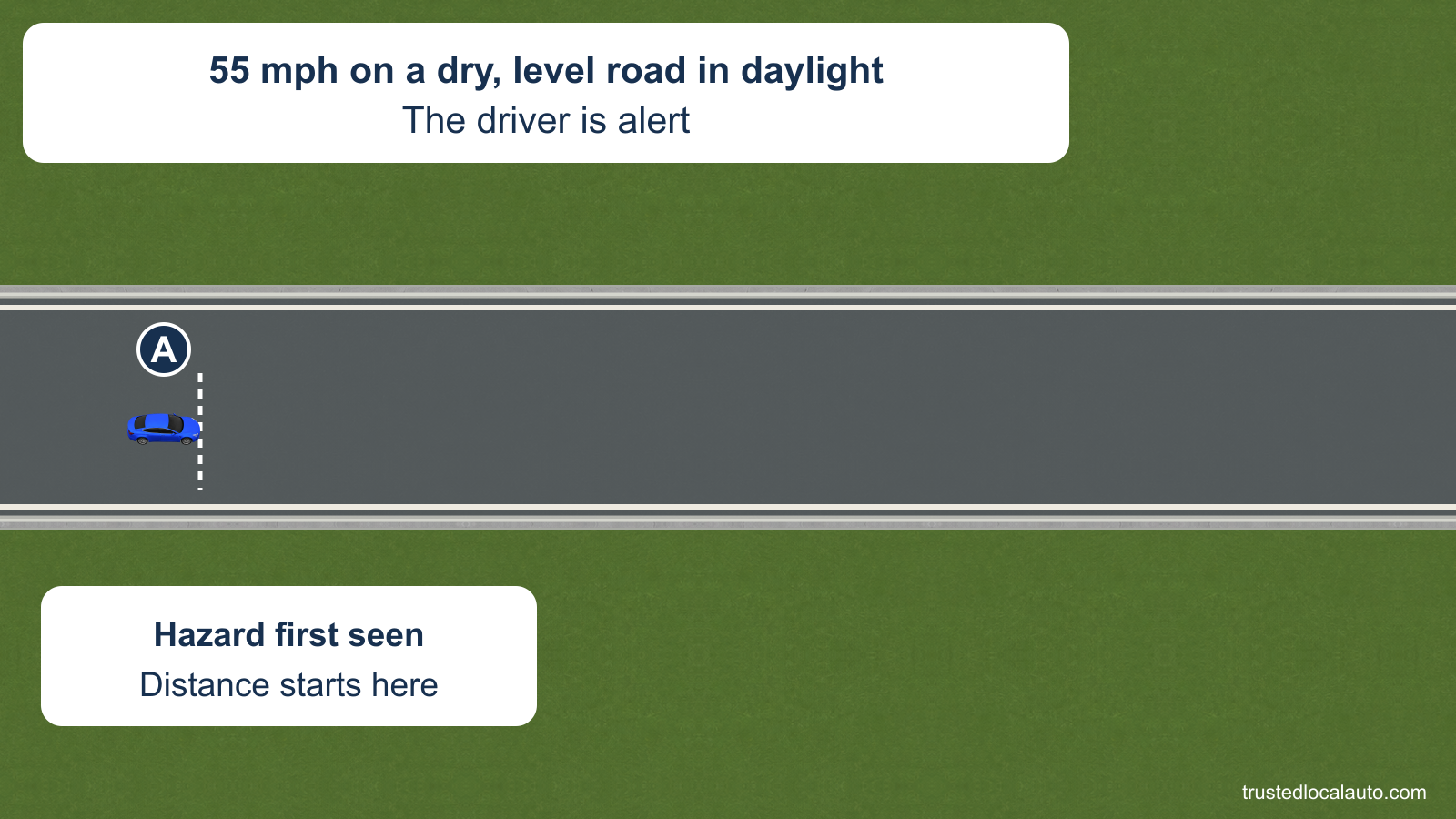
Correct answer: About 211 feet
Why
Stopping distance has two parts: the distance that you travel before your foot reaches the brake, and the braking distance. Both parts grow when your speed grows, and the braking distance grows faster than the speed. That is why a small increase in speed can turn a near miss into a crash. On wet or icy roads the total can be many times longer, so slow down and leave more space.
Verified against North Carolina Driver Handbook · Adjusting Your Speed to Driving Conditions · p. 55, 54, 74
Is this question correct and clear?
Continue learning
Related North Carolina questions
- On a four-lane highway, you want to move from the right lane to the left lane. Your inside and side mirrors show that the left lane is clear. What should you do before you move over?
- Which statement about stopping distance is NOT correct?
- You follow a tractor-trailer on a two-lane highway. The trailer hides the road ahead of it, and you cannot see the truck's side mirrors. What should you do?
- You are driving on a busy city street. To spot problems early, about how far ahead should you try to look along the road?
- You drive on a paved, winding secondary road with a marked center line and a posted 55 mph limit. Hills and sharp curves let you see only a short distance ahead. How should you choose your speed?
- You drive at 45 mph in the left lane of a highway with two lanes in each direction. The speed limit is 55 mph. Traffic is light. You are not passing anyone, and your route goes straight on for many miles. Which statement is correct?