
Practice question, Question 1 of 30
Passing target: 80% (24/30)
You drive at 65 mph on a four-lane rural Interstate. Most other vehicles move faster and pass you. Which lane should you use?
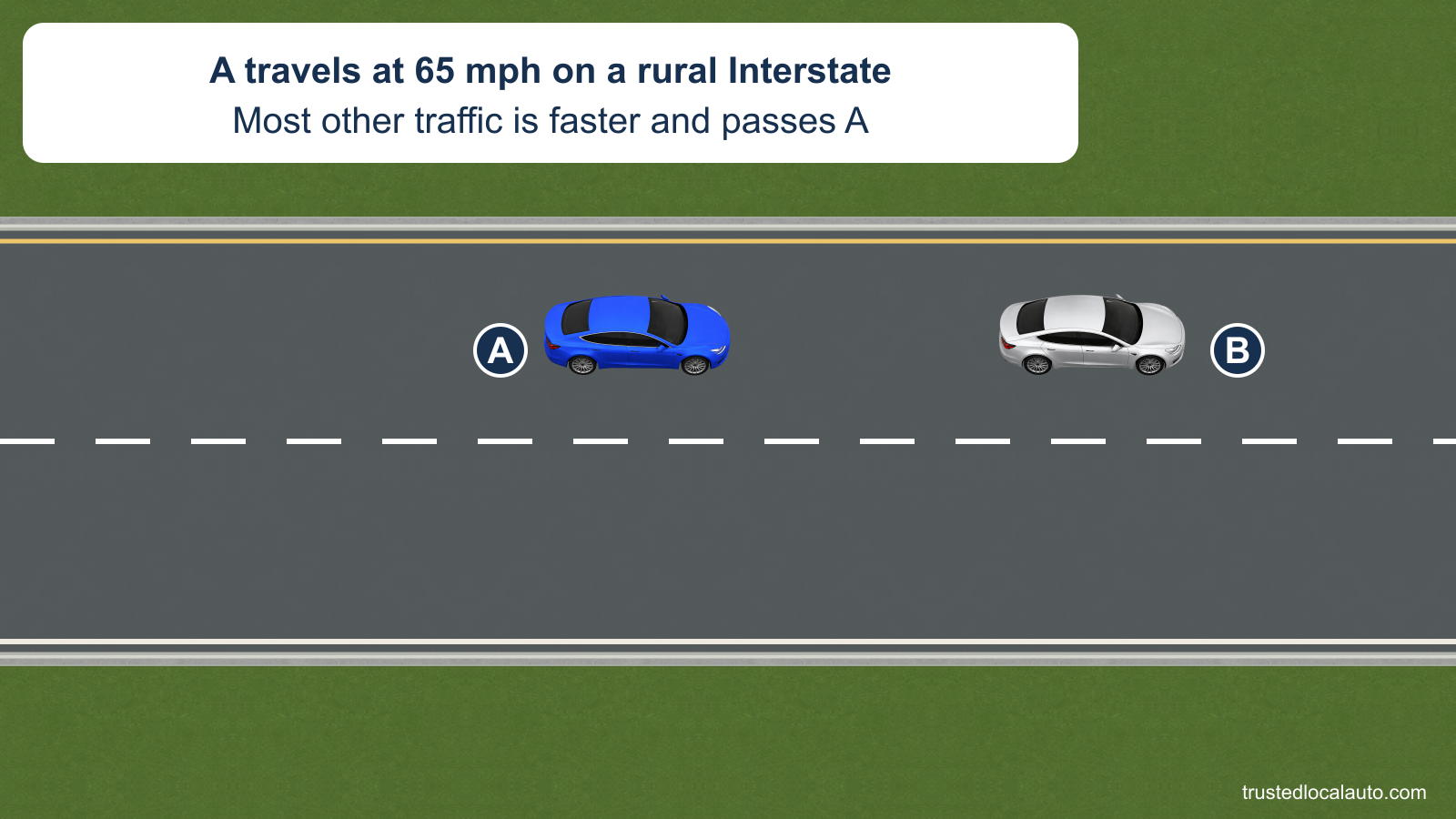
Correct answer: The right lane, and use the left lane only to pass another vehicle
Why
On North Dakota's rural Interstates, the speed limit is 80 mph unless another limit is posted, so the differences in speed between vehicles can be large. When slower vehicles keep right, faster vehicles pass on the left, and drivers can predict where other traffic will be. After you pass, leave enough room before you return to the right lane.
Verified against 2025-2027 Class D Noncommercial Driver License Manual · Interstate driving · p. 24, 28
Is this question correct and clear?
Continue learning
Related North Dakota questions
- You compare driving at 75 mph on the Interstate with driving at 30 mph on a city street. Your reaction time to a sudden hazard is the same at both speeds. Which statement about the distance that your car covers before you start to brake is correct?
- After two hours on I-94, you begin to feel sleepy. Your passenger does not have a license. Which plan does the North Dakota manual support?
- You are at the end of an acceleration lane. The ramp joins the freeway from the right, and a car in the freeway's right lane is level with you, on your left. A gap is open behind that car. No sign gives a different rule. What must you do?
- You drive at 75 mph on the Interstate instead of 30 mph on a city street. Your reaction time to a sudden hazard is the same. What changes?
- On a dry, clear day, you drive at 75 mph on the Interstate. You keep the same gap to the car ahead that you keep on city streets: one car length. What is true of this gap?
- Your engine begins to overheat on the Interstate, and you must stop. What does the North Dakota manual tell you to do?