
Practice question, Question 1 of 30
Passing target: 80% (24/30)
You reach the end of an acceleration lane at the same time as a car in the right lane of the freeway. No sign gives a different rule. What should you do?
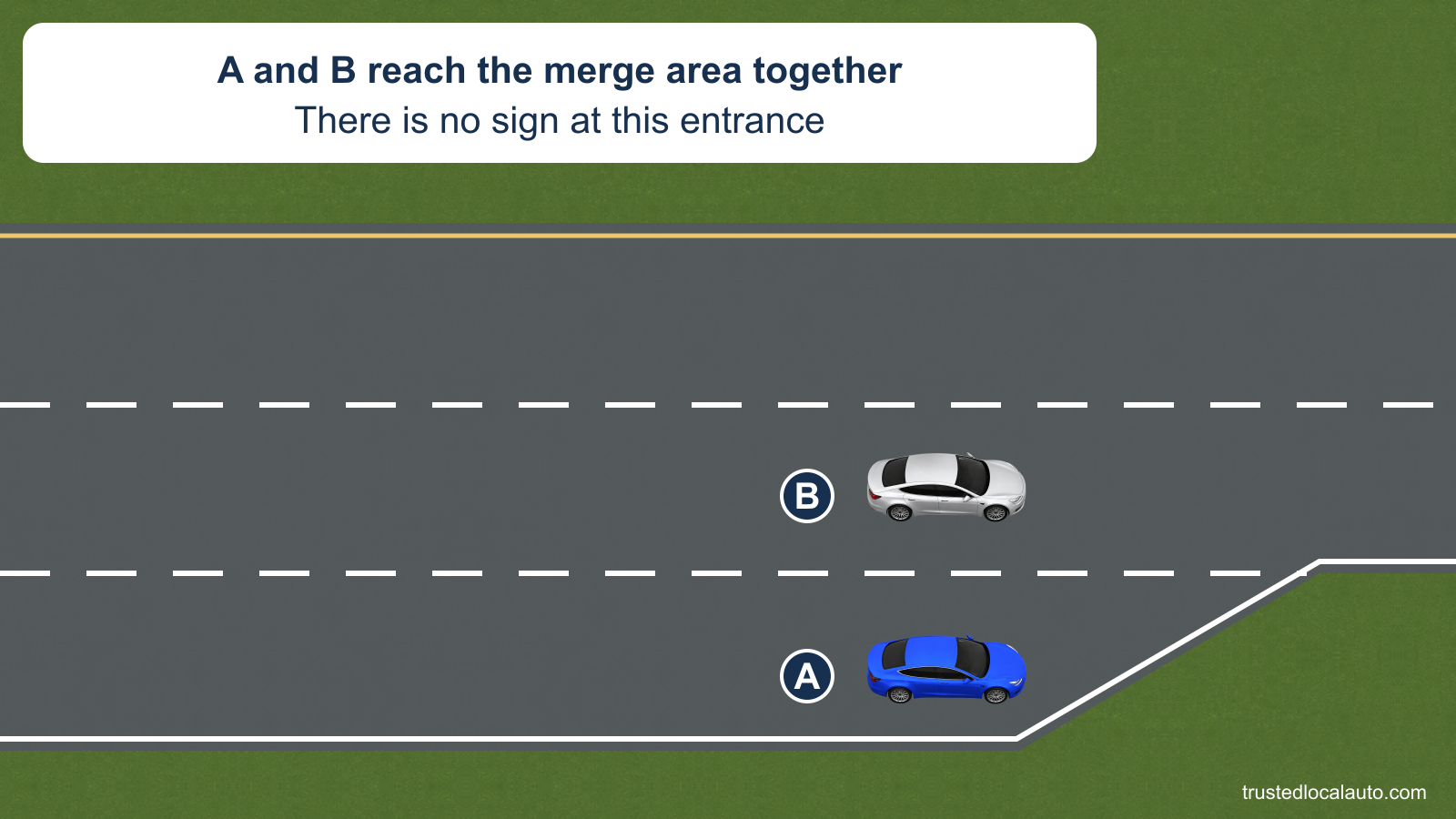
Correct answer: Yield to the car on the freeway, because traffic on the main roadway goes first.
Why
Freeway traffic moves fast and cannot stop quickly for a car that forces its way in. North Dakota law gives the right-of-way to vehicles on the main roadway, whether the ramp joins from the right or from the left. Watch for signs at some entrances that change this rule, and adjust your speed early so that you do not run out of acceleration lane.
Verified against 2025-2027 Class D Noncommercial Driver License Manual · Interchanges · p. 28
Is this question correct and clear?
Continue learning
Related North Dakota questions
- You compare driving at 75 mph on the Interstate with driving at 30 mph on a city street. Your reaction time to a sudden hazard is the same at both speeds. Which statement about the distance that your car covers before you start to brake is correct?
- After two hours on I-94, you begin to feel sleepy. Your passenger does not have a license. Which plan does the North Dakota manual support?
- You are at the end of an acceleration lane. The ramp joins the freeway from the right, and a car in the freeway's right lane is level with you, on your left. A gap is open behind that car. No sign gives a different rule. What must you do?
- You drive at 75 mph on the Interstate instead of 30 mph on a city street. Your reaction time to a sudden hazard is the same. What changes?
- On a dry, clear day, you drive at 75 mph on the Interstate. You keep the same gap to the car ahead that you keep on city streets: one car length. What is true of this gap?
- Your engine begins to overheat on the Interstate, and you must stop. What does the North Dakota manual tell you to do?