
Practice question, Question 1 of 40
Passing target: 75% (30/40)
You approach a railroad crossing. The red lights start to flash and the gate begins to come down, but you cannot see a train yet. What must you do?
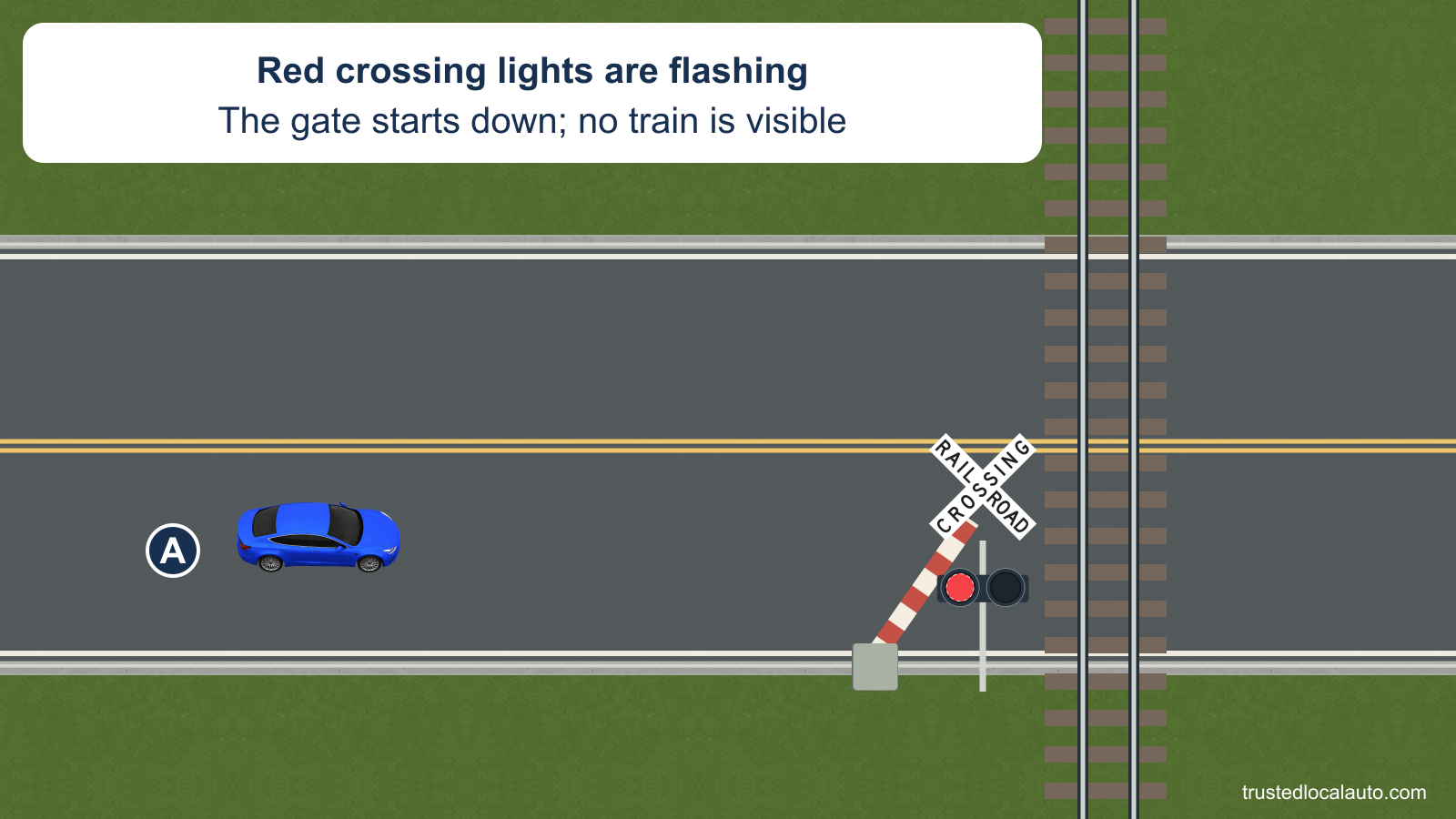
Correct answer: Stop between 15 and 50 feet from the nearest rail, and wait until the train passes and the lights stop
Why
A train cannot stop quickly or swerve, so the driver must always yield at a crossing. A stop at least 15 feet back keeps your car clear of the train, and a stop within 50 feet keeps you close enough to see the tracks and the signals. Never stop on the tracks.
Verified against Ohio Driver Manual · Railroad crossings · p. 24
Is this question correct and clear?
Continue learning
Related Ohio questions
- You follow a school bus on a two-lane road. The four amber lights on the bus start to flash. What does this mean for you?
- On a Sunday, you drive through a highway work zone. No workers or machines are in sight, but orange barrels shift traffic into a narrow lane. What should you do?
- A road has two lanes in each direction and no median. A southbound school bus stops in the right southbound lane. Its red lights flash and its stop arm is out. Which drivers may keep moving?
- You follow a school bus on a two-lane road. The bus comes to a railroad crossing that has only crossbuck signs. No train is in sight. What should you expect the bus to do?
- A road has two lanes in each direction and no median. A school bus that heads south stops in the right southbound lane. Its red lights flash and its stop arm is out. Which drivers must stop?
- On a two-lane road, you drive toward a school bus that has stopped in the other lane. Its red lights flash and its stop arm is out. What must you do?