
Practice question, Question 1 of 20
Passing target: 80% (16/20)
You follow a loaded tractor-trailer on a wet highway. Why should you keep more space behind it than you might think that you need?
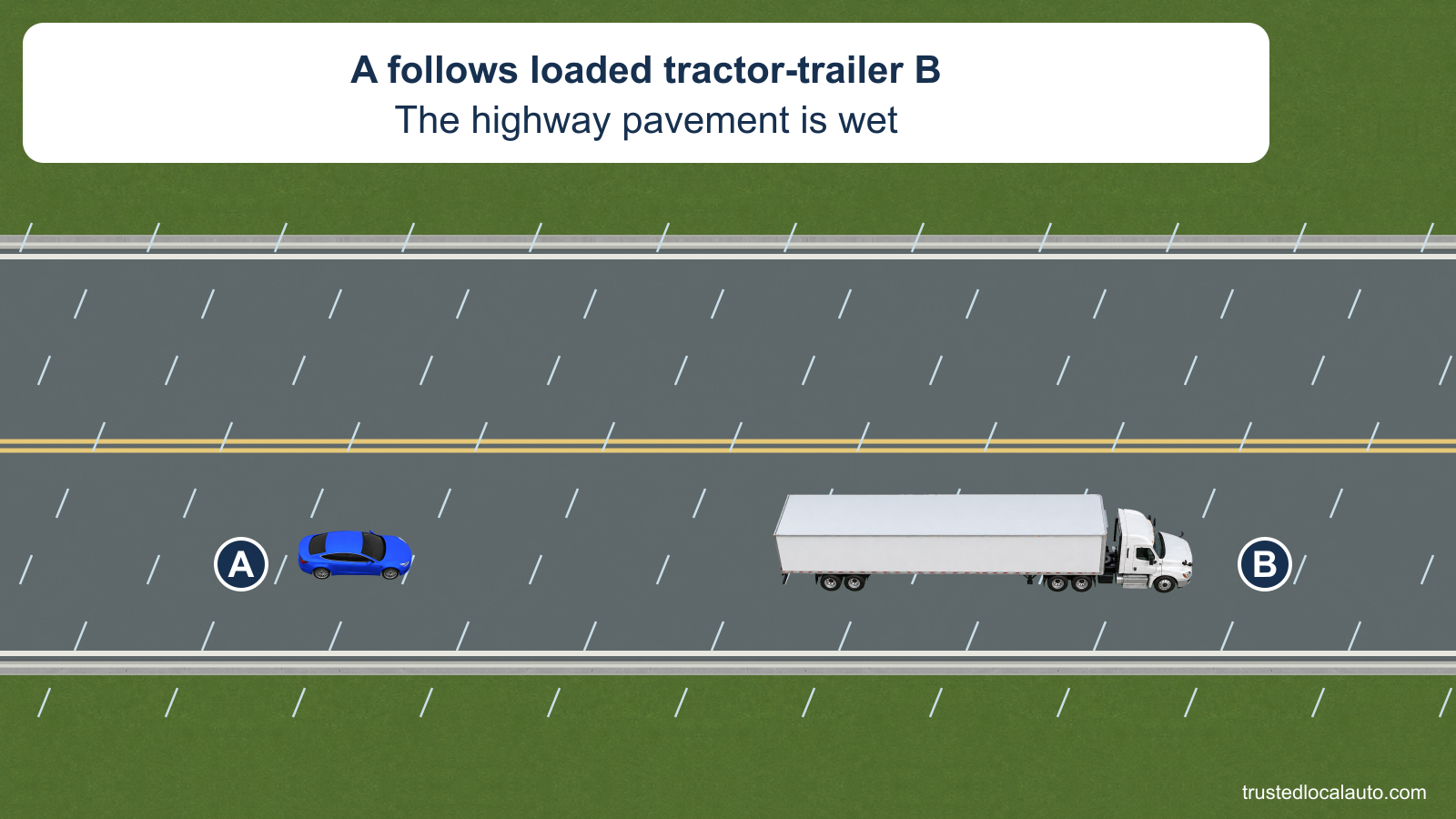
Correct answer: On wet pavement, the truck may be able to stop more quickly than your car.
Why
Many drivers think that a heavy truck always needs more distance to stop than a car. That is often true, but the Oklahoma manual warns that the truck may stop more quickly than you when the pavement is wet or the speed is high. A car that follows too closely then has no room to stop. Keep a longer gap on wet roads, and keep far enough back that the truck driver can see you in the mirrors.
Verified against Oklahoma Driver Manual · Following a truck · p. 42, 44
Is this question correct and clear?
Continue learning
Related Oklahoma questions
- It is raining, and you use the count check to set your following distance behind a car. Which statement is correct?
- You drive on a paved county road in normal conditions. You have not seen a speed limit sign, and the county has not posted a different limit for its roads. What is the maximum lawful speed?
- On a clear, dry day you drive at 35 mph in the right lane of a four-lane highway where traffic moves at about 60 mph. There is no hazard ahead, and a long line of cars forms behind you. Which statement is true?
- It is raining. The rear of the car ahead passes a sign post, and you reach the post as you count "one thousand three." Which statement is correct?
- It is raining. You choose a sign post ahead. The rear of the car in front passes the post, and you reach the post as you count "one thousand two." What should you do?
- You drive on a gravel county road. You have seen no speed limit sign, and the county has posted no other limit for its roads. Thick dust from a truck ahead cuts your view to a short distance. What speed does Oklahoma law require?