
Practice question, Question 1 of 20
Passing target: 80% (16/20)
You parallel park on a level city street that has a curb. No sign or yellow paint limits parking there. What is the farthest that your right-side wheels may be from the curb?
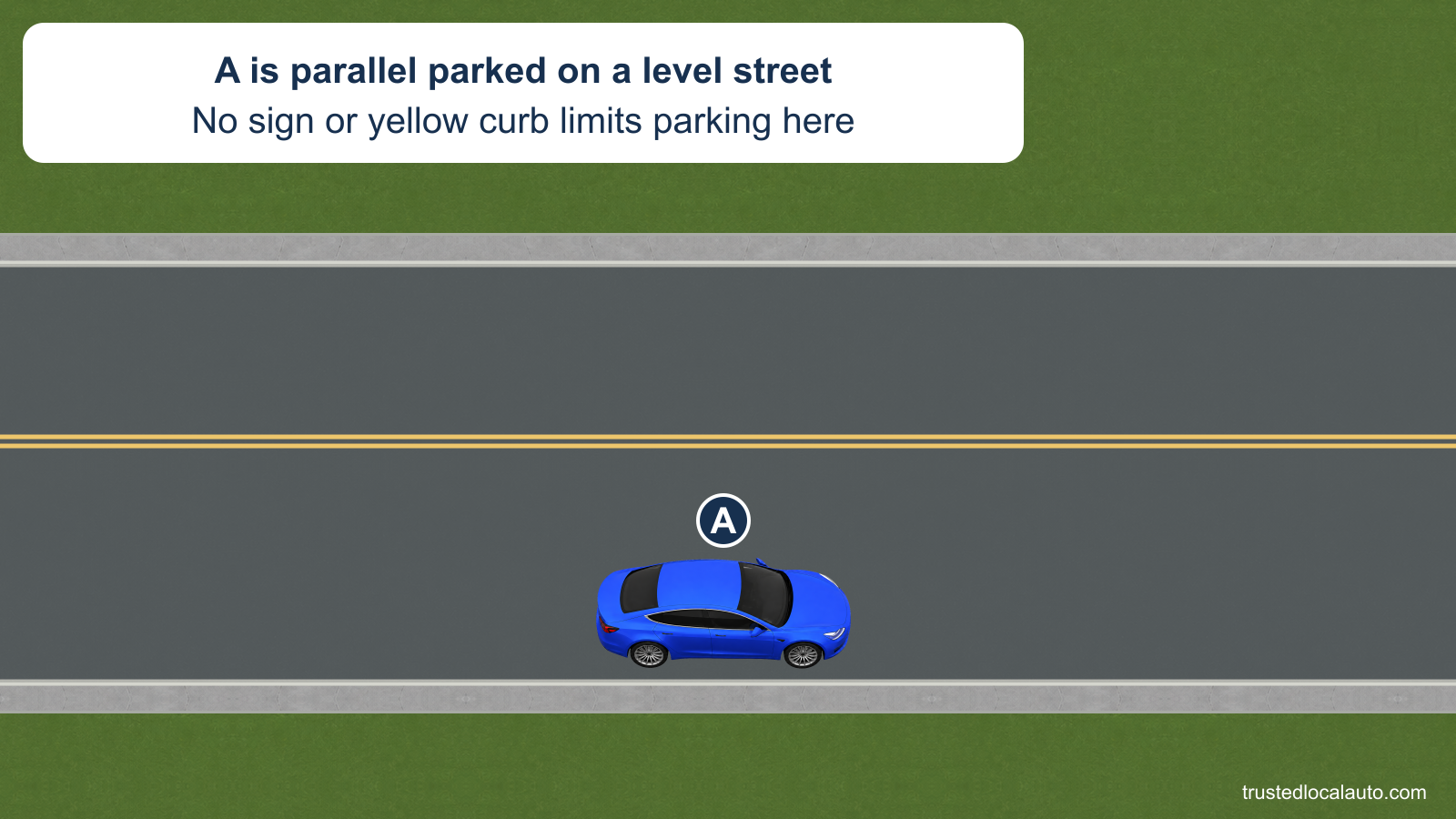
Correct answer: Not more than 18 inches
Why
A car that sits far from the curb sticks out into the travel lane, where passing traffic can hit it. Oklahoma law sets the limit at 18 inches for the right-hand wheels, with the car parallel to the curb. On a one-way street, a city can also allow parking with the left-hand wheels within 18 inches of the left curb. On a hill, get closer: the manual tells you to stop within 6 inches so a wheel can rest against the curb.
Verified against Oklahoma Driver Manual · Parallel parking · p. 47
Is this question correct and clear?
Continue learning
Related Oklahoma questions
- On a quiet two-lane street, you drive about 150 feet past the driveway that you wanted. No car is behind you. May you back up along the street to the driveway?
- You parallel park beside a curb. What is the farthest that your right wheels may be from the curb on a level street, and how close to the curb does the manual tell you to stop on a hill?
- A volunteer fire department serves your small town, and a town ordinance sets the hydrant distance at 30 feet. The only open curb space starts 20 feet from a hydrant, and no sign is posted. Which statement is correct?
- You stop on a level street in front of a store and will be inside for about five minutes. What should you do before you leave the car?
- You back your car out of a long driveway onto a quiet street. Where should you look while the car moves backward?
- No local ordinance or sign changes these distances. For one of these, Oklahoma law sets the minimum parking distance at exactly 30 feet. Which one is it?