
Practice question, Question 1 of 35
Passing target: 80% (28/35)
After a heavy storm, water covers a low part of the road ahead. You cannot see the pavement or tell how deep the water is. What should you do?
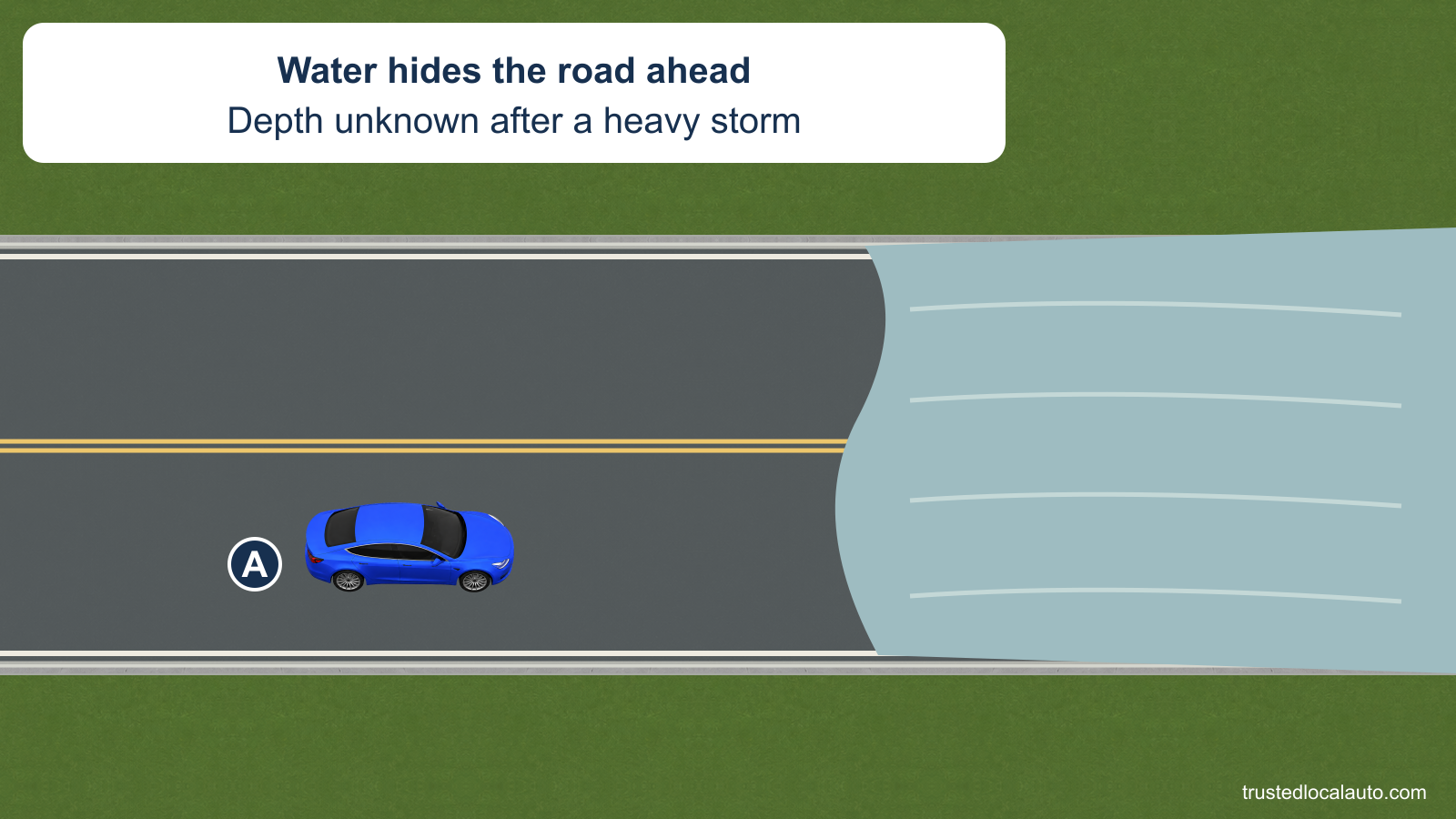
Correct answer: Turn around and use another route instead of driving into the water
Why
Moving water can push a car off the road, and water can hide a washed-out section of pavement. A stalled engine can leave you trapped. Rain also causes hydroplaning, when the tires ride on a film of water and you lose steering and braking. Slow down on wet roads, and never enter water when you cannot see the road surface.
Verified against Oregon Driver Manual · Rain · p. 86, 78
Is this question correct and clear?
Continue learning
Related Oregon questions
- You press the brake pedal as you approach a red light ahead, and the pedal sinks with almost no effect. You still have some distance before the intersection. What should you do?
- You drive through an intersection on a green light. A car on the cross street runs its red light and is about to strike the side of your car. The road ahead of you is open, and the lanes beside you are not clear. What is usually your best move?
- You drive east at 35 mph in the right of two lanes that go your way. A car pulls out of a driveway into your lane just ahead, and you cannot stop in time. The lane on your left is empty. Which statement is correct?
- You drive at 35 mph. A car pulls out of a driveway into your lane just ahead, and you cannot stop in time. A moment ago you checked the lane on your left, which goes your way, and it is empty. What is usually your best move?
- Rain begins to fall on a highway where you have been using cruise control. Which plan follows the Oregon manual's advice for wet roads?
- You drive on a dark rural highway with your high beams on. An oncoming car comes over a hill about 700 feet away and keeps coming toward you. At what distance does Oregon law require you to switch to low beams?